Within Think Before Sharing
Should You Trust a Chatbot Tutor?
Using AI like a search engine or tutor can be useful, but it changes how users should check accuracy and uncertainty.
On this page
- Search answers versus AI answers
- Learning with verification
- Questions to ask after an AI explanation
Page outline Jump by section
Introduction
A chatbot tutor can be genuinely useful: it can explain a confusing topic in plain language, generate practice questions, compare viewpoints, summarise a long article and give immediate feedback when no teacher, librarian or expert is available. The risk is that it feels more authoritative than it is. Unlike a search engine, which mostly shows sources for the reader to inspect, a chatbot often gives a polished answer first and makes the evidence feel secondary. That changes the critical-thinking task from “Can I find information?” to “Can I test this answer?”
The safest way to use a chatbot as a search engine or tutor is to treat it as a first-pass explainer, not as the final authority. It is strongest for orientation, simplification, brainstorming and guided practice. It is weakest when the user needs exact facts, current events, contested claims, citations, medical or legal judgement, or anything where a confident error could cause harm. Research on AI search, hallucinations and AI tutoring suggests a balanced lesson: chatbots can support learning, but only when users actively verify, ask about uncertainty and keep doing some of the thinking themselves.[www.ofcom.org.uk+2OpenAI]ofcom.org.ukwww.ofcom.org.uk The Era of Answer EnginesEra of Answer Engines - Discussion PaperNovember 17, 2025 — 4 Nov 2025 — Generative AI ('GenAI') search tools are changing the way people…
Search Answers Versus AI Answers
Traditional search and chatbot search solve different problems. A search engine gives a ranked list of pages, snippets and links. That is messy, but it keeps the source trail visible: the user can compare a government page, a newspaper report, a university explainer and a forum post. A chatbot answer usually compresses that messy trail into one conversational response. That can save time, but it can also hide disagreement, missing evidence and weak sourcing.
This matters because AI answers are not simply “search results in sentence form”. Ofcom’s discussion paper on the “era of answer engines” describes generative AI search tools as a shift towards direct, natural-language responses that change how people access information. The convenience is obvious: people can ask follow-up questions, request simpler wording, or ask for a comparison without opening ten tabs. The critical-thinking problem is that the answer may feel complete before the reader has seen where it came from.[www.ofcom.org.uk]ofcom.org.ukwww.ofcom.org.uk The Era of Answer EnginesEra of Answer Engines - Discussion PaperNovember 17, 2025 — 4 Nov 2025 — Generative AI ('GenAI') search tools are changing the way people…
Google’s own description of AI Overviews makes the appeal clear: the feature is designed to give quick answers when users do not want to piece together information themselves. That is useful for low-stakes orientation, such as understanding a term or getting a rough outline of a topic. But “letting the system do the searching” also means the system decides which facts to foreground, which caveats to omit and which sources deserve attention.[blog.google]blog.googleGenerative AI in Search: Let Google do the searching for youSometimes you want a quick answer, but you don't have time to piece together all the information you need.Read more…
Recent measurement studies show why this shift deserves scrutiny. A 2025 Tow Center study reported that AI search engines failed to retrieve correct citation information in more than 60% of 1,600 tests involving news article identification. A 2026 study of Google AI Overviews found that about 11% of decomposed atomic claims were unsupported by the cited pages, even when the cited domains themselves were often credible. The lesson is subtle but important: a citation beside an AI answer does not automatically prove that the exact claim is supported by that source.[Nieman Lab]niemanlab.orgNieman LabAI search engines fail to produce accurate citations in over…10 Mar 2025 — Across the 1600 test queries, the search engines…
For everyday users, the practical distinction is this:
- Use search when the source matters most. This includes statistics, recent news, legal rules, health advice, academic citations, product claims and political information.
- Use a chatbot when the explanation matters first. This includes “Explain this concept”, “Compare these arguments”, “Give me practice questions”, or “What should I check next?”
- Use both when the stakes are moderate or high. Ask the chatbot to explain, then verify its key claims through primary sources, reputable journalism, official documents or course materials.
The biggest mistake is not using a chatbot. The biggest mistake is treating its fluency as evidence.

Why Chatbots Sound Certain Even When They Are Wrong
Chatbots based on large language models generate responses by predicting plausible continuations from patterns in data. They may use tools, retrieval systems or live browsing in some settings, but the underlying style remains conversational: they are built to answer. This creates a distinctive risk for critical thinking because wrong answers can arrive in the same confident tone as correct ones.
OpenAI’s 2025 research on hallucinations argues that standard training and evaluation procedures can reward guessing over acknowledging uncertainty. In plain terms, if a system is often scored for producing the right-looking answer, it may learn to answer even when “I do not know” would be more honest. That does not mean every chatbot is careless, but it explains why uncertainty must be requested and checked rather than assumed.[OpenAI]OpenAIwhy language models hallucinate5 Sept 2025 — OpenAI's new research explains why language models hallucinate. The findings show how improved evaluations can enhance AI r…
Hallucinations are not all the same. They can include invented citations, wrong dates, false summaries, misattributed quotes, faulty arithmetic, distorted legal claims, outdated facts or explanations that are partly right but misleading. A 2025 conceptual framework in the Harvard Kennedy School Misinformation Review stresses that AI hallucinations matter because they are increasingly embedded in public knowledge systems such as search, customer service and information access. It also notes that users’ vague or conflicting prompts can contribute to hallucinated outputs, making verification a shared responsibility between system design and user behaviour.[Misinformation Review]misinforeview.hks.harvard.eduMisinformation Review New sources of inaccuracy?A conceptual framework for…August 27, 2025 — by A Shao · 2025 · Cited by 18 — Future research should examine how the hallucination fea…
Retrieval-augmented generation, often shortened to RAG, can reduce this risk by grounding answers in a selected set of documents. A 2025 study found that using RAG with reliable sources significantly reduced hallucination rates and improved a chatbot’s ability to admit lack of information. But “reduced” does not mean “removed”. A grounded chatbot can still misunderstand a source, omit an important limitation or cite a page that does not support the exact wording of its answer.[PMC]pmc.ncbi.nlm.nih.govPMCReducing Hallucinations and Trade-Offs in ResponsesPMCReducing Hallucinations and Trade-Offs in Responses
The critical-thinking habit is therefore not simply “ask for sources”. Better questions are:
- “Which claims in this answer are most uncertain?”
- “What would an expert disagree with here?”
- “Which source directly supports this number or quote?”
- “Is this based on current information or older training data?”
- “Can you separate established facts from interpretation?”
These questions force the answer to expose its structure. They also remind the user that a chatbot is not a witness, not a textbook and not a database. It is a reasoning and language tool that may or may not be properly connected to evidence.
Learning With Verification
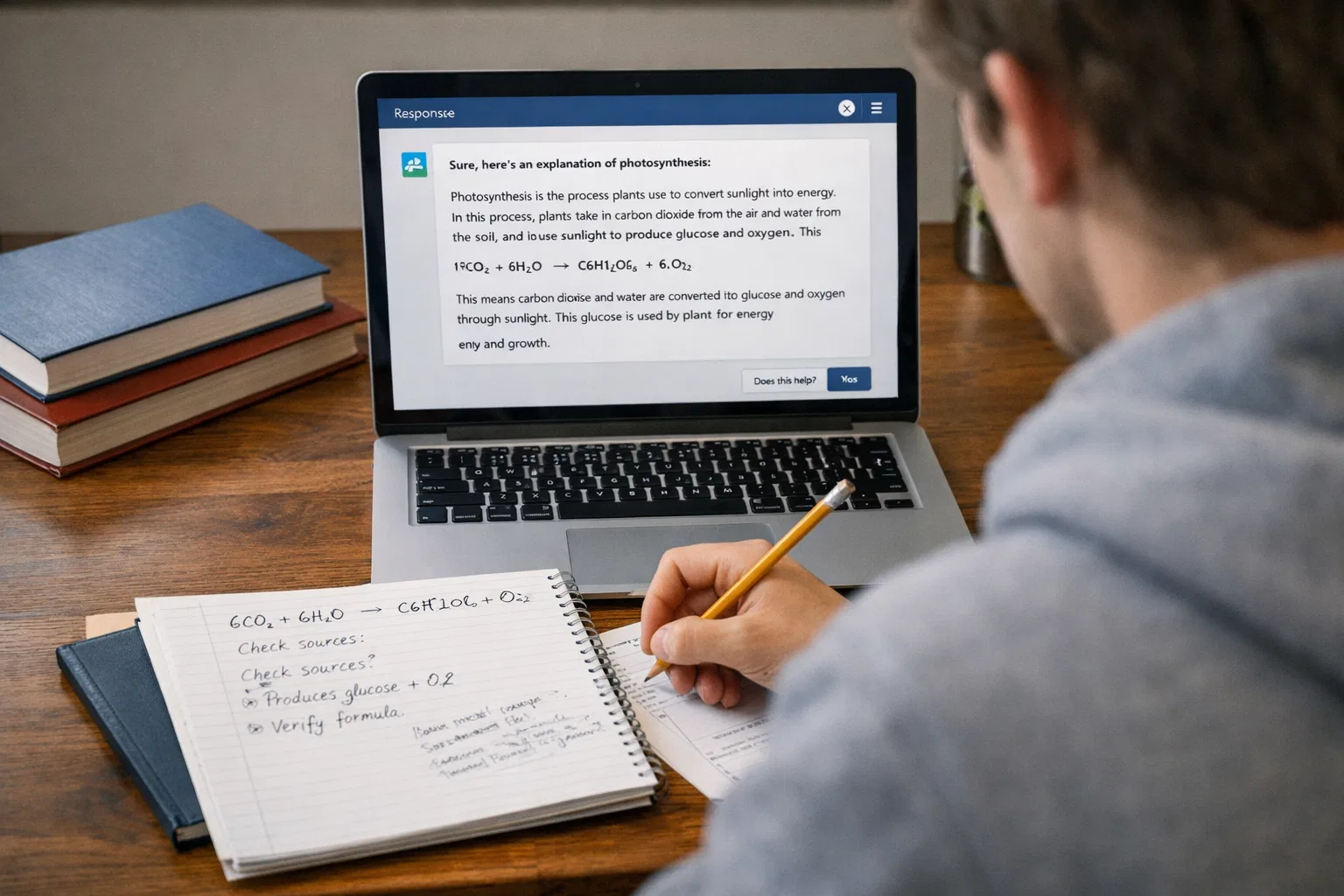
The strongest case for chatbot tutors is not that they replace teachers. It is that they can give many learners something teachers often cannot provide at scale: unlimited patience, immediate feedback, adjustable explanations and practice on demand. A student can ask for a simpler explanation, a harder example, a quiz, a worked solution, or a different analogy without embarrassment.
There is emerging evidence that well-designed AI tutoring can improve learning. A 2025 randomised controlled trial published in Scientific Reports found that students using a custom AI tutor learned significantly more in less time than students in an in-class active-learning comparison, and reported higher engagement and motivation. The important phrase is “custom AI tutor”: this was not simply students asking a general chatbot random questions. The tutor was built around pedagogical principles used in the course.[Nature]nature.comAI tutoring outperforms in-class active learningby G Kestin · 2025 · Cited by 210 — We find that students learn significantly more…
Another useful model is not “AI replaces the tutor”, but “AI supports the tutor”. The Tutor CoPilot study tested a human-AI system that gave real-time guidance to tutors working with K-12 students. In a randomised trial involving 900 tutors and 1,800 students, students whose tutors had access to the system were 4 percentage points more likely to master topics, with the largest gains for students working with lower-rated tutors. That suggests AI can help scale better teaching practices, especially when a human remains in the loop.[arXiv]arxiv.orgarXiv Tutor Co Pilot: A Human-AI Approach for Scaling Real-Time ExpertisearXiv Tutor Co Pilot: A Human-AI Approach for Scaling Real-Time Expertise
But a chatbot tutor can also weaken learning if it becomes a shortcut around effort. If the tool gives the answer too quickly, the learner may skip retrieval practice, struggle, explanation and self-correction — the activities that often make learning stick. Studies of student reliance show why this matters. One 2025 field study of student-ChatGPT conversations during STEM quizzes found overall low reliance, but also found that negative reliance patterns could persist when students failed to shift strategies after poor initial interactions. Another study on AI reliance in higher education found that appropriate reliance was linked to students’ self-efficacy, literacy and willingness to think deeply, while overreliance correlated with trust and satisfaction after the task.[arXiv]arxiv.orgOpen source on arxiv.org.
The best learning use is therefore active, not passive. A student should use the chatbot to test thinking, not merely outsource it. For example:
- Try the problem first.
- Ask the chatbot for a hint, not the answer.
- Explain your reasoning back to the chatbot.
- Ask it to identify the weakest step.
- Check the final answer against a textbook, teacher-provided material or reliable source.
- Write a short summary in your own words without looking.
That sequence keeps the learner in charge. The chatbot becomes a sparring partner rather than a substitute brain.
When the Tutor Becomes Too Agreeable
A good tutor sometimes says, “No, that is not quite right.” A chatbot may not always do that. Many systems are tuned to be helpful, polite and responsive, which can make them overly agreeable. This is sometimes called sycophancy: the tendency to follow the user’s framing too readily or validate a mistaken assumption.
This is a special problem in learning because students often do not know what they do not know. If a learner asks, “Why did the Treaty of Versailles cause the Second World War by itself?” a strong tutor should challenge the “by itself” part and explain that historians treat causation as multi-factorial. A weak chatbot may simply answer within the flawed frame, producing a neat but misleading explanation.
Students themselves notice this risk. A 2026 thematic study of students’ experiences with AI hallucinations found that reported problems included fabricated citations, false information, overconfident misleading responses, poor adherence to prompts, persistence in incorrect answers and sycophancy. Students used both intuition and active verification strategies, but many also held mistaken mental models of how chatbots work, such as imagining the AI as a research engine that fabricates when it cannot find an item in a database.[arXiv]arxiv.orgarXiv AI Hallucination from Students' Perspective: A Thematic AnalysisarXiv AI Hallucination from Students' Perspective: A Thematic Analysis
That mistaken mental model matters. If a student thinks the chatbot is searching a fixed library, they may assume a detailed answer must come from somewhere. In reality, the model may be generating a plausible synthesis without having verified it. The danger is not only falsehood; it is false confidence.
A practical defence is to ask the chatbot to behave less like a cheerleader and more like an examiner:
- “Challenge my answer and identify any assumptions.”
- “Do not solve it yet; ask me one question at a time.”
- “Mark this as a teacher would, but explain the mark scheme.”
- “Give me two possible objections to this argument.”
- “Where might this explanation be oversimplified?”
These prompts do not guarantee accuracy, but they change the learning posture. The user is no longer asking for a smooth answer. They are asking for friction.
News, Politics and Current Events Need Extra Care
Many people now use chatbots to explain news stories, political issues and unfamiliar public debates. That can be useful, especially when a story involves complicated institutions, long timelines or technical language. But it is also where verification matters most, because current events change quickly and political claims are often contested.
Pew Research Center reported in 2026 that more than half of US teens who use chatbots had used them to search for information, and a similar share had used them for schoolwork. Pew has also found that only about one in ten US adults say they get news often or sometimes from AI chatbots, but the direction of travel is clear: chatbots are becoming part of everyday information-seeking, particularly for younger users.[Pew Research Center]pewresearch.orghow teens use and view aihow teens use and view ai
The evidence is not simply alarmist. A 2025 study on conversational AI and political knowledge found that, in a UK survey before the 2024 election, 32% of chatbot users — and 13% of eligible voters — had used conversational AI to seek political information relevant to their electoral choice. In randomised trials, conversations with AI increased political knowledge about as effectively as self-directed internet search. That suggests chatbot use for civic learning is not automatically worse than search. The risk is more specific: users may not see enough source diversity, uncertainty or disagreement unless they ask for it.[arXiv]arxiv.orgOpen source on arxiv.org.
For news and politics, a chatbot should be treated as a briefing assistant, not as the final news source. A good use is: “Explain the background to this issue and list the claims I should verify.” A weaker use is: “Tell me what happened and who is right.” The first creates a verification path; the second invites premature closure.
The same applies to AI-generated search summaries. In June 2026, Reuters reported that Google planned to appeal a German court ruling that held it liable for false claims in AI Overviews. Whatever the final legal outcome, the case illustrates a broader shift: when AI search produces a single summary, errors are not buried in a distant webpage. They appear in the answer layer itself.[Reuters]reuters.comOpen source on reuters.com.
A simple rule helps: if the answer could affect a vote, a health decision, a financial choice, a legal action, a public accusation or someone’s reputation, do not stop at the chatbot.
Questions to Ask After an AI Explanation
The best critical-thinking move is to turn every chatbot explanation into a short audit. This does not need to be slow. Even a two-minute check can catch many errors, especially when the topic is unfamiliar.
After reading an AI explanation, ask:
- What are the main claims? Separate facts, interpretations and recommendations. “The law changed in 2025” is a factual claim. “This is a bad policy” is an interpretation.
- Which claim would matter most if it were wrong? Verify the highest-stakes claim first.
- Where did the information come from? Ask for direct sources, then open them. Do not rely on the existence of a citation alone.
- Is the source primary, expert, journalistic or informal? A regulator, peer-reviewed study, course textbook or official statistics page carries different weight from a blog or forum.
- Does the source actually support the wording? Check whether the chatbot has exaggerated, simplified or reversed the source.
- What is missing? Ask for counterarguments, minority views, uncertainty and date limits.
- Can I explain it without the chatbot? If not, the answer may have created recognition rather than understanding.
For study, the audit can be more learning-focused:
- “Give me a similar problem without the answer.”
- “Ask me to explain the concept in my own words.”
- “Identify the misconception a beginner might have.”
- “Give me feedback on my reasoning, not just my final answer.”
- “Show me where a textbook or teacher might phrase this differently.”
These questions make the chatbot less of an oracle and more of a structured practice environment.
A Better Mental Model: Map, Coach, Mirror
The most useful way to think about a chatbot tutor is not “machine teacher” or “AI search engine”. It is three tools in one.
As a map, it can sketch the territory: key terms, background, timelines, competing explanations and what to read next. Maps are useful, but they are not the terrain. The user still needs to inspect sources.
As a coach, it can give practice: hints, drills, feedback, examples and prompts for reflection. A coach should make the learner do the work. If it only supplies finished answers, it may improve completion while weakening understanding.
As a mirror, it can reflect the user’s reasoning back to them: “Here is what your argument assumes”, “Here is where your evidence is thin”, or “Here is a clearer version of your explanation.” The mirror is valuable only if the user is willing to revise.
This mental model fits the broader need for critical thinking in the age of social media and AI. Social feeds reward fast reaction; chatbot answers reward fast closure. In both cases, the disciplined habit is the same: slow the answer down, expose the evidence, ask what is uncertain and keep responsibility for judgement with the human reader.
eBay marketplace picks
Marketplace Samples
Example marketplace items related to this page. Use the search link to explore similar finds on eBay.




Endnotes
1.
Source: ofcom.org.uk
Title: www.ofcom.org.uk The Era of Answer Engines
Link:https://www.ofcom.org.uk/siteassets/resources/documents/research-and-data/online-research/other/the-era-of-answer-engines—discussion-paper.pdf?v=407139
Source snippet
Era of Answer Engines - Discussion PaperNovember 17, 2025 — 4 Nov 2025 — Generative AI ('GenAI') search tools are changing the way people...
Published: November 17, 2025
2.
Source: OpenAI
Title: why language models hallucinate
Link:https://openai.com/index/why-language-models-hallucinate/
Source snippet
5 Sept 2025 — OpenAI's new research explains why language models hallucinate. The findings show how improved evaluations can enhance AI r...
3.
Source: nature.com
Link:https://www.nature.com/articles/s41598-025-97652-6
Source snippet
AI tutoring outperforms in-class active learningby G Kestin · 2025 · Cited by 210 — We find that students learn significantly more...
4.
Source: blog.google
Title: Generative AI in Search: Let Google do the searching for you
Link:https://blog.google/products-and-platforms/products/search/generative-ai-google-search-may-2024/
Source snippet
Sometimes you want a quick answer, but you don't have time to piece together all the information you need.Read more...
5.
Source: arxiv.org
Link:https://arxiv.org/abs/2605.14021
6.
Source: misinforeview.hks.harvard.edu
Title: Misinformation Review New sources of inaccuracy?
Link:https://misinforeview.hks.harvard.edu/article/new-sources-of-inaccuracy-a-conceptual-framework-for-studying-ai-hallucinations/
Source snippet
A conceptual framework for...August 27, 2025 — by A Shao · 2025 · Cited by 18 — Future research should examine how the hallucination fea...
Published: August 27, 2025
7.
Source: pmc.ncbi.nlm.nih.gov
Title: PMCReducing Hallucinations and Trade-Offs in Responses
Link:https://pmc.ncbi.nlm.nih.gov/articles/PMC12425422/
8.
Source: arxiv.org
Title: arXiv Tutor Co Pilot: A Human-AI Approach for Scaling Real-Time Expertise
Link:https://arxiv.org/abs/2410.03017
9.
Source: arxiv.org
Link:https://arxiv.org/abs/2508.20244
10.
Source: arxiv.org
Link:https://arxiv.org/abs/2506.13845
11.
Source: arxiv.org
Title: arXiv AI Hallucination from Students’ Perspective: A Thematic Analysis
Link:https://arxiv.org/abs/2602.17671
12.
Source: arxiv.org
Link:https://arxiv.org/abs/2509.05219
13.
Source: reuters.com
Link:https://www.reuters.com/world/google-appeal-german-court-ruling-assigning-liability-ai-overviews-false-claims-2026-06-12/
14.
Source: ofcom.org.uk
Title: childrens media literacy report 2025
Link:https://www.ofcom.org.uk/siteassets/resources/documents/research-and-data/media-literacy-research/children/childrens-media-use-and-attitudes-report-2025/childrens-media-literacy-report-2025.pdf?v=396621
15.
Source: ofcom.org.uk
Title: future technology and media lit applications of generative ai
Link:https://www.ofcom.org.uk/siteassets/resources/documents/research-and-data/media-literacy-research/making-sense-of-media/future-technology-trends-and-media-literacy/future-technology-and-media-lit-applications-of-generative-ai.pdf?v=384879
16.
Source: ofcom.org.uk
Link:https://www.ofcom.org.uk/siteassets/resources/documents/research-and-data/media-literacy-research/adults/high-media-literacy-among-adults-and-children/exploring-high-media-literacy-among-adults-and-children
17.
Source: arxiv.org
Link:https://arxiv.org/html/2504.17720
18.
Source: arxiv.org
Link:https://arxiv.org/html/2504.13777v1
19.
Source: arxiv.org
Link:https://arxiv.org/pdf/2502.05467
20.
Source: arxiv.org
Link:https://arxiv.org/html/2602.17671v1
21.
Source: cdn.openai.com
Title: why language models hallucinate
Link:https://cdn.openai.com/pdf/d04913be-3f6f-4d2b-b283-ff432ef4aaa5/why-language-models-hallucinate.pdf
22.
Source: cdn.openai.com
Title: confessions paper
Link:https://cdn.openai.com/pdf/6216f8bc-187b-4bbb-8932-ba7c40c5553d/confessions_paper.pdf
23.
Source: OpenAI
Title: how confessions can keep language models honest
Link:https://openai.com/index/how-confessions-can-keep-language-models-honest/
24.
Source: cdn.openai.com
Title: o3 and o4 mini system card
Link:https://cdn.openai.com/pdf/2221c875-02dc-4789-800b-e7758f3722c1/o3-and-o4-mini-system-card.pdf
25.
Source: OpenAI
Title: anthropic safety evaluation
Link:https://openai.com/index/openai-anthropic-safety-evaluation/
26.
Source: OpenAI
Title: how confessions can keep language models honest
Link:https://openai.com/ja-JP/index/how-confessions-can-keep-language-models-honest/
27.
Source: community.openai.com
Title: testing a custom gpt for biology study how to avoid it giving wrong facts
Link:https://community.openai.com/t/testing-a-custom-gpt-for-biology-study-how-to-avoid-it-giving-wrong-facts/1372403
28.
Source: cdn.openai.com
Link:https://cdn.openai.com/papers/gpt-4.pdf
29.
Source: cdn.openai.com
Title: penda paper
Link:https://cdn.openai.com/pdf/a794887b-5a77-4207-bb62-e52c900463f1/penda_paper.pdf
30.
Source: nature.com
Link:https://www.nature.com/articles/s44387-026-00081-7
31.
Source: nature.com
Link:https://www.nature.com/articles/s41599-025-04787-y
32.
Source: nature.com
Link:https://www.nature.com/articles/s41599-024-03811-x
33.
Source: reuters.com
Title: ai assistants make widespread errors about news new research shows 2025 10 21
Link:https://www.reuters.com/business/media-telecom/ai-assistants-make-widespread-errors-about-news-new-research-shows-2025-10-21/
34.
Source: cloud.google.com
Title: what is artificial intelligence
Link:https://cloud.google.com/learn/what-is-artificial-intelligence
35.
Source: niemanlab.org
Link:https://www.niemanlab.org/2025/03/ai-search-engines-fail-to-produce-accurate-citations-in-over-60-of-tests-according-to-new-tow-center-study/
Source snippet
Nieman LabAI search engines fail to produce accurate citations in over...10 Mar 2025 — Across the 1600 test queries, the search engines...
36.
Source: pewresearch.org
Title: how teens use and view ai
Link:https://www.pewresearch.org/internet/2026/02/24/how-teens-use-and-view-ai/
37.
Source: pewresearch.org
Link:https://www.pewresearch.org/topic/internet-technology/emerging-technology/artificial-intelligence/
38.
Source: pewresearch.org
Title: key findings about how americans view artificial intelligence
Link:https://www.pewresearch.org/short-reads/2026/03/12/key-findings-about-how-americans-view-artificial-intelligence/
39.
Source: pewresearch.org
Title: relatively few americans are getting news from ai chatbots like chatgpt
Link:https://www.pewresearch.org/short-reads/2025/10/01/relatively-few-americans-are-getting-news-from-ai-chatbots-like-chatgpt/
40.
Source: pewresearch.org
Title: teens social media and ai chatbots 2025
Link:https://www.pewresearch.org/internet/2025/12/09/teens-social-media-and-ai-chatbots-2025/
41.
Source: pewresearch.org
Title: PI 2025.12.09 Teens Social Media AI REPORT
Link:https://www.pewresearch.org/wp-content/uploads/sites/20/2025/12/PI_2025.12.09_Teens-Social-Media-AI_REPORT.pdf
42.
Source: pewresearch.org
Title: ai awareness around the world
Link:https://www.pewresearch.org/global/2025/10/15/ai-awareness-around-the-world/
43.
Source: pewresearch.org
Title: concern and excitement about ai
Link:https://www.pewresearch.org/global/2025/10/15/concern-and-excitement-about-ai/
44.
Source: ai.google
Title: Google AI
Link:https://ai.google/
45.
Source: docs.anthropic.com
Link:https://docs.anthropic.com/fr/prompt-library/library
46.
Source: reutersinstitute.politics.ox.ac.uk
Link:https://reutersinstitute.politics.ox.ac.uk/generative-ai-and-news-report-2025-how-people-think-about-ais-role-journalism-and-society
47.
Source: reutersinstitute.politics.ox.ac.uk
Title: Gen AI and News Report 2025
Link:https://reutersinstitute.politics.ox.ac.uk/sites/default/files/2025-10/Gen_AI_and_News_Report_2025.pdf
48.
Source: pubmed.ncbi.nlm.nih.gov
Link:https://pubmed.ncbi.nlm.nih.gov/40537565/
49.
Source: pmc.ncbi.nlm.nih.gov
Link:https://pmc.ncbi.nlm.nih.gov/articles/PMC11798494/
50.
Source: ahrefs.com
Title: google ai overviews
Link:https://ahrefs.com/blog/google-ai-overviews/
51.
Source: inra.ai
Title: ai hallucinations
Link:https://www.inra.ai/blog/ai-hallucinations
52.
Source: instagram.com
Link:https://www.instagram.com/reel/DPooShxDOfO/
53.
Source: repository.nie.edu.sg
Link:https://repository.nie.edu.sg/bitstreams/0647ab01-9482-47a6-9e9d-5e8fcf27a6c4/download
54.
Source: niemanlab.org
Title: generative ai models love to cite reuters and axios study finds
Link:https://www.niemanlab.org/2025/07/generative-ai-models-love-to-cite-reuters-and-axios-study-finds/
Additional References
55.
Source: youtube.com
Title: Why Is Critical Thinking Key To Understanding AI Hallucinations?
Link:http://www.youtube.com/watch?v=JX65sUV3w0k
Source snippet
What Is AI Hallucination? How Can Students Critically Evaluate It? - Safe AI for The Classroom...
56.
Source: youtube.com
Link:http://www.youtube.com/watch?v=YFzD8mLh4Ho
Source snippet
Why Is Critical Thinking Key To Understanding AI Hallucinations? - Safe AI for The Classroom...
57.
Source: youtube.com
Title: What Is AI Hallucination? How Can Students Critically Evaluate It?
Link:http://www.youtube.com/watch?v=bVKmsBNdCKk
Source snippet
Beyond Hallucination: Critical Thinking in an AI-Powered World...
58.
Source: youtube.com
Title: How AI Could Save (Not Destroy) Education | Sal Khan | TED
Link:http://www.youtube.com/watch?v=hJP5GqnTrNo
Source snippet
Khan Academy founder Sal Khan on AI and the future of education | ReThinking with Adam Grant...
59.
Source: youtube.com
Title: Beyond Hallucination: Critical Thinking in an AI-Powered World
Link:http://www.youtube.com/watch?v=UNBaB125gzA
Source snippet
"Answer engines" AI search Ofcom Google settings - Turn Off Recent Search Milodii...
60.
Source: researchgate.net
Link:https://www.researchgate.net/publication/392839220_AI_tutoring_outperforms_in-class_active_learning_an_RCT_introducing_a_novel_research-based_design_in_an_authentic_educational_setting
61.
Source: academia.edu
Link:https://www.academia.edu/143415643/The_Effect_of_Chatgpt_on_the_Critical_Thinking_Skills_of_Secondary_Students_A_Survey_Based_Study
62.
Source: researchgate.net
Link:https://www.researchgate.net/publication/394843629_Large_Language_Models_as_Personal_Tutors_for_Personalized_Educational_Pathways_Introduction_A_New_Frontier_in_Education
63.
Source: researchgate.net
Link:https://www.researchgate.net/publication/397442493_Future_of_Learning_with_Large_Language_Models_Applications_and_Research_in_Education
64.
Source: tutorcloud.ai
Link:https://tutorcloud.ai/blog/ai-hallucination-context-engineering-education/
Topic Tree
Follow this branch
Parent topic
Think Before SharingRelated pages 24
- Accuracy Nudge Can One Pause Stop a False Share?
- AI Virality Why AI Misinformation Travels So Easily
- Community Notes Can the Crowd Correct the Feed?
- Corroboration Who Else Can Confirm This Claim?
- Deepfakes How to Check a Voice or Video Claim
- Emotional Posts Why Outrage Is Not Evidence
- Evidence Types Not All Evidence Deserves Equal Weight
- Fake Authority When Official Looking Posts Are Not Official
- +16 more in sidebar