Within Mixed Feeds
Why you forget where a story came from
When stories arrive through search or social feeds, readers often lose the source cues that help them decide what to trust.
On this page
- How platform context separates stories from news brands
- Why source memory matters for trust decisions
- Practical cues that restore the original source trail
Page outline Jump by section
Introduction
Many people can remember a striking headline, a shocking claim, or a dramatic image they saw online, yet struggle to remember where it came from. This is not simply a failure of attention. Social feeds are designed around posts, recommendations, and engagement rather than around publishers. As a result, the context that once travelled with a news story—its masthead, layout, editorial identity, and reputation—is often weakened or removed. Research from the Reuters Institute has repeatedly found that people are much less likely to correctly identify the news organisation behind a story when they encounter it through social media or search rather than by visiting the publisher directly.[reutersinstitute.politics.ox.ac.uk]reutersinstitute.politics.ox.ac.uka news brand if they accessed it directly rather than via search or social.Read more…
 In a media environment where trust decisions increasingly depend on quick judgements, forgetting the source matters. People may remember the claim but lose the information needed to evaluate its reliability.
How platform context separates stories from news brands
Traditional news products are built around brand visibility. A newspaper, broadcaster, or news website surrounds every article with cues that signal who produced it. Social feeds reorganise information differently.
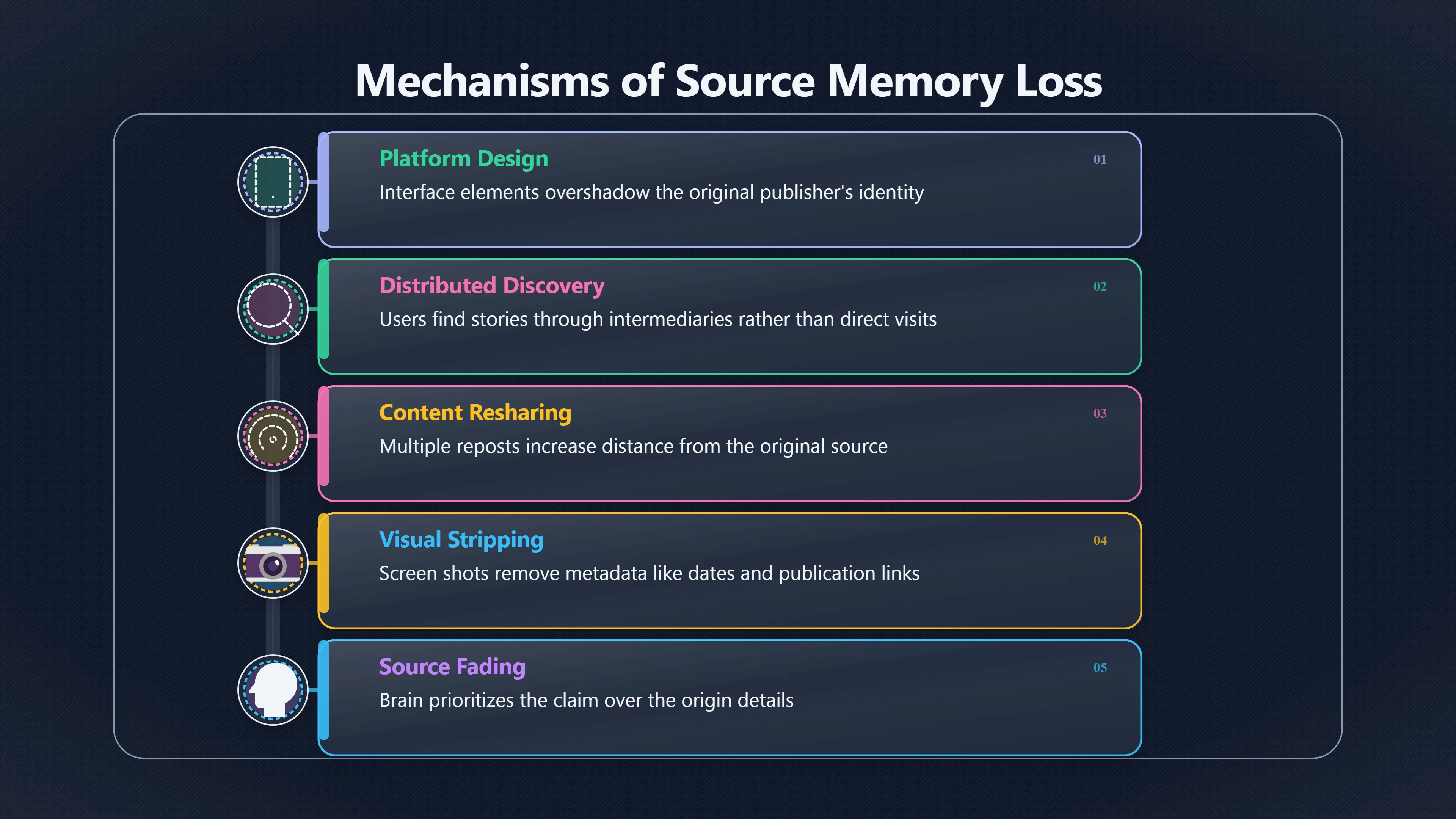
When a story appears in a feed, the platform’s design becomes more visible than the publisher’s identity. The user sees familiar interface elements—profile pictures, share buttons, reaction counts, comments, and recommendation labels—regardless of whether the content comes from a major newsroom, a government agency, an activist group, or an individual creator. The platform becomes the dominant visual frame.
Researchers studying news brand attribution describe this as a “distributed” news environment. Instead of visiting a news outlet directly, users discover stories through intermediaries such as social networks and search engines. In these settings, correct attribution drops significantly because attention is focused on the content and the sharing context rather than on the original producer.[reutersinstitute.politics.ox.ac.uk]reutersinstitute.politics.ox.ac.uka news brand if they accessed it directly rather than via search or social.Read more…
The effect becomes even stronger when content is reshared multiple times. A news article may appear as:
- a friend’s repost,
- a screenshot of a headline,
- a cropped image,
- a creator’s commentary about the article,
- a short video summarising the story.
Each step increases distance from the original publisher while preserving some version of the underlying claim.
Why remembering the claim is easier than remembering the source
Human memory treats content and source information differently.
Psychologists distinguish between remembering information itself and remembering where that information came from. Source memory is often more fragile than memory for the message. People may accurately recall a fact or statement while forgetting who said it, where they encountered it, or whether it came from a trustworthy source.[PMC]pmc.ncbi.nlm.nih.govPMCReading the news on Twitter: Source and item memoryby KA Bourne · 2020 · Cited by 22 — This study examined how the presentation of news-like content in social media affected both item a…
Social feeds encourage exactly this pattern. Users often consume information rapidly, scrolling through dozens or hundreds of posts in a single session. Under these conditions, attention is directed toward the novelty, emotional impact, or relevance of a claim rather than toward publisher details.
A feed also mixes many information types together:
- news reporting,
- personal updates,
- advertisements,
- influencer content,
- satire,
- commentary,
- AI-generated material.
Because all of these appear within a similar visual format, the brain receives fewer signals that a source deserves special attention. The claim becomes memorable while the source fades into the background.
Research examining news presented in social-media-style formats has found that the presentation environment can affect source memory independently of the information itself. The way content is packaged influences what people later remember about its origin.[PMC]pmc.ncbi.nlm.nih.govPMCReading the news on Twitter: Source and item memoryby KA Bourne · 2020 · Cited by 22 — This study examined how the presentation of news-like content in social media affected both item a…
Why source memory matters for trust decisions
Remembering the source is one of the quickest tools people use to judge credibility.
Most readers do not independently verify every claim they encounter. Instead, they rely on shortcuts such as:
- whether they recognise the publisher,
- whether the source has a reputation for accuracy,
- whether it has corrected mistakes in the past,
- whether it is known for expertise in a particular area.
When source memory weakens, those shortcuts become harder to use.
This creates a situation where a person may remember a claim but not remember whether it originated from a respected newsroom, a partisan activist, an anonymous account, or a fabricated post. The result is not necessarily immediate belief. Often it is uncertainty. However, uncertainty itself can make reliable and unreliable information appear more similar than they really are.[reutersinstitute.politics.ox.ac.uk]reutersinstitute.politics.ox.ac.ukBrand and trust in a fragmented news environmentOctober 11, 2016 — The qualitative study explored issues of brand and trust in an increasingly fragmented news environment, and specifica…
The problem becomes especially important when stories circulate for days or weeks. A claim can continue spreading long after users have forgotten where they first encountered it.
Repetition can replace source as the cue for credibility
When source information fades, people may rely on a different signal: familiarity.
Research on the illusory truth effect shows that repeated statements are often judged as more accurate than unfamiliar ones, even when they are false. Repetition increases processing fluency—the feeling that information is easy to recognise and understand—which people sometimes mistake for evidence of truth.[PMC]pmc.ncbi.nlm.nih.govThis finding is known as the illusory truth effect, and it is…
Social feeds are particularly effective repetition machines. Users may encounter the same claim:
- in multiple reposts,
- from different accounts,[mitsloan.mit.edu]mitsloan.mit.eduGiven that the fake news stories circulating on social media are quite different from the…Read more…
- in screenshots,
- in videos,
- in recommendation feeds.
Over time, people may forget where the information came from while retaining a strong sense that they have seen it before.
Studies have found that prior exposure can increase perceived accuracy and willingness to share information, including misinformation. Reliance on social media for news can amplify these effects because repeated exposure occurs frequently within feed-based environments.[PMC+2Taylor & Francis Online]pmc.ncbi.nlm.nih.govThe illusory truth effect leads to the spread of misinformationby V Vellani · 2023 · Cited by 121 — That is, repeated information seem…
This does not mean repetition automatically creates belief. Rather, it shifts attention away from source evaluation and towards familiarity as a judgement cue.
Screenshots, reposts, and the disappearing publisher
One of the clearest examples of source loss is the rise of screenshot culture.
Screenshots are convenient because they allow information to travel across platforms. Yet they often remove metadata that would normally help readers evaluate authenticity. Logos, links, publication dates, correction notices, and surrounding context may disappear.
Researchers studying social-media misattribution have highlighted how screenshots make it harder to verify authorship and trace material back to its original source. Once detached from its original environment, content can be reassigned to a different person, organisation, or publication.[arXiv]arxiv.orgCategorizing Social Media Screenshots for Identifying Author MisattributionOctober 9, 2024…
A screenshot of a headline can therefore continue circulating even after:
- the article has been corrected,
- the story has been updated,
- the original source has been challenged,
- readers have forgotten where it first appeared.
The content survives while the source trail weakens.
Practical cues that restore the original source trail
Source memory problems cannot be eliminated entirely, but readers can reduce them by deliberately restoring missing context.
Several habits are especially useful:
Open the original article rather than relying on reposts. The publisher’s site usually contains additional context, links, corrections, and attribution.
Look for the publication name before reading reactions. Checking the source first helps prevent comments and engagement metrics from becoming the primary cue.
Be cautious with screenshots. Ask whether the image includes a link, date, author, or evidence that it genuinely came from the claimed source.
Notice when multiple posts trace back to the same original report. Apparent agreement across many accounts may reflect repetition rather than independent confirmation.
Separate familiarity from credibility. Seeing a claim repeatedly is evidence of exposure, not evidence that it is true.[PMC+2Journal of Cognition]pmc.ncbi.nlm.nih.govThis finding is known as the illusory truth effect, and it is…
In mixed social feeds, critical thinking often begins with a simple question: not “Have I seen this before?” but “Who produced this, and can I still identify them?” Remembering the source restores information that modern platforms frequently push into the background, yet that remains essential for informed trust decisions.

eBay marketplace picks
Marketplace Samples
Example marketplace items related to this page. Use the search link to explore similar finds on eBay.




Endnotes
1.
Source: reutersinstitute.politics.ox.ac.uk
Link:https://reutersinstitute.politics.ox.ac.uk/our-research/news-brand-attribution-distributed-environments-do-people-know-where-they-get-their
Source snippet
a news brand if they accessed it directly rather than via search or social.Read more...
2.
Source: reutersinstitute.politics.ox.ac.uk
Link:https://reutersinstitute.politics.ox.ac.uk/our-research/i-saw-news-facebook-brand-attribution-when-accessing-news-distributed-environments
Source snippet
cular story when coming from search engines or social media.Read more...
3.
Source: pmc.ncbi.nlm.nih.gov
Title: PMCReading the news on Twitter: Source and item memory
Link:https://pmc.ncbi.nlm.nih.gov/articles/PMC7072077/
Source snippet
by KA Bourne · 2020 · Cited by 22 — This study examined how the presentation of news-like content in social media affected both item a...
4.
Source: reutersinstitute.politics.ox.ac.uk
Title: Brand and trust in a fragmented news environment
Link:https://reutersinstitute.politics.ox.ac.uk/sites/default/files/research/files/Brand%2520and%2520trust%2520in%2520a%2520fragmented%2520news%2520environment.pdf
Source snippet
October 11, 2016 — The qualitative study explored issues of brand and trust in an increasingly fragmented news environment, and specifica...
Published: October 11, 2016
5.
Source: pmc.ncbi.nlm.nih.gov
Link:https://pmc.ncbi.nlm.nih.gov/articles/PMC8116821/
Source snippet
This finding is known as the illusory truth effect, and it is...
6.
Source: pmc.ncbi.nlm.nih.gov
Link:https://pmc.ncbi.nlm.nih.gov/articles/PMC10636596/
Source snippet
The illusory truth effect leads to the spread of misinformationby V Vellani · 2023 · Cited by 121 — That is, repeated information seem...
7.
Source: arxiv.org
Link:https://arxiv.org/abs/2410.06443
Source snippet
Categorizing Social Media Screenshots for Identifying Author MisattributionOctober 9, 2024...
Published: October 9, 2024
8.
Source: reutersinstitute.politics.ox.ac.uk
Link:https://reutersinstitute.politics.ox.ac.uk/understanding-young-news-audiences-time-rapid-change
Source snippet
young news audiences at a time of rapid...24 Mar 2026 — 'News Brand Attribution in Distributed Environments: Do People Know Where They G...
9.
Source: tandfonline.com
Title: The grim conclusions of the largest-ever study of fake news.Read more
Link:https://www.tandfonline.com/doi/full/10.1080/08838151.2024.2410783
Source snippet
Taylor & Francis OnlineSocial Media News Use Amplifies the Illusory Truth Effects...by S Ahmed · 2024 · Cited by 20 — Distinguishing the...
10.
Source: journalofcognition.org
Link:https://journalofcognition.org/articles/10.5334/joc.161
Source snippet
The perception of repetition and explicit memory for the prior presentation might enhance the...
11.
Source: thedecisionlab.com
Title: Illusory truth effect
Link:https://thedecisionlab.com/biases/illusory-truth-effect
Source snippet
The Decision...This article is an in-depth look at the phenomenon of fake news: where most of it is coming from, why it spreads so easil...
12.
Source: ebsco.com
Link:https://www.ebsco.com/research-starters/psychology/illusory-truth-effect
Source snippet
Fake News: Overview;Hindsight bias;Social Media+ more. 2 of 3. Related...Read more...
13.
Source: Wikipedia
Title: Illusory truth effect
Link:https://en.wikipedia.org/wiki/Illusory_truth_effect
Source snippet
Illusory truth effectThe results of a 2015 study suggests that the illusory truth effect can... "The science behind why fake news is...
Additional References
14.
Source: researchgate.net
Link:https://www.researchgate.net/publication/385037614Social_Media_News_Use_Amplifies_the_Illusory_Truth_Effects_of_Viral[Deepfakes
Source snippet
Social Media News Use Amplifies the Illusory Truth Effects...17 Oct 2024 — The illusory truth effect, in which repeated exposure increas...
15.
Source: linkedin.com
Link:https://www.linkedin.com/posts/rasmus-kleis-nielsen-5b97663_in-a-new-reuters-institute-for-the-study-activity-7267804763583348737-Ok9q
Source snippet
Rasmus Kleis Nielsen's PostIn a new Reuters Institute for the Study of Journalism report led by Waqas Ejaz, PhD we document "platform amb...
16.
Source: researchgate.net
Link:https://www.researchgate.net/publication/339935257_Reading_the_news_on_Twitter_Source_and_item_memory_for_social_media_in_younger_and_older_adults
Source snippet
Source and item memory for social media in younger...This study examined how the presentation of news-like content in social media affec...
17.
Source: news.vanderbilt.edu
Link:https://news.vanderbilt.edu/2020/10/06/study-shows-that-repeated-statements-are-more-often-judged-to-be-true-regardless-of-a-persons-age-or-prior-knowledge/
Source snippet
Vanderbilt UniversityStudy shows that repeated statements are more often...Oct 6, 2020 — When adults hear a statement repeated twice, th...
18.
Source: mitsloan.mit.edu
Link:https://mitsloan.mit.edu/shared/ods/documents?DocumentID=4618
Source snippet
Given that the fake news stories circulating on social media are quite different from the...Read more...
19.
Source: osf.io
Link:https://osf.io/download/nkpgz/
Source snippet
Causes and consequences of mainstream media dissemination of fake news: literature.Read mor...
20.
Source: researchgate.net
Link:https://www.researchgate.net/publication/316418350_Fake_News_On_Social_Media_Illusory_Truth_and_the_2016_Presidential_Election
Source snippet
Quantitative and qualitative surveys of a sample of voters from across the United...Read more...
21.
Source: misq.umn.edu
Title: Fake News on Social Media People Believe What They
Link:https://misq.umn.edu/misq/article/43/4/1343/1791/Fake-News-on-Social-Media-People-Believe-What-They
Source snippet
News on Social Media: People Believe What They...Fake news (i.e., misinformation) on social media has sharply increased in the past few...
22.
Source: researchgate.net
Title: 388067519 Repeating Statements Increases Source Credibility
Link:https://www.researchgate.net/publication/388067519_Repeating_Statements_Increases_Source_Credibility
Source snippet
Research on the Illusory truth effect has almost exclusively investigated how repetition. changes participants...Read more...
23.
Source: academia.edu
Link:https://www.academia.edu/22013568/Source_misattributions_may_increase_the_accuracy_of_source_judgments
Source snippet
rom one source with another, which can affect memory accuracy.Read more...
Topic Tree