Within Hallucinations
Do Not Mistake Fluency for Evidence
A smooth AI answer should be treated as a starting point until its key claims can be traced to reliable outside evidence.
On this page
- Why polished structure feels trustworthy
- The claim source support test
- When to ask the AI to abstain or show uncertainty
Page outline Jump by section
Introduction
A fluent AI answer is not the same thing as an evidenced answer. Modern AI systems are designed to produce language that is coherent, well structured and persuasive. As a result, an answer can sound expert even when some of its claims are unsupported, inaccurate or entirely fabricated. Research on AI hallucinations consistently shows that people are often influenced by the apparent confidence and polish of an answer, especially when no obvious warning signs are present.[Misinformation Review]misinforeview.hks.harvard.eduMisinformation Review New sources of inaccuracy?A conceptual framework for…August 27, 2025 — by A Shao · 2025 · Cited by 18 — AI hallucinations are inaccurate outputs generated by AI…
 For anyone practising critical thinking in the age of social media and AI, the key habit is simple: treat fluency as a presentation feature, not as proof. A polished answer should be treated as a starting point until its important claims can be traced to reliable external evidence.
Why Polished Structure Feels Trustworthy
Human beings naturally use shortcuts when judging information. An explanation that is clear, organised and easy to follow often feels more credible than one that is fragmented or uncertain. AI systems are exceptionally good at producing exactly this kind of presentation.
The problem is that language quality and factual quality are different things. A model can generate a professional-looking answer, complete with headings, balanced arguments and technical vocabulary, without having verified the underlying facts. Researchers studying AI hallucinations describe these outputs as plausible but inaccurate statements that can appear trustworthy because of their form rather than their evidential basis.[Misinformation Review]misinforeview.hks.harvard.eduMisinformation Review New sources of inaccuracy?A conceptual framework for…August 27, 2025 — by A Shao · 2025 · Cited by 18 — AI hallucinations are inaccurate outputs generated by AI…
A useful mental shift is to separate two questions:
- Does this answer sound convincing?
- What evidence would make it convincing?
The first question is about style. The second is about knowledge.
Many users unconsciously stop at the first question. Critical thinking begins when the second question becomes automatic.
Signs of Fluency Without Evidence
Several warning signs appear repeatedly in studies and expert discussions of AI-generated misinformation:
- Detailed claims with no source attached.
- Precise numbers, dates or quotations that cannot be traced.
- Citations that look authentic but are difficult to locate.
- Confident language on subjects where experts would normally express uncertainty.
- Answers that change significantly when challenged or rephrased.[TechRadar]techradar.comTech Radar5 signs that Chat GPT is hallucinatingThese hallucinations stem from how AI is trained: by predicting text sequences without verifying facts. 1. **Strange specificity without…
None of these signs prove an answer is wrong. They simply indicate that presentation is doing more work than evidence.
The Claim-Source-Support Test
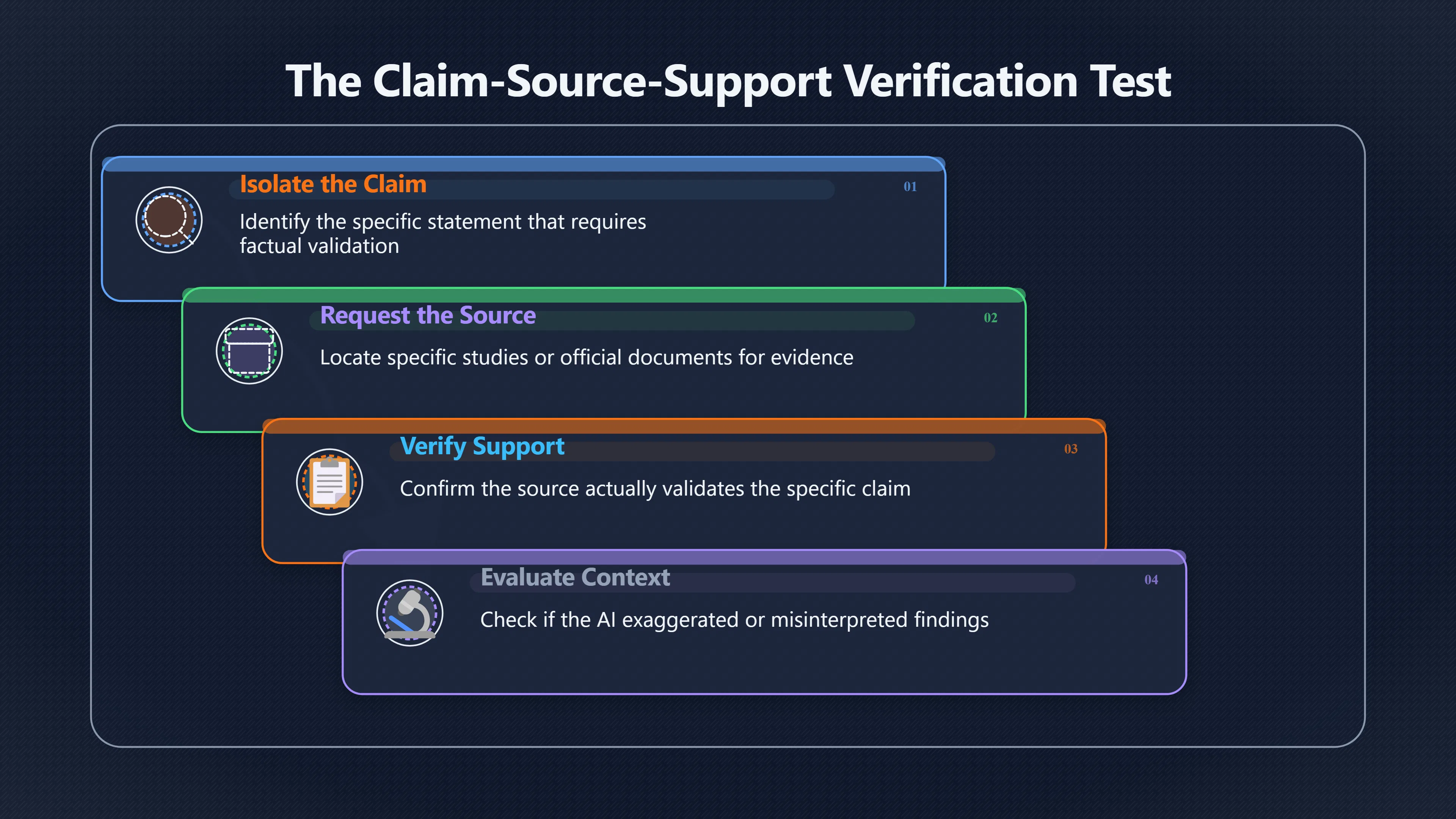
A practical way to separate fluency from evidence is to apply a three-step check to important claims.
Step 1: Identify the Claim
First isolate the statement that matters.
For example:
“A study found that social media use causes a 40% increase in anxiety.”
This is the claim. Everything else in the paragraph may simply be explanation or decoration.
Step 2: Ask for the Source
Next ask where the claim comes from.
A trustworthy answer should be able to point to a specific study, report, dataset, official document or expert source. Vague references such as “research shows” or “experts agree” are not enough when the claim matters.
If an AI cannot identify the source, that does not automatically make the claim false. It does mean the claim should not yet be treated as established fact.
Step 3: Check Whether the Source Actually Supports the Claim
This is the step many people skip.
Even when an AI provides a real source, the source may not say what the AI claims it says. The model may have misunderstood the study, exaggerated the findings or blended information from several places.
The question is not merely:
“Is the source real?”
The more important question is:[medium.com]medium.comame question multiple times and analyzing the consistency of the…Read more…
“Does the source support this specific statement?”
This distinction is especially important for academic, legal, medical and policy-related topics, where small changes in wording can completely alter the meaning.
A Practical Example
Imagine an AI states:
“Scientists have proven that a particular educational method always improves learning outcomes.”
The claim-source-support test would look like this:
QuestionResultWhat is the claim?The method always improves outcomes.What is the source?A specific study or review.Does the source support the claim?Perhaps the study found improvement in some contexts, not all contexts.
The answer may sound authoritative throughout, yet the evidential support may be much narrower than the wording suggests.
Ask Questions That Reveal Evidence
One of the most effective ways to evaluate an AI answer is to request information that fluency alone cannot provide.
Useful follow-up prompts include:
- “Which sources support this claim?”
- “What evidence contradicts this conclusion?”
- “How confident are you, and why?”
- “Which part of this answer is uncertain?”
- “What would change your conclusion?”
- “Can you distinguish established facts from informed speculation?”
These questions force the discussion away from presentation and towards justification.
Research on uncertainty in AI systems suggests that answer accuracy and confidence do not always align. Some models remain highly confident even when incorrect, while others struggle to communicate uncertainty consistently.[arXiv]arxiv.orgReasoning about Uncertainty: Do Reasoning Models Know When They Don't Know?June 22, 2025…
For that reason, confidence should be treated as information, not proof.
When to Ask the AI to Abstain or Show Uncertainty
A useful critical-thinking habit is to give AI permission not to answer.
Many language models have historically been rewarded for producing an answer rather than admitting uncertainty. Researchers from OpenAI have argued that current evaluation systems often encourage guessing because benchmarks reward correct answers but may not sufficiently reward saying “I don’t know” when evidence is lacking.[OpenAI+2arXiv]OpenAIwhy language models hallucinateSep 5, 2025 — While evaluations themselves do not directly cause hallucinations, most evaluations measure model performance in a way that…
This creates an important implication for users: sometimes the best answer is an incomplete answer.
Consider asking the model:
- “If you are unsure, say so.”
- “Separate what you know from what you are inferring.”
- “Estimate your confidence and explain why.”
- “What information would you need before answering reliably?”
These prompts encourage a more evidence-aware response.
Situations Where Abstention Is Valuable
Requests for uncertainty are especially important when:
- Making health decisions.
- Interpreting laws or regulations.
- Assessing financial risks.
- Verifying historical facts.[techradar.com]techradar.comTech Radar5 signs that Chat GPT is hallucinatingThese hallucinations stem from how AI is trained: by predicting text sequences without verifying facts. 1. **Strange specificity without…
- Evaluating scientific findings.
- Checking whether a quotation is genuine.
In these situations, a cautious answer with acknowledged limits is often more useful than a complete but potentially incorrect explanation.
The Most Reliable Mindset
The safest way to read AI-generated information is to assume that fluency and truth are separate qualities.
A smooth answer may be correct, partly correct or entirely wrong. Its polish does not reveal which of those possibilities is true. What matters is whether key claims can be connected to reliable evidence, whether the supporting sources actually justify the conclusions being drawn, and whether uncertainty is being communicated honestly.
In practice, the strongest question is often not “Does this sound right?” but “What evidence would convince me that it is right?” That shift turns AI from an authority to be trusted into a tool whose outputs can be examined, tested and verified.
Amazon book picks
Further Reading
Books and field guides related to Do Not Mistake Fluency for Evidence. Use these as the next step if you want deeper reading beyond the article.
Thinking, Fast and Slow
Explains why confidence and fluency can be mistaken for accuracy.

Scout Mindset
Directly addresses separating persuasive arguments from reliable evidence.

Illustrated Book of Bad Arguments
Shows how persuasive presentation can hide weak logic.
eBay marketplace picks
Marketplace Samples
Example marketplace items related to this page. Use the search link to explore similar finds on eBay.
![Listing image for NCT 127 [FACT CHECK] 5th Album EXHIBIT JUNGWOO Ver/CD+4 Post Card+Card+Sticker](/assets/images/marketplace-covers/56882ab3f02073dbc060.jpg)
Endnotes
1.
Source: arxiv.org
Link:https://arxiv.org/html/2504.13777v1
Source snippet
A Conceptual Framework for Studying AI Hallucinations in...18 Apr 2025 — This paper proposes a conceptual framework for understanding AI...
2.
Source: techradar.com
Title: Tech Radar5 signs that Chat GPT is hallucinating
Link:https://www.techradar.com/ai-platforms-assistants/5-signs-that-chatgpt-is-hallucinating
Source snippet
These hallucinations stem from how AI is trained: by predicting text sequences without verifying facts. 1. **Strange specificity without...
3.
Source: arxiv.org
Link:https://arxiv.org/abs/2506.18183
Source snippet
Reasoning about Uncertainty: Do Reasoning Models Know When They Don't Know?June 22, 2025...
Published: June 22, 2025
4.
Source: arxiv.org
Link:https://arxiv.org/abs/2604.17293
5.
Source: OpenAI
Title: why language models hallucinate
Link:https://openai.com/index/why-language-models-hallucinate/
Source snippet
Sep 5, 2025 — While evaluations themselves do not directly cause hallucinations, most evaluations measure model performance in a way that...
6.
Source: arxiv.org
Link:https://arxiv.org/abs/2509.04664
Source snippet
[2509.04664] Why Language Models Hallucinateby AT Kalai · 2025 · Cited by 300 — Like students facing hard exam questions, large language...
7.
Source: OpenAI
Link:https://openai.com/
Source snippet
comOpenAI | Research & DeploymentWe believe our research will eventually lead to artificial general intelligence, a system that can solve...
8.
Source: cdn.openai.com
Title: why language models hallucinate
Link:https://cdn.openai.com/pdf/d04913be-3f6f-4d2b-b283-ff432ef4aaa5/why-language-models-hallucinate.pdf
Source snippet
Humans learn the value of expressing uncertainty outside of school...Read more...
9.
Source: arxiv.org
Link:https://arxiv.org/pdf/2509.04664
Source snippet
hallucination-like guessing is rewarded by most primary evaluations. We discuss statistically rigorous modifications to existing evaluati...
10.
Source: misinforeview.hks.harvard.edu
Title: Misinformation Review New sources of inaccuracy?
Link:https://misinforeview.hks.harvard.edu/article/new-sources-of-inaccuracy-a-conceptual-framework-for-studying-ai-hallucinations/
Source snippet
A conceptual framework for...August 27, 2025 — by A Shao · 2025 · Cited by 18 — AI hallucinations are inaccurate outputs generated by AI...
Published: August 27, 2025
11.
Source: inra.ai
Title: ai hallucinations
Link:https://www.inra.ai/blog/ai-hallucinations
Source snippet
in Research: What They Are & How to Stop5 Mar 2026 — AI hallucinations occur when artificial intelligence systems generate information th...
12.
Source: linkedin.com
Link:https://www.linkedin.com/posts/ashbhatia_why-language-models-hallucinate-activity-7371387740669616129-HjQi
Source snippet
Accuracy alone cannot capture the real world risks of hallucinations. A...Read more...
13.
Source: linkedin.com
Title: william marcellino ph d 41982a19 ai activity 7370965554943377408 MYeA
Link:https://www.linkedin.com/posts/william-marcellino-ph-d-41982a19_ai-activity-7370965554943377408-MYeA
Source snippet
OpenAI paper on LLM hallucinations: a predictable result...OpenAI recently released a paper on why large language models (LLMs) hallucin...
14.
Source: reddit.com
Title: Why Language Models Hallucinate
Link:https://www.reddit.com/r/MachineLearning/comments/1namvsk/why_language_models_hallucinate_openai_pseudo/
Source snippet
OpenAi pseudo paperTLDR: hallucination-like guessing is rewarded by most primary evaluations. We discuss statistically rigorous modificat...
15.
Source: euronews.com
Title: Why do AI models make things up or hallucinate?
Link:https://www.euronews.com/next/2025/09/09/why-do-ai-models-make-things-up-or-hallucinate-openai-says-it-has-the-answer-and-how-to-pr
Source snippet
OpenAI...9 Sept 2025 — The reason hallucinations continue is because LLMs are “optimised to be good test-takers and guessing when uncert...
16.
Source: nngroup.com
Title: ai hallucinations
Link:https://www.nngroup.com/articles/ai-hallucinations/
Source snippet
What Designers Need to Know7 Feb 2025 — A hallucination occurs when a generative AI system generates output data that seems plausible but...
17.
Source: theregister.com
Title: openai hallucinations incentives
Link:https://www.theregister.com/2025/09/17/openai_hallucinations_incentives/
Source snippet
OpenAI says models trained to make up answersSep 17, 2025 — "Over thousands of test questions, the guessing model ends up looking better...
18.
Source: x.com
Link:https://x.com/aakashgupta/status/2030152922244469137
Source snippet
OpenAI's newest “smarter” models hallucinate 3x more...So the AI learned the optimal strategy: always guess. Never admit uncertainty. So...
Additional References
19.
Source: science.org
Title: ai hallucinates because it s trained fake answers it doesn t know
Link:https://www.science.org/content/article/ai-hallucinates-because-it-s-trained-fake-answers-it-doesn-t-know
Source snippet
AI hallucinates because it's trained to fake answers it...Oct 28, 2025 — Because the benchmark doesn't penalize incorrect guesses more t...
20.
Source: businessinsider.com
Link:https://www.businessinsider.com/why-ai-chatbots-hallucinate-openai-chatgpt-anthropic-claude
Source snippet
This test-centric optimization encourages models to provide confident but potentially incorrect outputs, rather than abstaining when unsu...
21.
Source: reddit.com
Link:https://www.reddit.com/r/singularity/comments/1n9fued/new_research_from_openai_why_language_models/
22.
Source: linkedin.com
Link:https://www.linkedin.com/posts/haythamassem_why-language-models-hallucinatepdf-activity-7370201125955997697–izi
Source snippet
Why language models hallucinate: A paper by OpenAIWe argue that language models hallucinate because the training and evaluation procedure...
23.
Source: youtube.com
Link:https://www.youtube.com/watch?v=xGO5Q94XXf0
Source snippet
Did OpenAI just solve hallucinations?open AAI may have just solved hallucinations they just put out a paper which identifies the root cau...
24.
Source: medium.com
Link:https://medium.com/the-resilient-is/when-ai-makes-things-up-understanding-hallucination-vs-[bad-citations
Source snippet
ame question multiple times and analyzing the consistency of the...Read more...
25.
Source: linkedin.com
Link:https://www.linkedin.com/pulse/combating-ai-hallucinations-verification-strategies-consider-donovan-ovpse
Source snippet
nimize hallucinations and establish robust verification frameworks.Read more...
26.
Source: medium.com
Link:https://medium.com/%40adnanmasood/why-language-models-hallucinate-a-practical-reading-of-openais-kalai-nachum-vempala-and-faaef2e10930
Source snippet
esses — and those confident guesses are the “hallucinations.”...Read more...
27.
Source: genta.dev
Title: Why Do LLMs Hallucinate & How to Reduce LLM
Link:https://genta.dev/resources/why-do-llms-hallucinate
Source snippet
Why do LLMs hallucinate? Because current benchmarks reward guessing. See simple examples, business risks, better benchmark design, a...
28.
Source: blogs.library.duke.edu
Title: its 2026 why are llms still hallucinating
Link:https://blogs.library.duke.edu/blog/2026/01/05/its-2026-why-are-llms-still-hallucinating/
Source snippet
duke.eduIt's 2026. Why Are LLMs Still Hallucinating?Jan 5, 2026 — Impressive as this sounds, many of the benchmark evaluation tests for L...
Topic Tree