Within Platform Incentives
Why screenshots outrun the source
Low-friction formats can detach claims from sources, dates and missing context while making reposting feel effortless.
On this page
- Why screenshots travel so easily
- How cropping and captions steer interpretation
- A practical context checklist before reposting
Page outline Jump by section
Introduction
Screenshots and short video clips are among the most shareable formats on social platforms because they remove friction. A screenshot can be reposted in seconds without opening a link. A cropped clip can deliver an emotional punch before viewers ask where it came from, when it was recorded, or what happened immediately before and after. In an environment where attention is scarce and sharing is rewarded, these formats often travel faster than the context needed to evaluate them.
 For critical thinking, the challenge is not that every screenshot or clip is deceptive. Many are accurate. The problem is that low-friction formats separate claims from the information that helps people judge them: source, date, authorship, surrounding discussion and original intent. Researchers, fact-checkers and media literacy specialists repeatedly identify decontextualisation—content presented without its original setting—as a major driver of misunderstanding online.[Sage Journals+2Taylor & Francis Online]journals.sagepub.comSage JournalsComparing the effects of textual disinformation to AI-…Jan 23, 2026 — We specifically compared decontextualized videos to…
Why screenshots travel so easily
A screenshot is unusually portable. It turns a post, article headline, message or comment into an image that can move across platforms without requiring users to visit the original source.
This portability changes how information is consumed. Instead of encountering a claim alongside the account that posted it, related replies, publication date or corrections, viewers often see only a frozen fragment. The screenshot becomes the evidence. Research on misinformation has highlighted how screenshots can acquire an aura of authenticity simply because they appear to document something that was supposedly seen on a platform. Studies examining misinformation ecosystems have found that screenshots are frequently used as visual evidence to legitimise claims and create impressions of authority.[Sage Journals]journals.sagepub.comSage JournalsThe legitimation of screenshots as visual evidence in social…by O Inwood · Cited by 13 — This study considers the role of…
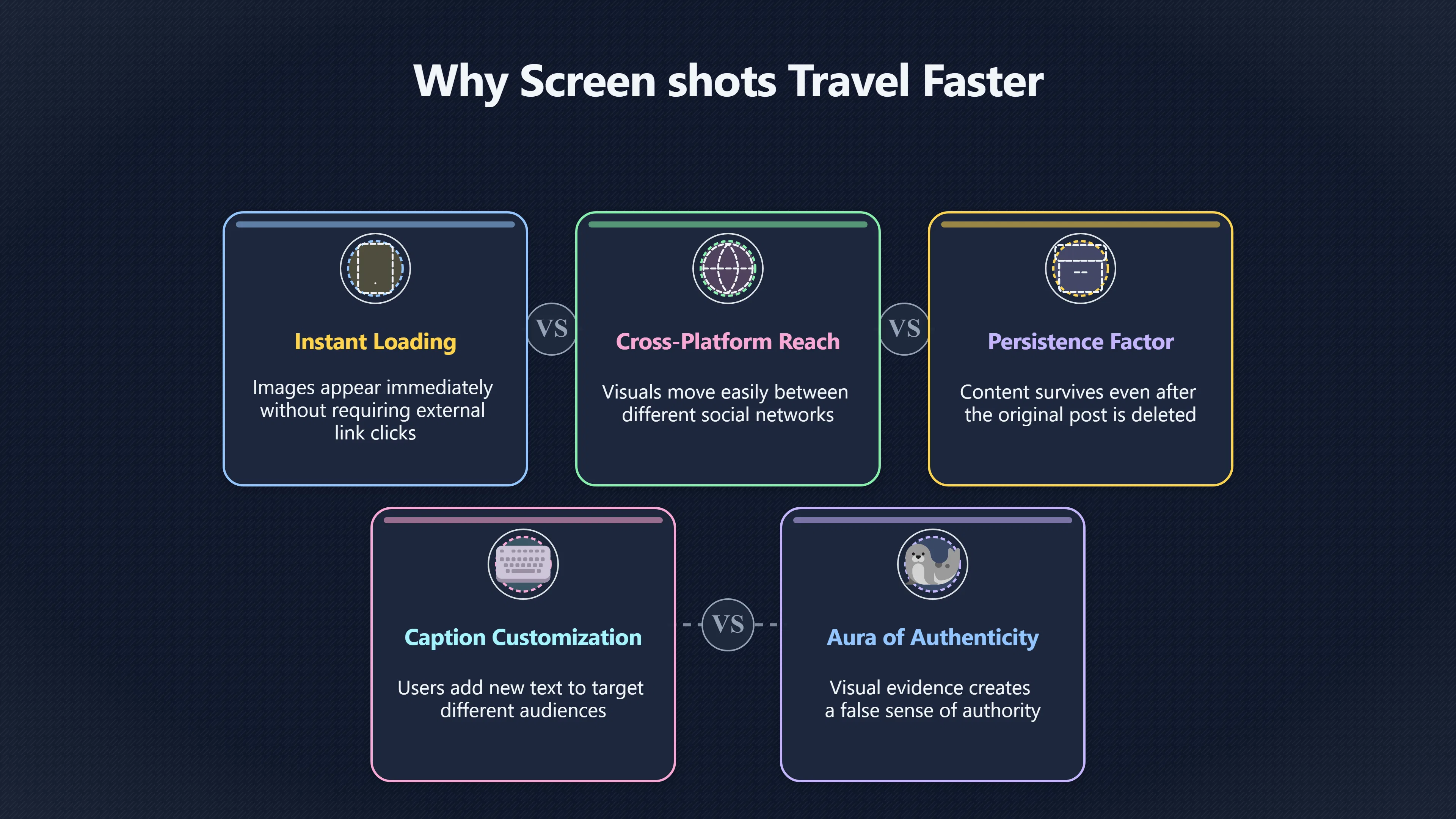
The format also benefits from platform incentives:
- It loads instantly.
- It can be shared across different networks.
- It avoids requiring readers to leave the feed.
- It often survives even after the original post is deleted.
- It can be reposted with a new caption tailored to a different audience.
Researchers studying social media screenshots note that they have become a common method of information sharing despite the difficulty many users face in verifying whether the depicted post is genuine, altered or accurately attributed.[arXiv]arxiv.orgarXiv Extracting Information from Twitter ScreenshotsExtracting Information from Twitter ScreenshotsJune 14, 2023…
A further complication is that screenshots frequently strip away metadata. Dates, usernames, URLs and surrounding conversation can disappear through cropping or editing. What remains is often the most emotionally provocative portion of the original content.
How cropping and captions steer interpretation
Cropping does not need sophisticated editing tools to change meaning. Sometimes removing part of an image or shortening a video is enough.
Researchers studying visual disinformation describe this practice as decontextualisation: real material presented in a way that changes how it is interpreted. In studies of visual misinformation, cropped or selectively edited videos are often categorised as “cheapfakes” because they rely on low-effort techniques rather than advanced AI generation.[Taylor & Francis Online]tandfonline.comTaylor & Francis OnlineHow persuasive are political cheapfakes disseminated via…by M Hameleers · 2025 · Cited by 12 — In this paper, v…
A viewer rarely sees what was excluded from the frame. As a result, interpretation becomes highly dependent on the clip itself and any accompanying caption.
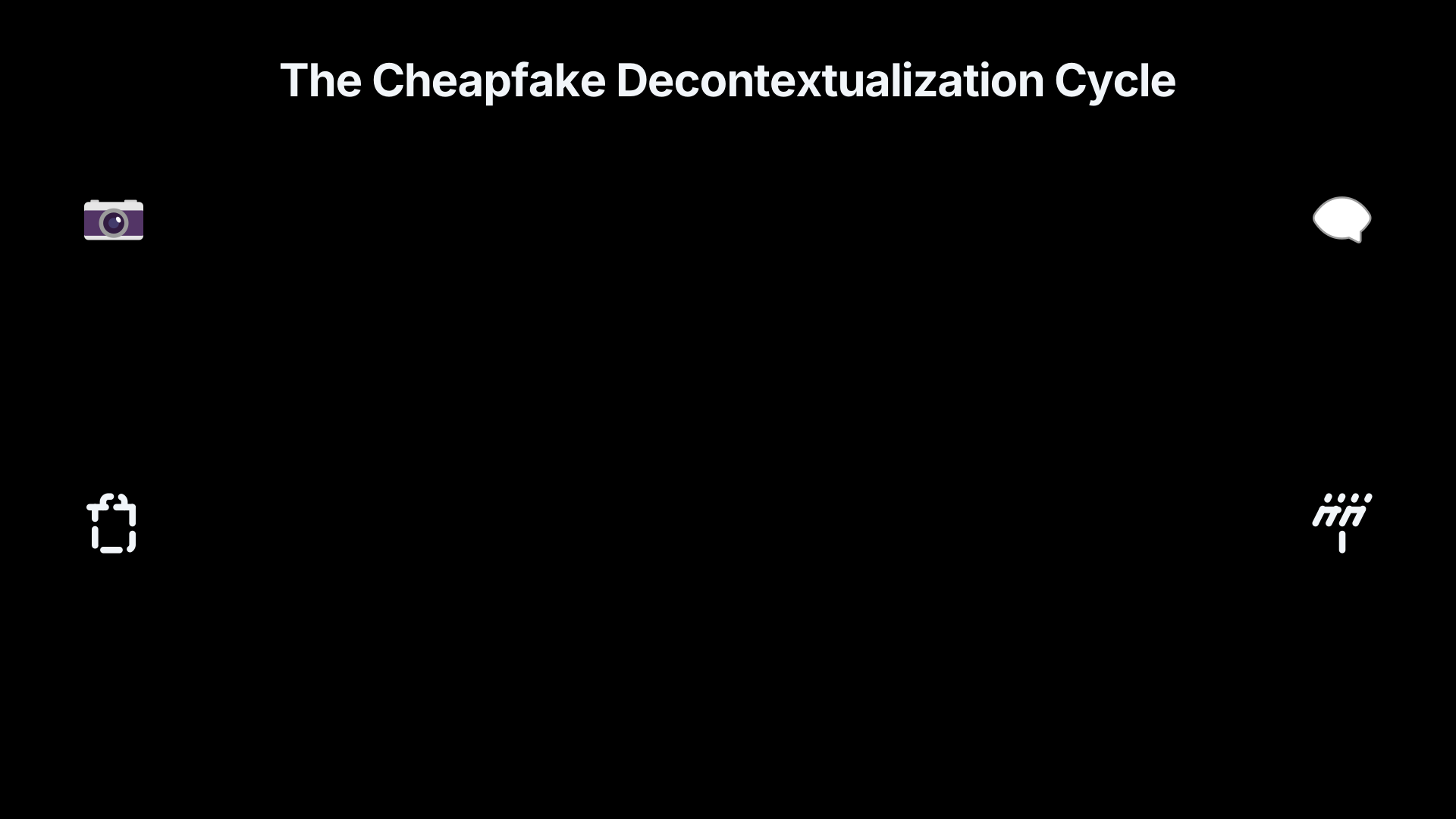
Consider a common pattern:
- A long video contains a confusing or ambiguous moment.
- A few seconds are isolated and reposted.
- A caption supplies a suggested interpretation.
- Viewers encounter the edited version before seeing any broader context.
Once this sequence occurs, the caption often becomes part of the perceived evidence. Research on social media reels and misleading contextual framing has shown that captions can substantially shape how audiences interpret visual content.[ACM Digital Library]dl.acm.orgACM Digital LibraryMisinformation in Reels, Influence of Contextual…Dec 3, 2024 — We conducted a qualitative study with N = 24 social…
Real-world examples illustrate the effect. Fact-checkers and journalists have repeatedly documented cases where political videos gained traction after selective cropping removed relevant context from the frame. In one widely discussed example from the 2024 G7 summit, a viral clip suggested that President Joe Biden had wandered away from an event. Wider footage showed him interacting with a skydiver outside the cropped frame. The narrower edit changed how the scene appeared to viewers.[The Washington Post]washingtonpost.comOne viral clip from the G-7 summit showed Biden appearing to wander off but omitted the fact that he was engaging with a skydiver, a cont…
The same mechanism appears during crises and conflicts. Reporting on misinformation during the war in Ukraine found that many viral images and videos were not fabricated at all; they were genuine visuals detached from their original time, location or event and then redistributed with new claims attached.[Axios]axios.comUkraine misinformation spreads as users share videos out of contextThe conflict marks an unprecedented level of digital documentation, which, while offering insights, also poses risks when content is misr…
Why context loses the race
Context is information-heavy. Virality rewards information-light formats.
A screenshot may fit on one screen. Proper verification may require checking an original article, locating a source account, reading replies, comparing dates or viewing a longer recording. The effort is asymmetrical: sharing takes seconds, verification can take minutes.
This creates a structural advantage for simplified content. The more context needed to understand a claim, the less likely that context is to accompany every repost. Each additional share increases the chance that source information, caveats and corrections will be lost.
Short-form media ecosystems can intensify this effect. Research on short-form video environments suggests that rapid context switching and highly engaging feeds encourage quick consumption patterns rather than extended source investigation.[arXiv]arxiv.orgShort-Form Videos Degrade Our Capacity to Retain Intentions: Effect of Context Switching On Prospective MemoryFebruary 7, 2023…
As content moves further from its origin, audiences increasingly evaluate it based on presentation rather than provenance. The question shifts from “Where did this come from?” to “Does this look convincing?”
That shift is particularly important in the age of AI because authentic screenshots, altered screenshots, genuine clips, edited clips and synthetic media can all appear in the same feed. The visual format alone no longer guarantees reliability.
A practical context checklist before reposting
When a screenshot or cropped clip provokes a strong reaction, a brief pause can prevent accidental amplification of misleading information.
Media literacy specialists frequently recommend approaches such as Mike Caulfield’s SIFT method, which emphasises stopping, investigating the source, finding better coverage and tracing material back to its original context. guides.lib.uchicago.edu+2Media Helping Media[guides.lib.uchicago.edu]guides.lib.uchicago.eduThe SIFT MethodEvaluating Resources and Misinformation30 Jun 2025 — The SIFT method is an evaluation strategy developed by digital literacy expert, Mike…
Before reposting, ask:
Can I identify the original source?
Look for the account, publication, organisation or creator responsible for the original material. A screenshot of a post is not the same thing as the post itself.

Is the date visible?
Old content is routinely recycled and attached to new events. If a date is missing, assume that timing remains unverified until checked.
What happened outside the frame?
For videos, search for a longer version. For screenshots, look for surrounding comments, replies or article text.
Does the caption match the evidence?
Separate what is visible from what is being claimed. The image or clip may be real while the accompanying explanation is misleading.
Has independent coverage confirmed the interpretation?
If the claim is significant, reliable reporting, fact-checking organisations or primary sources should provide additional evidence.
The most useful habit is simple: treat screenshots and cropped clips as leads, not conclusions. They may point towards something important, but they rarely contain enough information on their own to establish what actually happened. In social environments designed to reward fast sharing, recovering that missing context is one of the most practical forms of critical thinking.
Amazon book picks
Further Reading
Books and field guides related to Why screenshots outrun the source. Use these as the next step if you want deeper reading beyond the article.
Stolen Focus
Connects attention economics and digital environments to reduced reflection and judgement.
eBay marketplace picks
Marketplace Samples
Example marketplace items related to this page. Use the search link to explore similar finds on eBay.




Endnotes
1.
Source: researchers.westernsydney.edu.au
Title: the legitimation of screenshots as visual evidence in social medi
Link:https://researchers.westernsydney.edu.au/en/publications/the-legitimation-of-screenshots-as-visual-evidence-in-social-medi/
Source snippet
It considers their role in YouTube videos that spread...Read mo...
2.
Source: arxiv.org
Title: arXiv Extracting Information from Twitter Screenshots
Link:https://arxiv.org/abs/2306.08236
Source snippet
Extracting Information from Twitter ScreenshotsJune 14, 2023...
Published: June 14, 2023
3.
Source: arxiv.org
Link:https://arxiv.org/abs/2410.06443
4.
Source: dl.acm.org
Link:https://dl.acm.org/doi/10.1007/978
Source snippet
ACM Digital LibraryMisinformation in Reels, Influence of Contextual...Dec 3, 2024 — We conducted a qualitative study with N = 24 social...
5.
Source: axios.com
Title: Ukraine misinformation spreads as users share videos out of context
Link:https://www.axios.com/2022/02/28/ukraine-misinformation-videos-context
Source snippet
The conflict marks an unprecedented level of digital documentation, which, while offering insights, also poses risks when content is misr...
6.
Source: arxiv.org
Link:https://arxiv.org/abs/2302.03714
Source snippet
Short-Form Videos Degrade Our Capacity to Retain Intentions: Effect of Context Switching On Prospective MemoryFebruary 7, 2023...
Published: February 7, 2023
7.
Source: guides.lib.uchicago.edu
Title: The SIFT Method
Link:https://guides.lib.uchicago.edu/c.php?g=1241077&p=9082322
Source snippet
Evaluating Resources and Misinformation30 Jun 2025 — The SIFT method is an evaluation strategy developed by digital literacy expert, Mike...
8.
Source: arxiv.org
Link:https://arxiv.org/html/2410.06443v1
Source snippet
1 Introduction9 Oct 2024 — We discuss the difference between misinformation and disinformation and how screenshots are used to spread aut...
9.
Source: arxiv.org
Title: Fake news, disinformation and misinformation in social media: a review.Read more
Link:https://arxiv.org/html/2504.07687v1
Source snippet
FMNV: A Dataset of Media-Published News Videos for...Apr 10, 2025 — In this paper, we conduct an empirical analysis for fake news video...
10.
Source: journals.sagepub.com
Link:https://journals.sagepub.com/doi/10.1177/14614448251409208
Source snippet
Sage JournalsComparing the effects of textual disinformation to AI-...Jan 23, 2026 — We specifically compared decontextualized videos to...
11.
Source: tandfonline.com
Link:https://www.tandfonline.com/doi/full/10.1080/1369118X.2024.2388079
Source snippet
Taylor & Francis OnlineHow persuasive are political cheapfakes disseminated via...by M Hameleers · 2025 · Cited by 12 — In this paper, v...
12.
Source: journals.sagepub.com
Link:https://journals.sagepub.com/doi/10.1177/14703572241255664
Source snippet
Sage JournalsThe legitimation of screenshots as visual evidence in social...by O Inwood · Cited by 13 — This study considers the role of...
13.
Source: washingtonpost.com
Link:https://www.washingtonpost.com/politics/2024/06/14/cheapfake-biden-videos-enrapture-right-wing-media-deeply-mislead/
Source snippet
One viral clip from the G-7 summit showed Biden appearing to wander off but omitted the fact that he was engaging with a skydiver, a cont...
14.
Source: mediahelpingmedia.org
Title: sift for fact checking
Link:https://mediahelpingmedia.org/basics/sift-for-fact-checking/
Source snippet
SIFT for fact-checking30 Mar 2025 — SIFT teaches students how to critically evaluate information online through four steps: Stop, Investi...
15.
Source: nwtc.libguides.com
Link:https://nwtc.libguides.com/evaluating_resources/sift
Source snippet
Method - Evaluating Resources5 days ago — SIFT is a series of actions you can take to determine the validity and reliability of claims an...
16.
Source: frontiersin.org
Link:https://www.frontiersin.org/journals/public-health/articles/10.3389/fpubh.2025.1713794/full
Source snippet
Understanding how users identify health misinformation in...by R Wang · 2025 · Cited by 3 — Misinformation can distort risk perceptions...
Additional References
17.
Source: researchgate.net
Link:https://www.researchgate.net/publication/390774908_Misinformation_and_Disinformation_on_TikTok
Source snippet
(PDF) Misinformation and Disinformation on TikTokThis study investigates the contrasts between misinformation and disinformation, emphasi...
18.
Source: guides.lib.byu.edu
Title: It consists of four moves: Stop, Investigate the source, find better coverage
Link:https://guides.lib.byu.edu/c.php?g=216428&p=10146879
Source snippet
Management: Source Evaluation (SIFT)6 May 2026 — The SIFT method helps analyze information, especially news or other online media...
Published: May 2026
19.
Source: pmc.ncbi.nlm.nih.gov
Title: govan integrated analysis using PLS-SEM and fs QCA
Link:https://pmc.ncbi.nlm.nih.gov/articles/PMC12719425/
Source snippet
integrated analysis using PLS-SEM and fsQCA - PMCby R Wang · 2025 · Cited by 3 — Misinformation can distort risk perceptions, promote har...
20.
Source: pbs.org
Title: out of context photos are a powerful low tech form of misinformation
Link:https://www.pbs.org/newshour/science/out-of-context-photos-are-a-powerful-low-tech-form-of-misinformation
Source snippet
Out-of-context photos are a powerful low-tech form...18 Feb 2020 — Psychological research demonstrates that these out-of-context photogr...
21.
Source: guides.lib.lsu.edu
Title: The SIFT Method, created by Mike Caulfield, is a way to determine if resources
Link:https://guides.lib.lsu.edu/c.php?g=1486395&p=11087305
Source snippet
Information: SIFT Method - Research Guides - LSU9 Mar 2026 — Evaluating Information with the SIFT Method (The Four Moves)...
22.
Source: researchgate.net
Link:https://www.researchgate.net/publication/384716476_The_legitimation_of_screenshots_as_visual_evidence_in_social_media_YouTube_videos_spreading_misinformation_and_disinformation
Source snippet
shots in instances of misinformation and disinformation, highlighting the importance...Read more...
23.
Source: poynter.org
Title: why people still fall for fake screenshots
Link:https://www.poynter.org/fact-checking/2020/why-people-still-fall-for-fake-screenshots/
Source snippet
13 Feb 2020 — The surge of misinformation accompanying the coronavirus outbreak has included several cases in which people have been dece...
24.
Source: guides.library.charlotte.edu
Title: SIFT is a four-step method that helps you
Link:https://guides.library.charlotte.edu/c.php?g=1499262&p=11347573
Source snippet
and Evaluating Sources: SIFT - Research Guides5 Mar 2026 — SIFT is a source evaluation methodology created by Mike Caulfield, a misinform...
25.
Source: nature.com
Link:https://www.nature.com/articles/s44271-025-00379-3_reference.pdf
Source snippet
Video inoculation against election misinformation across...by M Biddlestone · 2026 — These videos targeted three widely used misinformat...
26.
Source: nshah.net
Title: Identifying Misinformation from Website Screenshots
Link:https://nshah.net/publications/VisualFakeNews.ICWSM.21.pdf
Source snippet
In this paper, we propose to use a promising, yet neglected...Read...
Topic Tree