Within Not Cynicism
When updates look like cover ups
Responsible updates can look suspicious to cynical readers, even when changing the record is part of getting closer to truth.
On this page
- Why good reporting changes as evidence improves
- How cynicism misreads corrections and context notes
- How to judge whether an update answers the claim
Page outline Jump by section
Introduction
One of the most common mistakes in online reasoning is treating a correction as evidence of a cover-up. A news report is updated, a fact-check changes its wording, a public agency revises guidance, or an AI system receives new information. To a cynical audience, the change itself can appear suspicious: “Why are they changing the story?” Yet the ability to revise claims in response to better evidence is often a sign that a system is working as intended, not that it is hiding the truth.
 Critical thinking and cynicism part ways at this point. Critical thinking asks whether the update improves accuracy and explains what changed. Cynicism assumes that any revision proves dishonesty. In social media environments, where screenshots of earlier versions circulate long after corrections are made, that assumption can make routine efforts to improve accuracy look like evidence of conspiracy.
Why good reporting changes as evidence improves
Most public knowledge is produced under uncertainty. Journalists publish breaking news before every detail is known. Researchers release findings that later studies refine. Public authorities make decisions using incomplete information and then adjust when new evidence appears.
Professional journalism has long treated corrections as part of maintaining accuracy. Many news organisations have formal correction policies requiring errors to be fixed and explained publicly rather than quietly removed. Transparency advocates in journalism argue that audiences should be able to see what changed and why, precisely because correction is part of the truth-seeking process rather than evidence of deception.[Trusting News+2Ethics and Journalism]trustingnews.orgTrusting NewsCorrectionsThis Trust Kit helps you assess how easy it is for your users to: understand your process for correcting errors k…
The digital environment has made these changes more visible. In print newspapers, a correction might appear the next day in a dedicated section. Online, the original article is often updated directly, accompanied by an editor’s note explaining the change. This means readers can encounter multiple versions of the same story over time and compare them side by side.[Granite State News Collaborative+2Monadnock Ledger-Transcript]collaborativenh.orgGranite State News Collaborative What Happens When a Mistake Is Made?How Corrections…September 23, 2025 — 23 Sept 2025 — corrections can be made right in the original story, typically with an editor's no…
The visibility of revision creates a paradox. Transparency allows people to see accuracy improving, but it also gives sceptical observers material that can be presented as proof that “the story keeps changing”.
Updates, corrections and clarifications are not the same thing
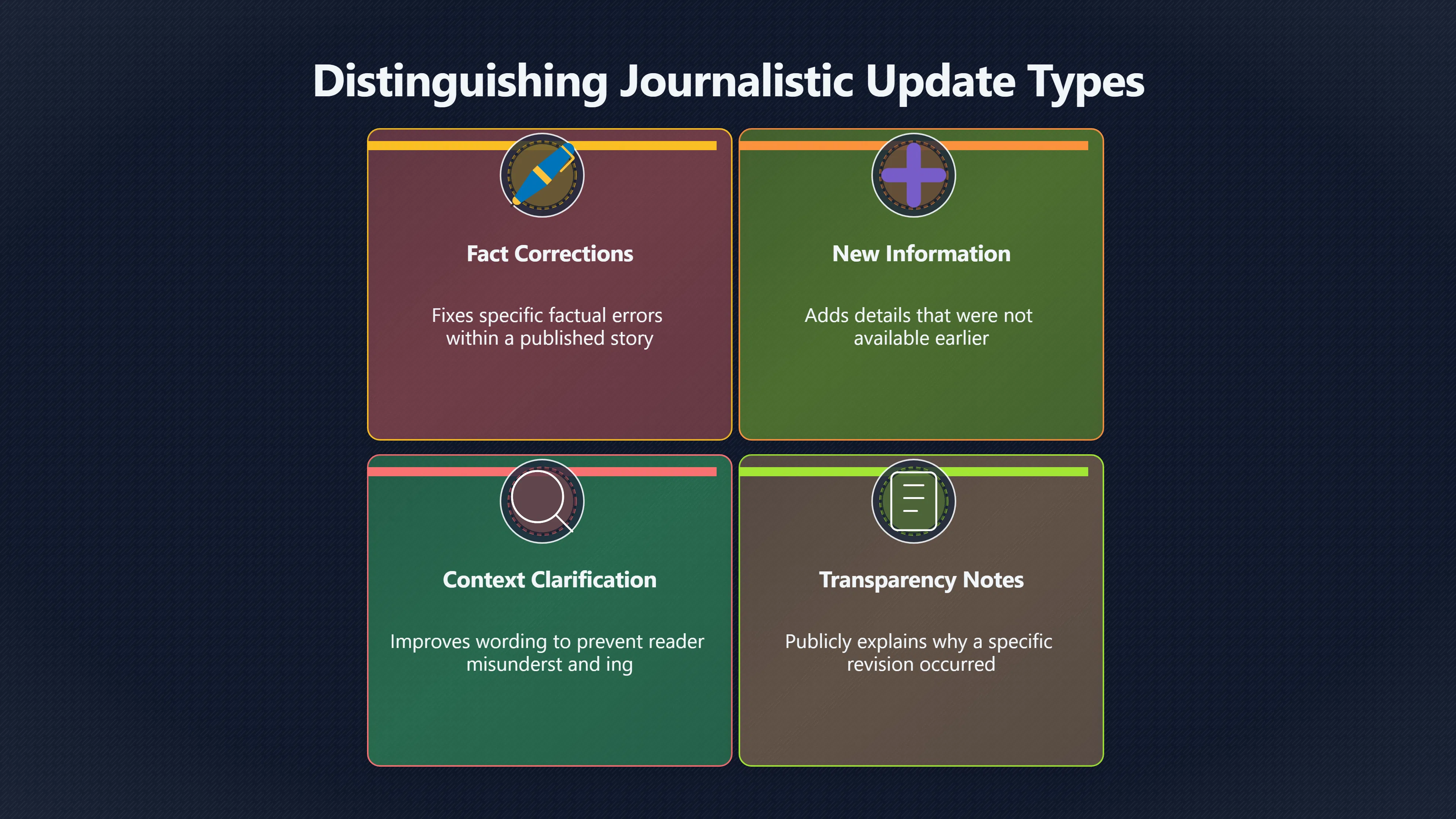
A useful distinction is often lost in online debates:
- Updates add new information that was not available earlier.
- Corrections fix factual errors.[britannica.com]britannica.comcorrections policyEncyclopedia BritannicaCorrections policies in journalism | Overview, History…31 May 2026 — Media organizations use corrections polici…
- Clarifications improve wording or context when readers may misunderstand an accurate statement.
These changes can look similar in a screenshot comparison even though they serve different purposes. A claim that “they edited the article” does not by itself reveal whether the change corrected a mistake, added new evidence or clarified ambiguous wording.[Food Trade News & Food World+2Wikipedia]foodtradenews.comFood Trade News & Food WorldCorrections PolicyUpdating the article with corrected information; Appending a correction or editor's note to…
How cynicism misreads corrections and context notes
Cynical interpretations often rely on a hidden assumption: if an institution ever made a mistake, it cannot be trusted. Under that standard, admitting error becomes evidence against credibility.
This creates a strange incentive. A newsroom that openly publishes corrections may appear less trustworthy than one that quietly leaves mistakes unaddressed. Research on audience reactions has found that corrections can sometimes reduce perceptions of credibility in the short term, even though correcting errors improves factual accuracy.[Nieman Lab]niemanlab.orgNieman LabThe corrections dilemma: Admitting your mistakes…27 Mar 2023 — The corrections dilemma: Admitting your mistakes increases ac…
That reaction is understandable but flawed. A correction reveals two facts at once:
- An error existed.
- Someone acknowledged and fixed it.
Cynicism focuses only on the first fact. Critical thinking evaluates both.
A related pattern appears on social media when users circulate “before and after” screenshots. The implication is often that any change demonstrates manipulation. Yet real cover-ups and ordinary corrections leave different traces.
A genuine cover-up usually involves suppressing evidence, obstructing investigation, concealing records or misleading observers about what happened. Merely changing a published statement after new evidence emerges does not fit that pattern.[Wikipedia]WikipediaOpen source on wikipedia.org.
The appeal of “the story changed”
“The story changed” is rhetorically powerful because it is often true. Stories do change. The crucial question is why.
When new evidence appears, a responsible account should change. If a report about a developing event never changes despite emerging facts, that may indicate rigidity rather than reliability.
Historical examples from journalism show that correction systems exist precisely because first reports are not always complete. Corrections policies emerged as mechanisms for accountability and public transparency, not as admissions that truth is unknowable.[Encyclopedia Britannica]britannica.comcorrections policyEncyclopedia BritannicaCorrections policies in journalism | Overview, History…31 May 2026 — Media organizations use corrections polici…
The cynical interpretation treats consistency as the highest value. Critical thinking treats accuracy as the highest value, even when accuracy requires revision.
Why people remember the error more than the correction
Another reason corrections are mistaken for cover-ups is that misinformation is cognitively sticky. People often remember the original claim long after they encounter a correction.
Research on misinformation and debunking has repeatedly shown that false information can continue influencing judgement even after it has been retracted. Corrections help, but they do not instantly erase the earlier belief from memory.[ResearchGate]researchgate.netResearch Gate(PDF) Misinformation and Its Correction ContinuedResearchGate(PDF) Misinformation and Its Correction Continued…December 1, 2012 — We look at people's memory for misinformation and ans…
This creates a misleading experience for audiences:
- They remember the original statement.
- They encounter a later correction.
- The contradiction feels suspicious.
- The suspicion is attributed to deception rather than to the normal process of updating knowledge.
Online platforms amplify this effect because old screenshots, clips and posts often circulate independently of later corrections. A user may encounter version one repeatedly while never seeing version two.
As a result, people can mistake evidence of transparency for evidence of concealment. The correction becomes more visible than the reason the correction was necessary.
How to judge whether an update answers the claim
When encountering accusations that an update proves a cover-up, a more useful question is: does the revision meaningfully address the issue?
Several indicators help distinguish responsible correction from suspicious behaviour.
Signs that an update is likely improving accuracy
- The change is explained openly.
- The previous wording remains visible through a correction note or edit history.
- New evidence or sources are cited.
- The update narrows uncertainty rather than pretending certainty never existed.
- The correction appears promptly after the error is discovered.[Trusting News+2Ethics and Journalism]trustingnews.orgTrusting NewsCorrectionsThis Trust Kit helps you assess how easy it is for your users to: understand your process for correcting errors k…
Signs that deserve closer scrutiny
- Changes occur without acknowledgement when the original claim was significant.
- Records disappear entirely with no explanation.
- The revised version contradicts earlier statements without accounting for the difference.
- Requests for clarification are ignored.
- Independent evidence suggests relevant information is being withheld.
The key point is that neither revision nor consistency alone proves anything. The quality of the explanation matters more than the fact that a change occurred.
Corrections as evidence of a functioning knowledge system
In the age of social media and AI, people increasingly encounter information while it is still being assembled, verified and revised. That visibility can make uncertainty uncomfortable. It is often easier to believe that every correction reveals hidden motives than to accept that knowledge develops incrementally.
Yet systems that never acknowledge mistakes are rarely more trustworthy. Research on public trust consistently finds that openness about errors and a demonstrated commitment to correcting them are important signals of credibility.[RTDNA]rtdna.orgwhy corrections are key to gaining trust and how to do them betterWhy Corrections are Key to Gaining Trust (and How to Do…9 Mar 2021 — The two highest-rated factors that engender trust in the new…
Critical thinking therefore asks a different question from cynicism. Instead of asking, “Why did they change the story?” it asks, “Did the change bring the account closer to the available evidence?” When that distinction is lost, ordinary acts of correction can be misread as proof of concealment, and one of the strongest mechanisms for improving accuracy becomes mistaken for evidence of a cover-up.
Amazon book picks
Further Reading
Books and field guides related to When updates look like cover-ups. Use these as the next step if you want deeper reading beyond the article.
The Elements of Journalism
Explains verification, corrections, and accountability in reporting.

Mistakes Were Made (but Not by Me) Third Edition
Renowned social psychologists Carol Tavris and Elliot Aronson take a compelling look into how the brain is wired for self-justification....
eBay marketplace picks
Marketplace Samples
Example marketplace items related to this page. Use the search link to explore similar finds on eBay.
Endnotes
1.
Source: britannica.com
Title: corrections policy
Link:https://www.britannica.com/topic/corrections-policy
Source snippet
Encyclopedia BritannicaCorrections policies in journalism | Overview, History...31 May 2026 — Media organizations use corrections polici...
Published: May 2026
2.
Source: Wikipedia
Title: Correction (newspaper)
Link:https://en.wikipedia.org/wiki/Correction_%28newspaper%29
3.
Source: researchgate.net
Link:https://www.researchgate.net/publication/304356966_Do_Not_Stand_Corrected_Transparency_and_Users_Attitudes_to_Inaccurate_News_and_Corrections_in_Online_Journalism
Source snippet
ResearchGate(PDF) Do Not Stand Corrected: Transparency and Users...In this study, we investigate Swedish citizens' attitudes toward erro...
4.
Source: Wikipedia
Link:https://en.wikipedia.org/wiki/Cover-up
5.
Source: researchgate.net
Title: Research Gate(PDF) Misinformation and Its Correction Continued
Link:https://www.researchgate.net/publication/258180567_Misinformation_and_Its_Correction_Continued_Influence_and_Successful_Debiasing
Source snippet
ResearchGate(PDF) Misinformation and Its Correction Continued...December 1, 2012 — We look at people's memory for misinformation and ans...
Published: December 1, 2012
6.
Source: rtdna.org
Title: why corrections are key to gaining trust and how to do them better
Link:https://www.rtdna.org/news/why-corrections-are-key-to-gaining-trust-and-how-to-do-them-better
Source snippet
Why Corrections are Key to Gaining Trust (and How to Do...9 Mar 2021 — The two highest-rated factors that engender trust in the new...
7.
Source: trustingnews.org
Link:https://trustingnews.org/trustkits/corrections/
Source snippet
Trusting NewsCorrectionsThis Trust Kit helps you assess how easy it is for your users to: understand your process for correcting errors k...
8.
Source: ethicsandjournalism.org
Link:https://ethicsandjournalism.org/resources/best-practices/best-practices-corrections/
Source snippet
Best Practices: CorrectionsIn this post, we are exploring the topic of corrections and how journalists and newsrooms should navigate writ...
9.
Source: collaborativenh.org
Title: Granite State News Collaborative What Happens When a Mistake Is Made?
Link:https://www.collaborativenh.org/know-your-news-stories/2025/9/23/what-happens-when-a-mistake-is-made-how-corrections-work-in-journalism
Source snippet
How Corrections...September 23, 2025 — 23 Sept 2025 — corrections can be made right in the original story, typically with an editor's no...
Published: September 23, 2025
10.
Source: ledgertranscript.com
Title: journalistic corrections truth accuracy
Link:https://ledgertranscript.com/2025/11/18/journalistic-corrections-truth-accuracy/
Source snippet
The importance of corrections in journalism18 Nov 2025 — Learn about the importance of corrections in journalism and how they impact publ...
11.
Source: foodtradenews.com
Link:https://foodtradenews.com/about/corrections-policy/
Source snippet
Food Trade News & Food WorldCorrections PolicyUpdating the article with corrected information; Appending a correction or editor's note to...
12.
Source: niemanlab.org
Link:https://www.niemanlab.org/2023/03/the-corrections-dilemma-admitting-your-mistakes-increases-accuracy-but-reduces-audience-trust-a-new-study-finds/
Source snippet
Nieman LabThe corrections dilemma: Admitting your mistakes...27 Mar 2023 — The corrections dilemma: Admitting your mistakes increases ac...
13.
Source: journalism.co.uk
Title: Made a mistake?
Link:https://www.journalism.co.uk/how-to-handle-online-news-corrections/
Source snippet
Advice for journalists on online corrections21 Jan 2013 — An in-depth look at handling errors and online corrections, based on the advice...
Additional References
14.
Source: caj.ca
Link:https://caj.ca/wp-content/uploads/online_corrections_2011.pdf
Source snippet
Canadian Association of JournalistsBest practices in digital accuracy and correctionsDoes transparency demand that corrections note are a...
15.
Source: ap.org
Link:https://www.ap.org/about/news-values-and-principles/telling-the-story/
Source snippet
Telling the Story | The Associated PressJournalists at The Associated Press utilize a set of standards and practices that safeguards AP s...
16.
Source: ethics.sjmc.wisc.edu
Title: correcting the record experts weigh in on ethical news corrections
Link:https://ethics.sjmc.wisc.edu/2024/12/13/correcting-the-record-experts-weigh-in-on-ethical-news-corrections/
Source snippet
the record: Experts weigh in on ethical news...13 Dec 2024 — NewsGuard Senior Editor Peggy Ackerman said good corrections simply state t...
17.
Source: usher.ed.ac.uk
Title: ed.ac.uk False and Misleading Information: An Evidence
Link:https://usher.ed.ac.uk/sites/default/files/2026-05/False%20and%20Misleading%20Information%3A%20An%20Evidence%20Summary%20and%20Map%20for%20Policy%20and%20Practice%20.pdf
Source snippet
and Misleading Information: An Evidence Summary and...by HM Baird · 2026 — These include widely used terms such as misinformation, disin...
18.
Source: intechopen.com
Link:https://www.intechopen.com/online-first/1236914
Source snippet
Trust in the Digital Age: Mechanisms of Formation, Erosion...by A Alabri · 2026 — Research indicates that increased exposure to misinfor...
19.
Source: medium.com
Link:https://medium.com/trusting-news/make-corrections-a-building-block-of-trust-with-our-step-by-step-guide-3c7e96645a5c
Source snippet
journalists, we care deeply about being accurate in our reporting...
20.
Source: amjmed.com
Link:https://www.amjmed.com/article/S0002-9343%2826%2900415-8/pdf
Source snippet
, science, and public policy. Many people...Read more...
21.
Source: open-research-europe.ec.europa.eu
Link:https://open-research-europe.ec.europa.eu/articles/6-93
Source snippet
evolving study of political polarizationby E Erdogan · 2026 — Their mixed-method evaluation indicates improved critical reasoning and red...
22.
Source: youtube.com
Link:https://www.youtube.com/watch?v=Lne8hw-UNio
Source snippet
How online misinformation is 'supercharging' conspiracy theories...
23.
Source: youtube.com
Title: How conspiracy theorists “hijack” journalism to spread misinformation
Link:https://www.youtube.com/watch?v=HmZrznUyIGw
Source snippet
Why do we fall for conspiracy theories? Fake AI films, Covid & flat-Earth theories...
Topic Tree