Within Lateral Reading
A Four Move Check Before You Share
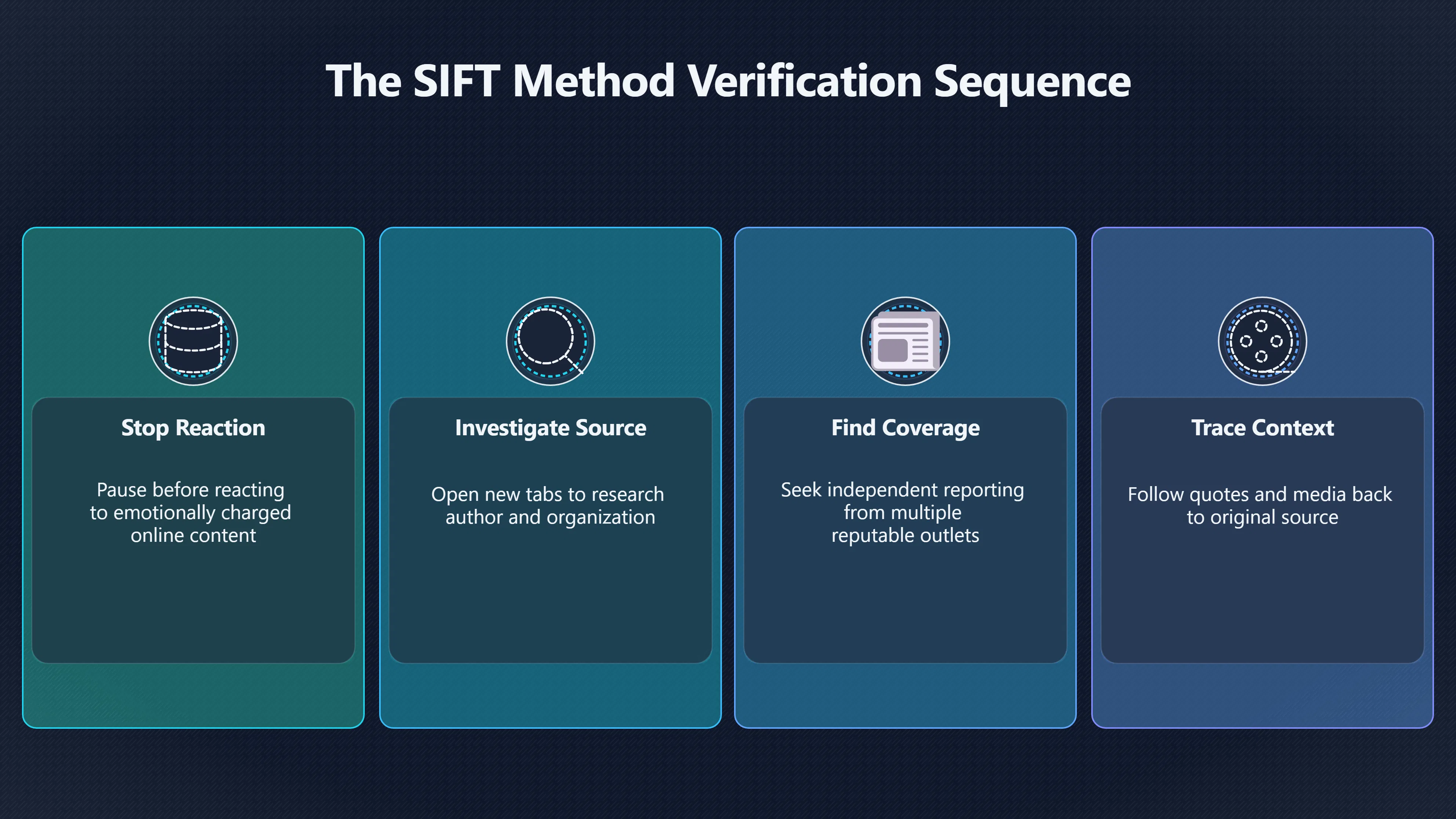
SIFT gives readers a simple sequence for pausing, checking the source, finding better coverage and tracing evidence.
On this page
- Stop before the emotional reaction
- Investigate, find coverage and trace evidence
- Choosing a confidence level before sharing
Page outline Jump by section
Introduction
SIFT is a practical framework that turns lateral reading from a good idea into a repeatable habit. Developed by digital literacy researcher Mike Caulfield, the method gives readers four simple moves—Stop, Investigate the source, Find better coverage, and Trace claims to their original context. Rather than asking people to become expert investigators, SIFT provides a short routine that can be used in seconds when encountering a social media post, news story, AI-generated answer, meme, screenshot or viral claim.[Hapgood]hapgood.usSIFT (The Four MovesSIFT (The Four Moves) - HapgoodJun 19, 2019 — We call the “things to do” moves and there are four of them: The four moves: Stop, I…
 Its value lies in structure. Many people know they should “check sources”, but in fast-moving online environments they often lack a clear process. SIFT supplies that process. Each move encourages readers to leave the original page, gather context from elsewhere and make a more informed judgement before believing, sharing or acting on information.[libguides.mnsu.edu]libguides.mnsu.eduSource Evaluation: Using Lateral Reading & SIFT26 Mar 2026 — This guide provides information to help you use lateral reading and the SIFT…
A Four-Move Check Before You Share
SIFT works because it converts the broad principle of lateral reading into a sequence of actions. Instead of asking whether a post feels trustworthy, readers ask a series of focused questions.
The four moves are:[hapgood.us]hapgood.usSIFT (The Four MovesSIFT (The Four Moves) - HapgoodJun 19, 2019 — We call the “things to do” moves and there are four of them: The four moves: Stop, I…
- Stop[2. Investigate the source]hapgood.usSIFT (The Four MovesSIFT (The Four Moves) - HapgoodJun 19, 2019 — We call the “things to do” moves and there are four of them: The four moves: Stop, I…[3. Find better coverage]3. Find better coverageEvaluating Resources and MisinformationJun 30, 2025 — The SIFT Method · S - Stop · I - Investigate the Source · F - Find Better Coverage

- Trace claims, quotes and media to the original context guides.lib.uchicago.edu+2Hapgood
Importantly, the framework is not intended as a rigid checklist. Users may apply only one or two moves depending on the situation. The goal is to create a habit of verification before engagement rather than after misinformation has already spread. lib.iastate.edu
Stop Before the Emotional Reaction
The first move appears simple, but it addresses one of the main drivers of misinformation sharing: impulsive response.
Online content is often designed to provoke anger, excitement, fear or outrage. Emotional reactions encourage quick clicks and rapid sharing. SIFT begins by interrupting that cycle. Before reading deeply, liking, reposting or arguing, the reader pauses and asks whether they already know the source and whether the claim deserves immediate trust. Open Oregon+2eCampus Ontario
This step matters because many online mistakes occur before any fact-checking happens. A dramatic headline, a convincing image or an AI-generated summary can create an impression of credibility within seconds. The “Stop” move creates a moment for reflection. Rather than deciding whether information is true or false straight away, the reader decides whether further checking is needed. Information Literacy Toolkit+2Enterprise Open Systems (EOS)
In practice, this move shifts the question from “Do I agree with this?” to “Do I know enough to trust this yet?”
Investigate, Find Coverage and Trace Evidence
Investigate the source
[The second move puts lateral reading into action.](#endnote-11 “
Source snippet
Reading and the SIFT Method - Fake News & Digital...7 days ago — Lateral reading involves leaving the website, opening a new tab, and se...")...
Instead of carefully studying the page itself, readers leave it and search for information about the author, organisation or publication. Professional fact-checkers routinely open new tabs to see what independent sources say about a website before spending time on its content. Research comparing fact-checkers, historians and students found that fact-checkers were both faster and more accurate because they checked sources across the web rather than evaluating a site solely from its appearance. SSRN+2digitalgreensboro.org
For example, a site may have a professional design, impressive credentials and authoritative language. A quick search might reveal that it is an advocacy group, a satirical publication, a commercial operation or an organisation with a specific agenda. That external context often tells readers more than the website’s self-description. Open Oregon
Find better coverage
The third move recognises that the original source may not be the best source.
When a social media post makes a factual claim, readers do not have to remain attached to the post itself. Instead, they can search for independent reporting, expert analysis or multiple reputable accounts covering the same issue. The goal is to see whether trustworthy sources confirm, contradict or complicate the claim. Wayne State University Library Guides+2Open Oregon
This is particularly useful with viral content. A meme, screenshot or short video clip may offer very little context. Rather than debating the post, a SIFT user searches for broader coverage and evaluates the issue through stronger sources. In effect, they “trade up” from a weak source to a stronger one. Open Oregon
Trace claims and media to the original context
The fourth move addresses a common online problem: information detached from its source.
Quotes are shortened. Statistics lose their methodology. Images are reposted without dates. Videos circulate without showing what happened before or after the clip. Tracing information back to its original context helps readers determine whether it has been accurately represented. guides.lib.uchicago.edu+2Information Literacy Toolkit
For example, a striking statistic should ideally be connected to the study or dataset that produced it. A viral quotation should be checked against the original speech, interview or document. A photograph should be traced to its first publication and date. This move often reveals omissions, misinterpretations or selective framing that are invisible in the reposted version. Graduate Institute LibGuides
Why SIFT Works as a Habit Rather Than a Checklist
Many traditional source-evaluation methods ask readers to inspect a page for signs of authority, accuracy or professionalism. While useful in some contexts, such approaches can be slow and vulnerable to manipulation. Modern websites can easily imitate the appearance of credibility. lib.iastate.edu+2Wiley Online Library
SIFT takes a different approach. It focuses on behaviour rather than page features. The reader is encouraged to move away from the source, seek independent information and compare perspectives. Because the process is short and memorable, it is easier to apply in everyday situations than a lengthy evaluation framework. Hapgood+2library.nwacc.edu
This behavioural focus also makes SIFT relevant to AI-generated content. An AI system may produce fluent answers that sound authoritative while containing errors, outdated information or fabricated citations. The same four moves apply: stop before accepting the answer, investigate cited sources, find independent coverage and trace claims back to original evidence. lib.iastate.edu
Choosing a Confidence Level Before Sharing
One of the most useful outcomes of SIFT is that it replaces the demand for certainty with a more realistic question: how confident should I be?
Online information rarely falls neatly into categories of completely true or completely false. After using SIFT, a reader may conclude that:
- The claim is strongly supported by multiple reliable sources.
- The evidence is mixed or incomplete.
- The claim cannot be verified with available information.
- The claim appears misleading or unsupported.
This graduated judgement is often more valuable than a simple yes-or-no verdict. It encourages proportional trust and discourages overconfidence. Boosting
Research on digital literacy suggests that even relatively brief instruction in source-checking strategies can improve people’s ability to recognise questionable online information. The strength of SIFT is that it packages those strategies into a routine simple enough to use during everyday browsing rather than only during formal fact-checking exercises. Stanford Education
By giving lateral reading a memorable sequence of actions, SIFT helps transform critical thinking from an occasional effort into a practical habit that can be applied before every share, repost or confident belief. Hapgood+2library.nwacc.edu

eBay marketplace picks
Marketplace Samples
Example marketplace items related to this page. Use the search link to explore similar finds on eBay.



Endnotes
1.
Source: hapgood.us
Title: SIFT (The Four Moves)
Link:https://hapgood.us/2019/06/19/sift-the-four-moves/
Source snippet
SIFT (The Four Moves) - HapgoodJun 19, 2019 — We call the “things to do” moves and there are four of them: The four moves: Stop, I...
2.
Source: libguides.mnsu.edu
Link:https://libguides.mnsu.edu/sourcecredibility/lateralreading
Source snippet
Source Evaluation: Using Lateral Reading & SIFT26 Mar 2026 — This guide provides information to help you use lateral reading and the SIFT...
4.
Source: lib.iastate.edu
Link:https://www.lib.iastate.edu/news/sift-savvy-how-evaluate-information-pro
Source snippet
SIFT Savvy: How to evaluate information like a pro6 Dec 2024 — Lateral reading uses sites like Wikipedia, Google, and Snopes to verify th...
5.
Source: library.nwacc.edu
Link:https://library.nwacc.edu/lateralreading/sift
Source snippet
LibGuides: Lateral Reading: SIFT It9 Mar 2026 — Lateral reading is a key piece of the SIFT method developed by Mike Caulfield. Originally...
6.
Source: papers.ssrn.com
Link:https://papers.ssrn.com/sol3/papers.cfm?abstract_id=3048994
Source snippet
Reading Less and Learning More When Evaluating Digital...by S Wineburg · 2019 · Cited by 79 — They read vertically, staying within a...
7.
Source: digitalgreensboro.org
Link:https://www.digitalgreensboro.org/record/3817/files/facultystaff_4436_PDF.pdf
Source snippet
GICOIL Lateral ReadingFact-checkers were the most effective and the most efficient group when it came to online source evaluation. Why? B...
8.
Source: onlinelibrary.wiley.com
Link:https://onlinelibrary.wiley.com/doi/10.1002/tl.20608
Source snippet
Wiley Online LibraryCut the CRAAP: Replacing vertical evaluation with lateral...8 Jul 2024 — The Stanford History Education Group (SHEG)...
9.
Source: guides.lib.wayne.edu
Link:https://guides.lib.wayne.edu/sift/find
Source snippet
Sometimes, after you investigate the source, you'll find that the source is sufficient for your needs.Read more...
10.
Source: ed.stanford.edu
Title: it doesn t take long learn how spot misinformation online stanford study finds
Link:https://ed.stanford.edu/news/it-doesn-t-take-long-learn-how-spot-misinformation-online-stanford-study-finds
Source snippet
Stanford EducationIt doesn't take long to learn how to spot misinformation online...19 Apr 2022 — Research from the Stanford History Edu...
11.
Source: centralmethodist.libguides.com
Title: lateral reading and sift
Link:https://centralmethodist.libguides.com/fake_news/lateral_reading_and_sift
Source snippet
Reading and the SIFT Method - Fake News & Digital...7 days ago — Lateral reading involves leaving the website, opening a new tab, and se...
12.
Source: uscupstate.libguides.com
Link:https://uscupstate.libguides.com/LateralReading/sift
Source snippet
"SIFT" in research stands for "Stop, Investigate, Find, Trace" and is a method developed by digital literacy...Read more...
13.
Source: catawba.libguides.com
Link:https://catawba.libguides.com/c.php?g=1174610&p=8582457
Source snippet
Stop · Investigate the Source · Find Better Coverage · Trace Claims, Quotes, and Media Back to Their Original Context · Resources...Read...
14.
Source: openoregon.pressbooks.pub
Title: Open Oregon The SIFT Method –
Link:https://openoregon.pressbooks.pub/findinginfo/chapter/four-moves/
Source snippet
source is worthy of your attention: SIFT: Stop. Investigate the source. Find better coverage. Trace claims, quotes. Stop. Just a reminder...
15.
Source: ecampusontario.pressbooks.pub
Title: e Campus Ontario Lateral Reading – Western Libraries Tutorials SIFT
Link:https://ecampusontario.pressbooks.pub/westernlibrariestutorials/chapter/lateral-reading/
Source snippet
Mike Caulfield (Washington State University) developed the Four Moves or SIFT to support lateral reading evaluation. STOP: stop and take...
16.
Source: werkzeugkasten-ik.ch
Title: Information Literacy Toolkit The SIFT Method
Link:https://www.werkzeugkasten-ik.ch/en/2025/08/21/the-sift-method/
Source snippet
Before you read or share a source, pause. · Investigate the Source. Research the origin of the content. · Find Better Coverage · Trace Cl...
17.
Source: eosgmbh.com
Title: the sift method
Link:https://eosgmbh.com/en/the-sift-method/
Source snippet
Enterprise Open Systems (EOS)The SIFT methodMar 11, 2025 — It consists of four steps: Stop, Investigate, Find better coverage, Trace clai...
18.
Source: libguides.graduateinstitute.ch
Title: Graduate Institute Lib Guides Fact-Checking with SIFT
Link:https://libguides.graduateinstitute.ch/how_to_search/sift
Source snippet
Read laterally. Once you get to the source of a claim, read...Read more...
19.
Source: scienceofboosting.org
Title: Boosting Lateral Reading
Link:https://www.scienceofboosting.org/project/lateral-reading/
Source snippet
BoostingLateral Reading - Boosting4 May 2023 — Lateral reading is a simple heuristic for online fact-checking: Open multiple tabs in your...
Published: May 2023
20.
Source: libguides.ucmerced.edu
Title: sift method
Link:https://libguides.ucmerced.edu/news/evaluation/sift-method
Source snippet
Both can be used. In fact, "Stop, Investigate, Find Better Coverage, and Trace Claims (SIFT)...Read more...
21.
Source: pressbooks.pub
Link:https://pressbooks.pub/webliteracy/chapter/four-strategies/
Source snippet
They are associated with specific tactics. Here are the four moves this guide will hinge on.Read more...
22.
Source: pressbooks.pub
Title: students and disinformation
Link:https://pressbooks.pub/introtocollegeresearch/chapter/students-and-disinformation/
Source snippet
Web Evaluation Skills: A “Bleak” Track RecordIn 2017, the Stanford History Education Group conducted a study, “Lateral Reading: Reading L...
Additional References
23.
Source: researchgate.net
Link:https://www.researchgate.net/publication/320657723_Lateral_Reading_Reading_Less_and_Learning_More_When_Evaluating_Digital_Information
Source snippet
Reading Less and Learning More When Evaluating Digital...SIFT was influenced by Wineburg and McGrew's (2017) study, which found that pro...
24.
Source: openmindsfoundation.org
Link:https://www.openmindsfoundation.org/blog/the-power-of-lateral-reading/
Source snippet
The power of lateral readingIt enables a single source to gain more credibility than it potentially merits, and does not encourage the re...
25.
Source: youtube.com
Link:https://www.youtube.com/watch?v=SHNprb2hgzU
Source snippet
Sort Fact from Fiction Online with Lateral ReadingShe explains the right approach at first but gives far too much credit to a method (lat...
26.
Source: guides.lib.byu.edu
Link:https://guides.lib.byu.edu/c.php?g=216428&p=10146879
Source snippet
Management: Source Evaluation (SIFT)May 6, 2026 — The SIFT method helps analyze information, especially news or other online media...
Published: May 6, 2026
27.
Source: projectcora.org
Title: sift pick fact checking source evaluation
Link:https://projectcora.org/assignment/sift-pick-fact-checking-source-evaluation
Source snippet
SIFT & PICK Fact Checking & Source Evaluation14 Apr 2023 — The SIFT & PICK approach to evaluating sources adapts and builds on Mike Caulf...
28.
Source: libguides.csun.edu
Title: reading laterally fact checking
Link:https://libguides.csun.edu/coms-research/reading-laterally-fact-checking
Source snippet
Studies: Reading Laterally for Fact Checking18 May 2026 — The University Library's Reading Laterally for Fact Checking page offers in-dep...
Published: May 2026
29.
Source: mediahelpingmedia.org
Title: sift for fact checking
Link:https://mediahelpingmedia.org/basics/sift-for-fact-checking/
Source snippet
SIFT for fact-checking30 Mar 2025 — SIFT teaches students how to critically evaluate information online through four steps: Stop, Investi...
30.
Source: smu.ca
Link:https://www.smu.ca/webfiles/SIFT_Method_final.pdf
Source snippet
“SIFT”: A Method for Evaluating Information SourcesFor more information, watch this YouTube video by Mike Caulfied, the creator of SIFT...
31.
Source: youtube.com
Link:https://www.youtube.com/channel/UCISUBBsZSMpUGO8OcqAvGhA
Source snippet
mike.mike. (born Michael Francis Seander) is an American platinum recording artist. His musical journey started in 2012 recovering from s...
32.
Source: facebook.com
Link:https://www.facebook.com/itsjustmikenow/
Source snippet
s and info at mikeontour.com.Read more...
Topic Tree