Within Lateral Reading
Who Actually Made This Claim?
A viral post is often only the last stop in a longer source trail, and finding the origin can change how much trust it deserves.
On this page
- Shared post versus original source
- Account signals that mislead readers
- Quick searches that reveal origin and ownership
Page outline Jump by section
Introduction
When a claim goes viral, the post in your feed is often the last link in a much longer chain. A statistic may have started in a research paper, passed through a news article, been summarised by a blog, turned into a screenshot, reposted on several platforms, and finally reached you stripped of context. Finding the original source is one of the most useful habits in lateral reading because trust often changes when you discover who actually made the claim, when it was made, and what was left out along the way. Professional fact-checkers routinely leave the shared post behind and trace claims back to their origin rather than evaluating only the version that happens to be circulating.[Inquiry Group]cor.inquirygroup.orgInquiry GroupTeaching Lateral Reading | CORBy observing fact checkers, we found that the best way to learn about a website is lateral rea…
 The goal is not to prove a claim true or false immediately. The goal is to answer a simpler question first: who actually made this claim?
Shared Post Versus Original Source
A viral post is rarely the source. It is usually a container.
Consider a common chain:
- A government agency releases a report.
- A journalist writes a story about the report.
- A commentator highlights one finding.
- A social media account screenshots the commentary.
- Thousands of users share the screenshot.
By the time most people encounter the claim, they are several steps removed from the original evidence.
This is why the “T” in the SIFT framework—Trace claims, quotes, and media to the original source—is so important. Instead of evaluating the repost, you work backwards toward the earliest identifiable version.[wisconsin.pressbooks.pub]pressbooks.pubEvaluating Sources – Information Literacy: A Practical Guide SIFT stands for: StopInvestigate the source with lateral reading. Find trusted coverage. Trace claims, quotes, and media to the original source. We'll
When tracing a claim, ask:
- Is this a direct statement or a summary of someone else’s statement?
- Is there a linked article behind the post?
- Does the article cite a report, study, speech, court filing, interview, or dataset?
- Can I find that original document?
Often the original source contains qualifications that disappeared during sharing. A study may discuss a limited sample, a politician’s quote may be clipped from a longer answer, or a photograph may have been taken years earlier than the viral caption suggests. Reuters fact-check investigations frequently find that old images, videos, and statements are recirculated with new descriptions that change their meaning.[Reuters]reuters.comReuters Fact CheckReuters Fact Check addresses online misinformation with coverage that maintains accuracy, integrity and impartia…
Account Signals That Mislead Readers
Many people try to judge a claim by judging the account that shared it. While account information can be useful, it is easy to overvalue.
A large follower count does not establish expertise. Verification badges, professional graphics, emotional certainty, and confident language can create an impression of authority without proving anything about the underlying claim. Research on lateral reading found that less experienced readers often spend time examining the appearance of a source, while professional fact-checkers move quickly to independent verification.[SSRN]papers.ssrn.comReading Less and Learning More When Evaluating Digital…by S Wineburg · 2019 · Cited by 79 — In contrast, fact checkers read latera…
Several account signals deserve caution:
Reposted screenshots
A screenshot removes context. The original post may have been edited, deleted, satirical, or fabricated entirely. Screenshots are especially difficult because they often prevent readers from checking timestamps, replies, or account history. Researchers studying misattributed social media posts note that screenshots make it easier for false attributions to spread.[arXiv]arxiv.orgDid They Really Tweet That? Querying Fact-Checking Sites and Politwoops to Determine Tweet MisattributionNovember 17, 2022…
Aggregator accounts
Many viral accounts specialise in collecting material from elsewhere. They may be useful distributors, but they are rarely primary sources. If an account repeatedly posts “breaking” information without showing where it originated, treat it as a relay station rather than an authority.
Anonymous or newly created accounts
An anonymous source is not automatically wrong, but anonymity removes a layer of accountability. When a major claim depends entirely on a source whose identity cannot be verified, the need to find independent confirmation becomes much greater.
The key question remains the same: even if this account shared the claim, where did the information come from originally?
Quick Searches That Reveal Origin and Ownership
Finding the original source is often faster than people expect.
Search the exact wording
If a claim includes a distinctive sentence, statistic, or quotation, place a unique phrase inside quotation marks in a search engine.
This can reveal:
- Earlier versions of the claim
- News coverage discussing it[reuters.com]reuters.comReuters Fact CheckReuters Fact Check addresses online misinformation with coverage that maintains accuracy, integrity and impartia…
- Fact-checks
- Original publications
If many results repeat the same wording but all trace back to one article, you may have found the source.
Search the person or organisation behind the claim
If a report is attributed to an institute, foundation, expert, or research group, open a new tab and investigate that entity separately.
Professional fact-checkers frequently use this lateral-reading approach because it quickly reveals whether an organisation is widely recognised, newly created, politically affiliated, commercially motivated, or frequently criticised for inaccuracies.[Inquiry Group]cor.inquirygroup.orgInquiry GroupTeaching Lateral Reading | CORBy observing fact checkers, we found that the best way to learn about a website is lateral rea…
Follow citations backward
If an article says “according to a study”, do not stop there.
Look for:
- The study itself
- The journal or publisher
- The data source
- The methodology
A surprising number of viral claims collapse during this step because the cited source says something narrower than the social media summary suggests. Fact-checking guides consistently recommend opening the original study, transcript, dataset, or document whenever possible.[Model Diplomat]modeldiplomat.comModel DiplomatFact-Checking MethodologyImage? Reverse image search (see below). Triangulate. No single source is enough. Two or three ind…
When the Claim Is a Photo or Video
Visual content often travels farther from its source than text.
A dramatic image may be reshared thousands of times with different captions. A video from one country may be relabelled as an event in another. In many misinformation cases, the visual itself is real but the accompanying description is false. Reuters fact-checks regularly document examples where genuine images or videos are attached to incorrect narratives.[Reuters]reuters.comReuters Fact CheckReuters Fact Check addresses online misinformation with coverage that maintains accuracy, integrity and impartia…
To trace visual content:
- Use reverse image search tools.[modeldiplomat.com]modeldiplomat.comModel DiplomatFact-Checking MethodologyImage? Reverse image search (see below). Triangulate. No single source is enough. Two or three ind…
- Search key frames from videos.
- Look for earlier appearances of the same media.
- Compare dates, locations, and captions across versions.
Reverse image searches can often reveal that a supposedly current image first appeared years earlier. Fact-checkers and digital investigators rely heavily on this technique when verifying visual claims.[blog.google+2Pic Detective]blog.google3 new ways to check images and sources onlineFact Check Explorer gives journalists and fact checkers a deeper way to learn about an image or topic.Read more…
One useful mindset is to separate two questions:
- Is the image authentic?
- Is the caption accurate?
Many viral posts fail on the second question even when the image itself is genuine.
Ownership Matters More Than Popularity
A claim’s popularity tells you almost nothing about its origin.
Thousands of shares can be generated by repetition, recommendation algorithms, emotional reactions, or coordinated amplification. What matters more is ownership: who produced the information in the first place?
When you locate the original source, you can evaluate things that are invisible in a repost:
- Expertise and credentials
- Evidence provided
- Funding or affiliations
- Publication date
- Corrections or updates
- Scope and limitations
This shift—from asking “How many people shared this?” to “Who first made this claim?”—is one of the most valuable habits in critical thinking online.
A Practical Three-Minute Source Trail
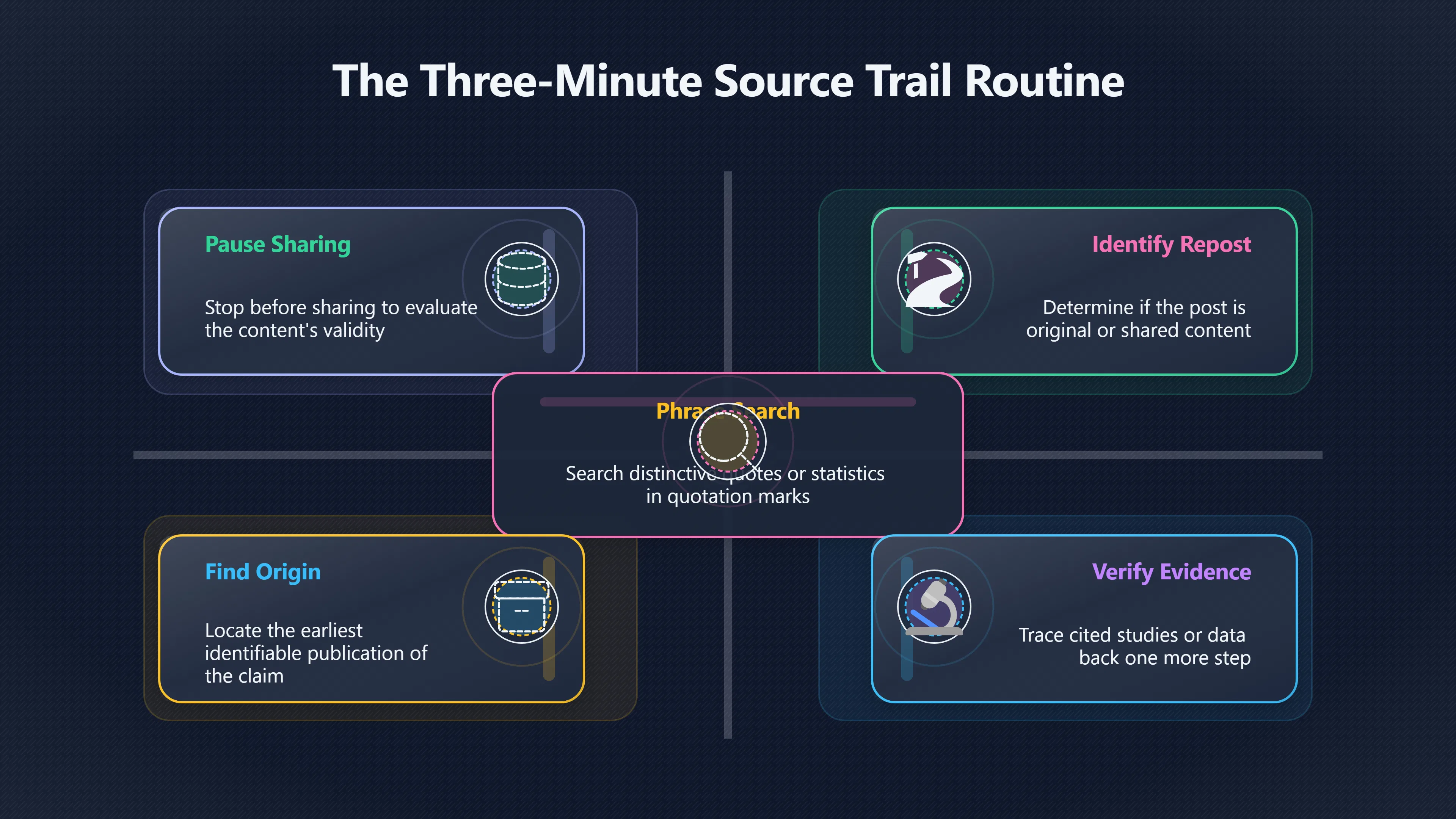
For most viral claims, a quick source-tracing routine looks like this:
- Stop before sharing.
- Identify whether the post is original or reposted.
- Search a distinctive phrase, quote, or statistic.
- Find the earliest identifiable publication.
- Trace any cited evidence back another step if necessary.
- Check whether reputable reporting or fact-checking organisations describe the same source and context. wisconsin.pressbooks.pub+2Poynter Institute
You do not need to become an investigator to benefit from lateral reading. Often a few targeted searches are enough to reveal that a viral post is not the source at all—and that the real source tells a different story.
Amazon book picks
Further Reading
Books and field guides related to Who Actually Made This Claim?. Use these as the next step if you want deeper reading beyond the article.
The Skeptics' Guide to the Universe
Helps readers evaluate claims before accepting them.

News and How to Use It
Explains how information moves from sources to public audiences.
eBay marketplace picks
Marketplace Samples
Example marketplace items related to this page. Use the search link to explore similar finds on eBay.
Endnotes
1.
Source: papers.ssrn.com
Link:https://papers.ssrn.com/sol3/papers.cfm?abstract_id=3048994
Source snippet
Reading Less and Learning More When Evaluating Digital...by S Wineburg · 2019 · Cited by 79 — In contrast, fact checkers read latera...
3.
Source: reuters.com
Link:https://www.reuters.com/fact-check/
Source snippet
Reuters Fact CheckReuters Fact Check addresses online misinformation with coverage that maintains accuracy, integrity and impartia...
4.
Source: reuters.com
Link:https://www.reuters.com/fact-check/transgender-woman-misidentified-trump-shooter-2024-07-24/
Source snippet
The misinformation originated from an anonymous post on 4chan, an online message board, which claimed the shooter was transgender. This c...
5.
Source: arxiv.org
Link:https://arxiv.org/abs/2211.09681
Source snippet
Did They Really Tweet That? Querying Fact-Checking Sites and Politwoops to Determine Tweet MisattributionNovember 17, 2022...
Published: November 17, 2022
6.
Source: blog.google
Title: 3 new ways to check images and sources online
Link:https://blog.google/products-and-platforms/products/search/google-search-new-fact-checking-features/
Source snippet
Fact Check Explorer gives journalists and fact checkers a deeper way to learn about an image or topic.Read more...
7.
Source: poynter.org
Title: lateral reading the best media literacy tip to vet credible sources
Link:https://www.poynter.org/fact-checking/media-literacy/2023/lateral-reading-the-best-media-literacy-tip-to-vet-credible-sources/
Source snippet
Poynter InstituteLateral reading: The best media literacy tip to vet credible...20 Jul 2023 — We teach people digital media literacy and...
8.
Source: toolbox.google.com
Link:https://toolbox.google.com/factcheck/about
Source snippet
Google ToolboxAbout Fact Check ToolsThis tool allows you to easily browse and search for fact checks. For example, you can search for a p...
9.
Source: pressbooks.pub
Title: students and disinformation
Link:https://pressbooks.pub/introtocollegeresearch/chapter/students-and-disinformation/
Source snippet
Web Evaluation Skills: A “Bleak” Track RecordHow are we doing when it comes to recognizing disinformation and navigating the information...
10.
Source: cor.inquirygroup.org
Link:https://cor.inquirygroup.org/curriculum/collections/teaching-lateral-reading/
Source snippet
Inquiry GroupTeaching Lateral Reading | CORBy observing fact checkers, we found that the best way to learn about a website is lateral rea...
11.
Source: modeldiplomat.com
Link:https://modeldiplomat.com/learn/media/resources/fact-checking/complete-fact-checking-guide
Source snippet
Model DiplomatFact-Checking MethodologyImage? Reverse image search (see below). Triangulate. No single source is enough. Two or three ind...
12.
Source: picdetective.com
Link:https://picdetective.com/blog/reverse-image-search-identify-fake-news-misinformation
Source snippet
Pic DetectiveSpot Fake News and Misinformation with Reverse Image...23 Jan 2026 — Reverse image search verifies whether an image is auth...
13.
Source: libguides.milton.edu
Title: lateral reading
Link:https://libguides.milton.edu/lateral-reading
Source snippet
milton.eduLIB: Source Evaluation: Lateral Reading - Resource Guides5 Mar 2026 — A recent study from the Stanford History Education Group...
14.
Source: x.com
Link:https://x.com/ReutersFacts
15.
Source: libguides.chowan.edu
Link:https://libguides.chowan.edu/evaluate
Source snippet
Whitaker Library18 Sept 2024 — A lot of the SIFT strategies use a concept called lateral reading. That is doing an internet search to see...
16.
Source: scienceofboosting.org
Title: Lateral Reading
Link:https://www.scienceofboosting.org/project/lateral-reading/
Source snippet
Boosting4 May 2023 — This short video from the Stanford History Education Group explains how to use lateral reading and outlines the rese...
Published: May 2023
17.
Source: libguides.cmich.edu
Link:https://libguides.cmich.edu/web_research/lateral
Source snippet
Research: Lateral Reading and SIFT12 Dec 2024 — SIFT stands for Stop; Investigate the source; Find better coverage; and Trace claims, quo...
18.
Source: libguides.clackamas.edu
Link:https://libguides.clackamas.edu/research-help/sift
Source snippet
Research help18 May 2026 — The final step is to Trace Claims, Quotes, and Media to their Original Context. When an article references a q...
Published: May 2026
Additional References
19.
Source: misinforeview.hks.harvard.edu
Link:https://misinforeview.hks.harvard.edu/article/lateral-reading-college-students-learn-to-critically-evaluate-internet-sources-in-an-online-course/
Source snippet
reading: College students learn to critically...23 Feb 2021 — A small body of research suggests that students in face-to-face settings c...
20.
Source: theverge.com
Link:https://www.theverge.com/tech/888303/photo-video-fake-news-verification-nyt-bellingway
Source snippet
Trusted digital investigators like The New York Times, Bellingcat, and Indicator rely on rigorous verification protocols to discern real...
21.
Source: youtube.com
Link:https://www.youtube.com/watch?v=SHNprb2hgzU
Source snippet
Sort Fact from Fiction Online with Lateral ReadingShe explains the right approach at first but gives far too much credit to a method (lat...
22.
Source: ed.stanford.edu
Link:https://ed.stanford.edu/news/it-doesn-t-take-long-learn-how-spot-misinformation-online-stanford-study-finds
Source snippet
doesn't take long to learn how to spot misinformation online...19 Apr 2022 — It doesn't take long to learn how to spot misinformation on...
23.
Source: researchgate.net
Link:https://www.researchgate.net/publication/349535570_Lateral_reading_College_students_learn_to_critically_evaluate_internet_sources_in_an_online_course
Source snippet
an improve at judging the credibility of online sources...
24.
Source: thecrashcourse.com
Title: Check Yourself with Lateral Reading
Link:https://thecrashcourse.com/courses/check-yourself-with-lateral-reading-crash-course-navigating-digital-information-3/
Source snippet
Crash CourseJohn Green is going to teach you how to read laterally, using multiple tabs in your browser to look stuff up and fact-check a...
25.
Source: libguides.csun.edu
Title: reading laterally fact checking
Link:https://libguides.csun.edu/journalism/reading-laterally-fact-checking
Source snippet
csun.eduJournalism: Reading Laterally for Fact Checking - LibGuides8 days ago — Video: Stanford History Education Group. This video provi...
26.
Source: wittenberg.libguides.com
Title: Wittenberg University Lib Guides Lateral Reading / SIFT Method
Link:https://wittenberg.libguides.com/c.php?g=1484462&p=11070234
Source snippet
Does the original source say the same things as the re-reporting you read first? Adapted...
27.
Source: instagram.com
Title: Old photos are recycled
Link:https://www.instagram.com/p/DXPD_msDSVk/
Source snippet
Context is twisted. Narratives are...But you can verify. This simple 6-step guide to Google Reverse Image Search helps you trace where a...
28.
Source: hapgood.us
Title: SIFT (The Four Moves)
Link:https://hapgood.us/2019/06/19/sift-the-four-moves/
Source snippet
19 Jun 2019 — We call the “things to do” moves and there are four of them: The four moves: Stop, Investigate the source, find bett...
Topic Tree