Within Screenshots
When Screenshots Borrow Official Authority
Screenshots can borrow institutional authority by making false claims look like official statements during fast-moving events.
On this page
- How impersonation changes perceived credibility
- Crisis settings where screenshots travel fastest
- Signals that separate official records from lookalikes
Page outline Jump by section
Introduction
During a crisis, screenshots that appear to come from government agencies, police forces, emergency services, health authorities or major news organisations can spread faster than official information itself. A single image showing an alleged warning, evacuation order, casualty update or public safety instruction may be reposted thousands of times before anyone checks whether the account behind it is genuine. The danger is not only that the information may be false. It is that the screenshot borrows the credibility of an institution and presents that credibility as evidence. Once viewers believe they are looking at an official statement, many lower their guard and stop asking where the claim originated. Research on misinformation and guidance from emergency-management agencies consistently identify impersonation and false attribution as recurring risks during disasters and fast-moving emergencies. Department of Homeland Security+2Government Communication Service[dhs.gov]dhs.gov. 17 Madhusree Mukerjee. “How Fake News Goes Viral…Read more…
 Within the broader problem of screenshots and reposts as weak evidence, impersonated authority accounts are a particularly important failure mode because they exploit trust in institutions at the exact moment people are seeking reliable guidance.
How Impersonation Changes Perceived Credibility
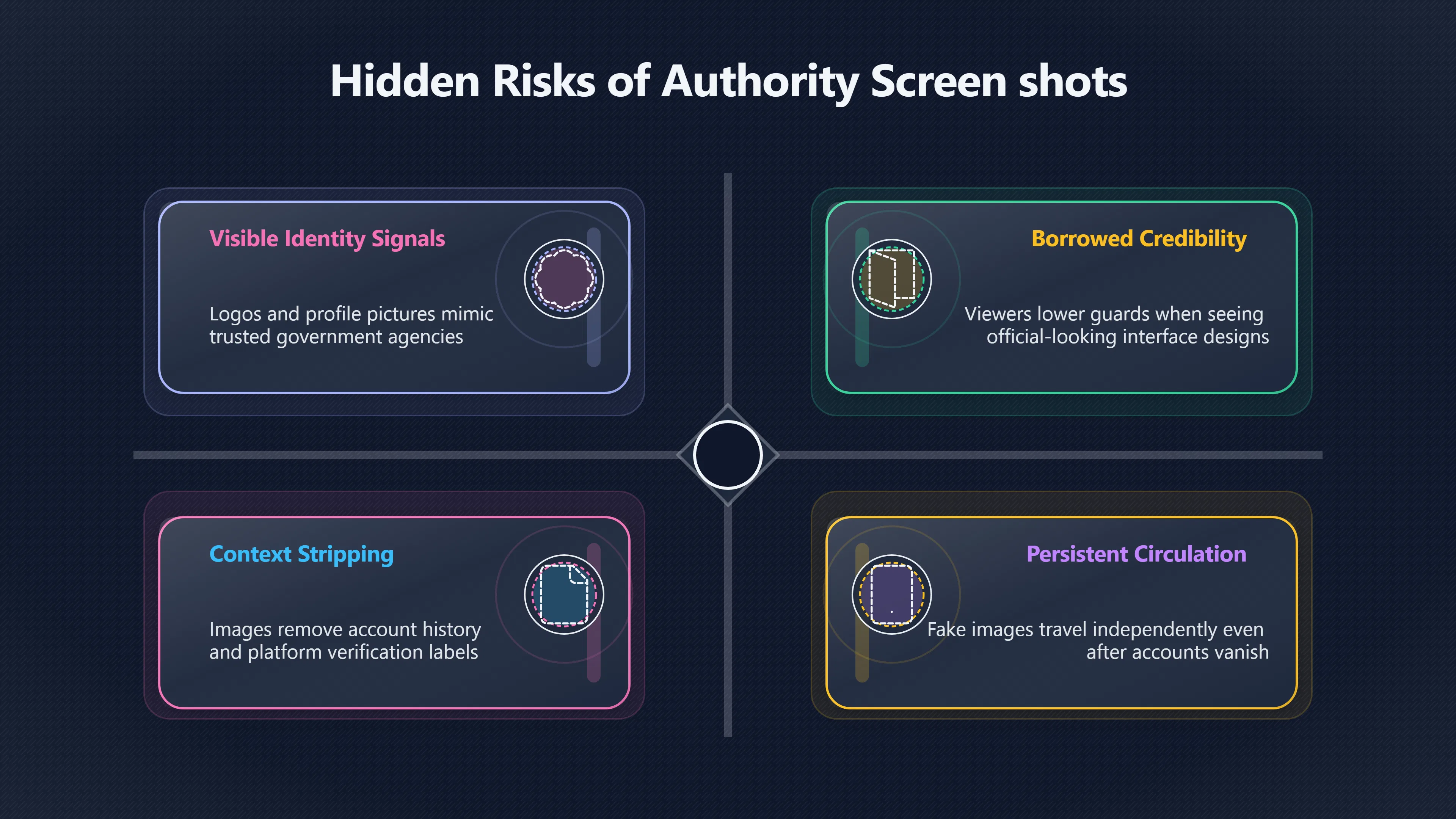
A screenshot does not merely display text. It also displays identity signals: a logo, account name, profile picture, interface design and apparent affiliation. When those signals resemble a trusted authority, viewers often treat the message as though the institution itself has authenticated it.
In crisis situations, this borrowed authority can be more persuasive than the content of the message. A claim that would seem doubtful if posted by an anonymous account may appear credible when shown beside a police crest, health-agency logo or emergency-management badge. The screenshot format amplifies this effect because viewers often cannot click through to inspect the account, examine its history or verify whether the post exists on the platform.[Poynter]poynter.orgwhy people still fall for fake screenshotsWhy people still fall for fake screenshots13 Feb 2020 — The surge of misinformation accompanying the coronavirus outbreak has incl…
Researchers studying online impersonation have documented how fake accounts mimic legitimate organisations through similar names, copied imagery and lookalike profiles. The goal is not always long-term deception. Sometimes a fake account only needs to appear authentic long enough for a screenshot to be captured and circulated. Once the image spreads independently, the original account can disappear while the screenshot continues travelling.[arXiv]arxiv.orgarXiv How Impersonators Exploit Instagram to Generate Fake Engagement?arXiv How Impersonators Exploit Instagram to Generate Fake Engagement?
This dynamic creates a psychological shortcut: people often evaluate the apparent source before evaluating the evidence. If the source looks official, the message inherits authority it may not deserve.
Crisis Settings Where Screenshots Travel Fastest
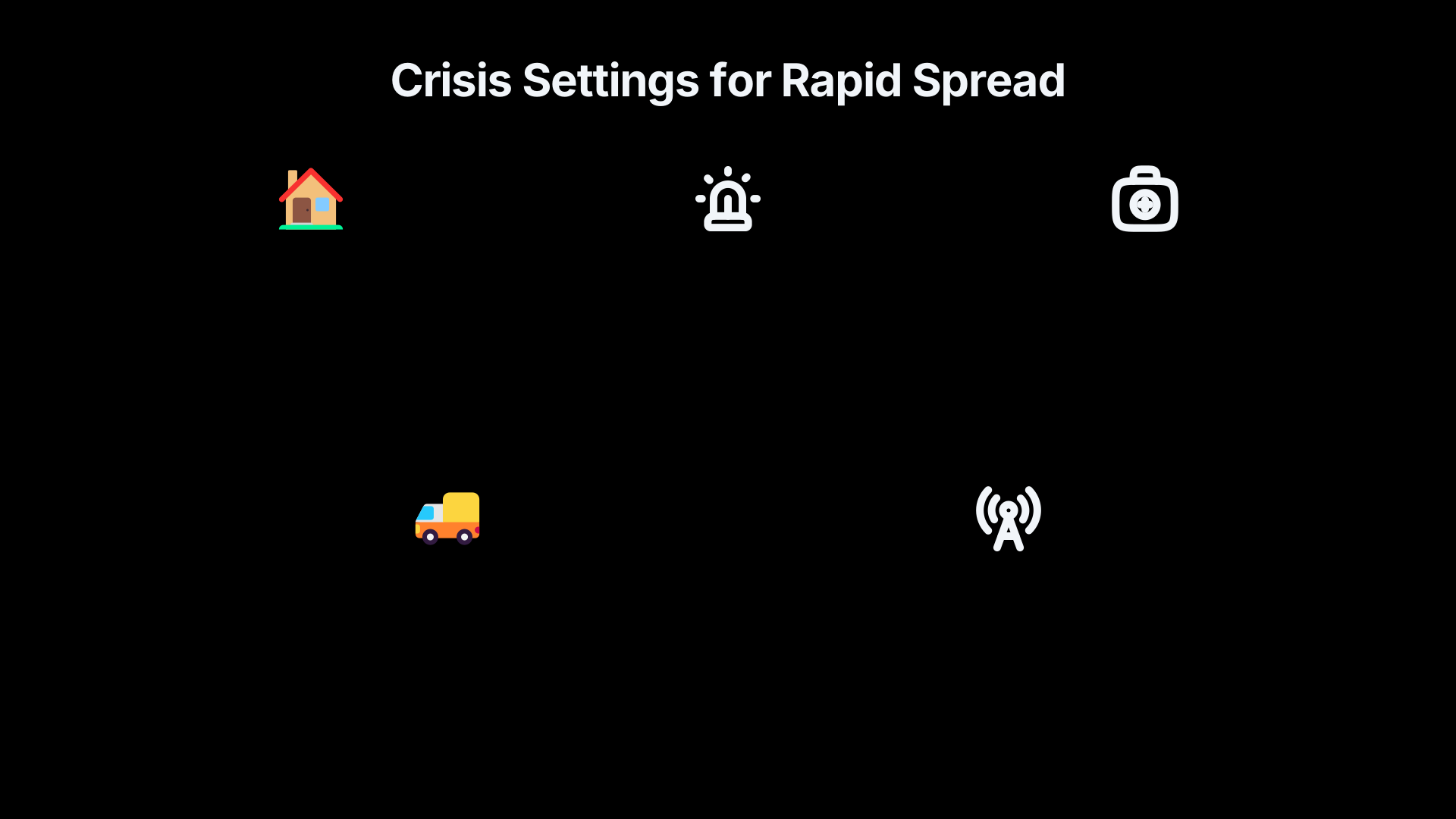
Emergency conditions create an environment in which impersonated authority screenshots are unusually effective.
Natural Disasters and Evacuations
Floods, hurricanes, wildfires and earthquakes generate urgent demand for information. Residents want to know whether roads are closed, shelters are open or evacuation orders have changed. Because official channels can become overloaded or difficult to access, screenshots of alleged agency statements frequently circulate through messaging apps and social platforms.
Emergency-management agencies have repeatedly warned that scammers and impersonators exploit disaster periods by presenting themselves as government representatives or aid providers. FEMA, for example, advises disaster victims to verify identities because fraudsters may falsely present themselves as connected to the agency.[FEMA]fema.govDisaster Fraud4 days ago — Beware of Fraud and Scams · FEMA Housing Inspectors · Fake Offers of Local or Federal Aid · Fraudulent Bui…
A fabricated screenshot claiming to be an emergency update can therefore exploit both urgency and institutional trust at the same time.
Public Safety Incidents
Terror attacks, shootings, civil unrest and major accidents often produce intense information vacuums. During the first hours of an incident, people search for police announcements, safety instructions and suspect descriptions.
Fact-checkers have repeatedly investigated fake notices, posters and social-media graphics falsely attributed to police departments and local authorities. One Reuters fact check addressed a fabricated image that appeared to show a police warning telling the public to avoid a town because of a supposed threat to life; the police force stated that the notice was not genuine.[Reuters]reuters.comReuters Fact CheckReuters Fact Check addresses online misinformation with coverage that maintains accuracy, integrity and impartia…
Because public safety warnings are expected to be shared quickly, users may repost such screenshots without verifying whether the issuing authority actually published them.
Health Emergencies
Disease outbreaks and public-health scares generate strong demand for guidance from health ministries, hospitals and international organisations. False screenshots attributed to health authorities can spread recommendations, restrictions or warnings that were never issued.
The early stages of disease outbreaks have repeatedly produced fake screenshots and fabricated statements claiming endorsement by health agencies or international bodies. Fact-checkers and media-literacy organisations have highlighted how screenshots mimicking official communications became part of broader misinformation waves.[Poynter]poynter.orgwhy people still fall for fake screenshotsWhy people still fall for fake screenshots13 Feb 2020 — The surge of misinformation accompanying the coronavirus outbreak has incl…
Why Screenshots Make Impersonation Harder to Detect
A live account leaves a trail. A screenshot often removes it.
When viewing an image rather than the original post, readers may lose access to:
- The account creation date.
- Verification indicators or platform labels.
- Previous posts and posting history.
- Corrections, deletions or follow-up statements.
- Community notes, warnings or fact-check labels.[x.com]x.comAP Fact Check (@APFactCheck) / Posts / XSocial media users this week shared: • Misinformation about FEMA's upcoming emergency alert test…
- Links to official websites or contact information.
The result is that the viewer sees the claimed authority but not the evidence supporting the authority claim.
This is particularly important because identity-based deception is a recognised category of information threat. Government communication guidance describes false attribution and fake accounts as forms of identity manipulation that make content appear to originate from trusted organisations or individuals when it does not.[Government Communication Service]communications.gov.ukernment Communication ServiceRESIST 3: Building resilience to information threats - GCS29 Oct 2025 — 'Facts not Fakes: Tackling Disinf…
In practical terms, a screenshot can freeze the moment before scrutiny occurs. Even if the platform later flags the account as fake or removes it entirely, the image may continue circulating detached from those corrective actions.
Signals That Separate Official Records From Lookalikes
No single clue proves authenticity, but several checks can significantly reduce the risk of being misled.
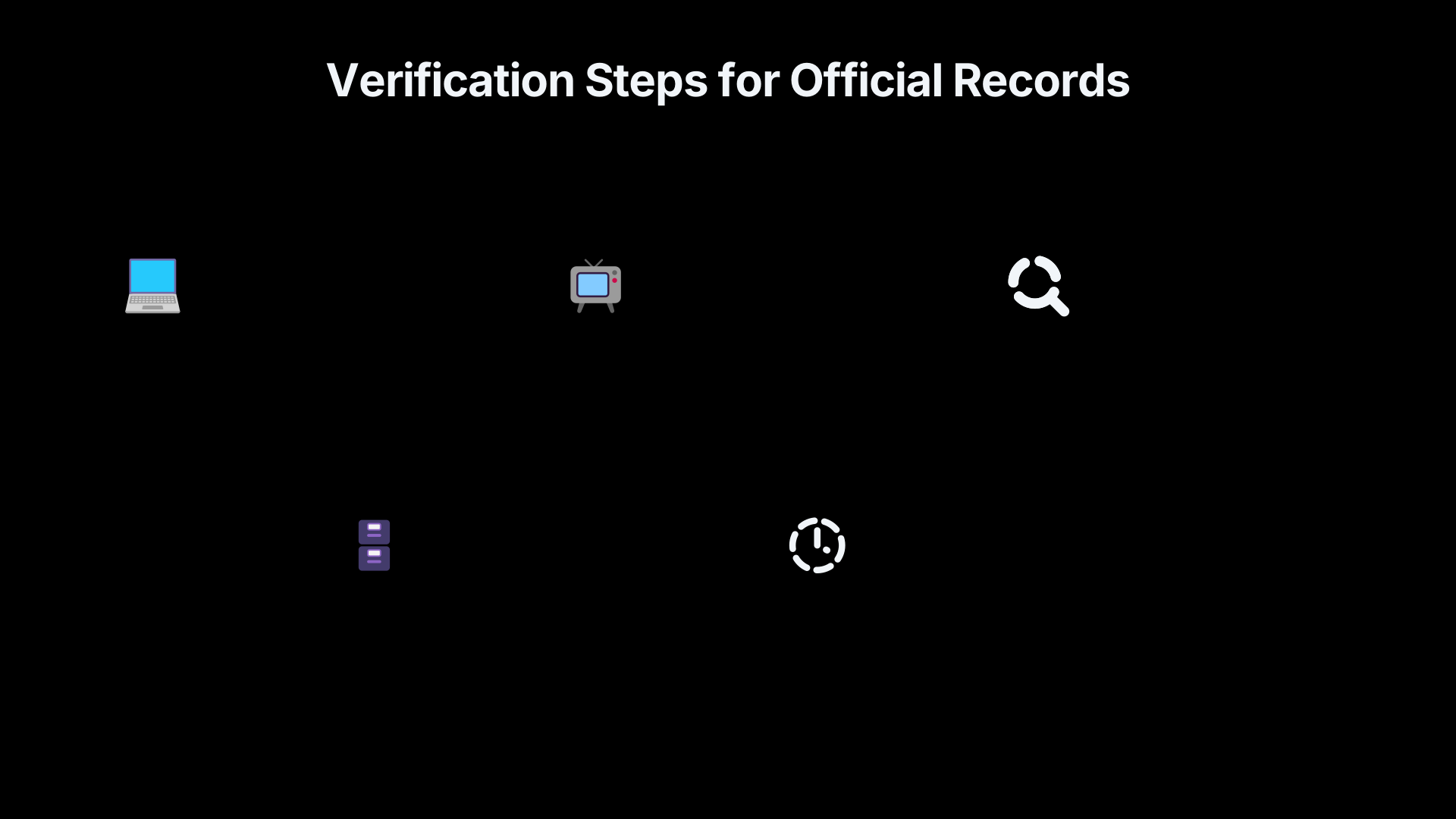
Look for a traceable original source. Genuine emergency announcements normally appear on an organisation’s official website, verified social-media account or established communication channel. If a screenshot cannot be matched to a live source, confidence should decrease.
Check whether multiple authoritative channels agree. Major emergency instructions are rarely confined to a single social-media post. Local authorities, emergency services, government websites and reputable news organisations often echo important announcements. A screenshot standing alone deserves extra scrutiny.[Department of Homeland Security]dhs.gov. 17 Madhusree Mukerjee. “How Fake News Goes Viral…Read more…
Examine account details carefully. Impersonators often use subtle alterations in names, handles or logos. A profile may resemble an official account while differing by one character, additional punctuation or a slightly altered username. Research on social-network impersonation shows that these visual similarities are a central tactic.[arXiv]arxiv.orgarXiv How Impersonators Exploit Instagram to Generate Fake Engagement?arXiv How Impersonators Exploit Instagram to Generate Fake Engagement?
Check the institution’s own channels. If a screenshot claims that police, emergency management officials or a health authority issued a major warning, the same message should generally be discoverable through the organisation’s public records or official communications.
Be cautious of emotional urgency. Messages that demand immediate sharing, claim that authorities are hiding information, or insist that viewers spread the screenshot before it is removed often rely on emotional pressure rather than verifiable evidence.
The Critical-Thinking Lesson
Impersonated authority screenshots exploit a simple vulnerability: people trust institutions, and screenshots can imitate institutional identity while stripping away the context needed for verification. During emergencies, when speed competes with accuracy, that combination becomes especially powerful.
The most useful habit is to treat a screenshot of an alleged official statement as a lead rather than a record. The key question is not whether the image looks authentic. It is whether the institution actually published the message. Until that connection can be verified through an original source, the apparent authority displayed in the screenshot should be treated as a claim requiring evidence rather than evidence itself. Government Communication Service+2Department of Homeland Security[communications.gov.uk]communications.gov.ukernment Communication ServiceRESIST 3: Building resilience to information threats - GCS29 Oct 2025 — 'Facts not Fakes: Tackling Disinf…
Amazon book picks
Further Reading
Books and field guides related to When Screenshots Borrow Official Authority. Use these as the next step if you want deeper reading beyond the article.
The Skeptics' Guide to the Universe
Offers practical tools for assessing authority claims.

eBay marketplace picks
Marketplace Samples
Example marketplace items related to this page. Use the search link to explore similar finds on eBay.


Endnotes
1.
Source: arxiv.org
Title: arXiv How Impersonators Exploit Instagram to Generate Fake Engagement?
Link:https://arxiv.org/abs/2002.07173
2.
Source: poynter.org
Title: why people still fall for fake screenshots
Link:https://www.poynter.org/fact-checking/2020/why-people-still-fall-for-fake-screenshots/
Source snippet
Why people still fall for fake screenshots13 Feb 2020 — The surge of misinformation accompanying the coronavirus outbreak has incl...
3.
Source: fema.gov
Link:https://www.fema.gov/assistance/individual/disaster-fraud
Source snippet
Disaster Fraud4 days ago — Beware of Fraud and Scams · FEMA Housing Inspectors · Fake Offers of Local or Federal Aid · Fraudulent Bui...
4.
Source: reuters.com
Link:https://www.reuters.com/fact-check/
Source snippet
Reuters Fact CheckReuters Fact Check addresses online misinformation with coverage that maintains accuracy, integrity and impartia...
5.
Source: fema.gov
Title: disaster fraud
Link:https://www.fema.gov/de/about/offices/security/disaster-fraud
Source snippet
Betrug bei Katastrophen16 Oct 2024 — Nach einer Katastrophe versuchen Betrüger, Identitätsdiebe und andere Kriminelle oft die Opfer einer...
6.
Source: dhs.gov
Link:https://www.dhs.gov/sites/default/files/publications/SMWG_Countering-False-Info-Social-Media-Disasters-Emergencies_Mar2018-508.pdf
Source snippet
<[https://www.merriam-webster.com/dictionary/misinformation](https://www.merriam-webster.com/dictionary/misinformation)>. 17 Madhusree Mukerjee. “How Fake News Goes Viral...Read more...
7.
Source: communications.gov.uk
Link:https://www.communications.gov.uk/publications/resist-3-building-resilience-to-information-threats/
Source snippet
ernment Communication ServiceRESIST 3: Building resilience to information threats - GCS29 Oct 2025 — 'Facts not Fakes: Tackling Disinf...
8.
Source: dictionary.cambridge.org
Link:https://dictionary.cambridge.org/dictionary/english/official
Source snippet
English meaning - Cambridge Dictionary4 days ago — used to describe something that has been announced publicly by someone in a position...
9.
Source: Wikipedia
Link:https://en.wikipedia.org/wiki/Official
Source snippet
OfficialAn official is someone who holds an office (function or mandate, regardless of whether it carries an actual working space with...
10.
Source: dhs.gov
Title: debunks false claims about federal emergency management
Link:https://www.dhs.gov/news/2025/08/29/dhs-debunks-false-claims-about-federal-emergency-management
Source snippet
Release Date: August 29, 2025. The media is laundering conspiracy theories...Read more...
Published: August 29, 2025
11.
Source: open.spotify.com
Link:https://open.spotify.com/artist/0ysBsu31ll9IGvNluyO8GV
Source snippet
OFFICIALListen to THE OFFICIAL on Spotify. Artist · 6.2K monthly listeners...
Additional References
12.
Source: x.com
Link:https://x.com/APFactCheck?lang=en
Source snippet
AP Fact Check (@APFactCheck) / Posts / XSocial media users this week shared: • Misinformation about FEMA's upcoming emergency alert test...
13.
Source: factcheck.org
Link:https://www.factcheck.org/fake-news/
Source snippet
Debunking Viral Claims ArchivesThese articles debunk misinformation shared on social media. We also provide resources for readers: an art...
14.
Source: merriam-webster.com
Link:https://www.merriam-webster.com/dictionary/official
Source snippet
OFFICIAL Definition & Meaning5 days ago — The meaning of OFFICIAL is one who holds or is invested with an office: officer. How to use of...
15.
Source: apnews.com
Link:https://apnews.com/ap-fact-check
Source snippet
AP Fact CheckVerify the latest news with AP Fact Check. AP fact checkers combat misinformation by debunking false and misleading claims...
16.
Source: collinsdictionary.com
Link:https://www.collinsdictionary.com/dictionary/english/official
Source snippet
According to the official figures, over one thousand people died during the revolution.Read more...
17.
Source: consumer.ftc.gov
Title: spot avoid fema impersonators
Link:https://consumer.ftc.gov/consumer-alerts/2025/07/spot-avoid-fema-impersonators
Source snippet
Consumer AdviceSpot and avoid FEMA impersonators14 Jul 2025 — FEMA staff and their contractors always wear an official badge with their n...
18.
Source: factcheck.org
Link:https://www.factcheck.org/hot-topics/
Source snippet
v. 18, 2016. More recently, we wrote about ways to debunk...Read more...
19.
Source: word.tips
Link:https://word.tips/spelling/official-vs-oficial/
Source snippet
al? The correct word is official. How to pronounce official?Read more...
20.
Source: instagram.com
Link:https://www.instagram.com/p/DZa5HEKk_L0/
Source snippet
Weekly Scam Alert: Hurricane Season Fraud Ramps up...Then, the edited out 5 mins of Johnson's interview to make Republicans look bad...
21.
Source: facebook.com
Title: Vetting and authenticating graphics
Link:https://www.facebook.com/groups/groundforcehumanitarianaid/posts/1444995786170297/
Source snippet
MISINFORMATION AND DISINFORMATION. According to Martina Chapman (Media Literacy Expert), there are three elements to fake news; '...
Topic Tree