Within Lateral Reading
Why Fact Checkers Read Less First
Professional fact-checkers often judged unfamiliar websites faster because they left the page sooner.
On this page
- Fact checkers, historians and students compared
- The lateral moves that improved judgement
- Limits of close reading online
Page outline Jump by section
Introduction
One of the most influential findings in research on online credibility came from a Stanford-led study that compared how professional fact-checkers, historians and university students evaluated unfamiliar websites. The surprise was not that fact-checkers knew more facts. It was that they approached the web differently. Rather than carefully analysing a site’s design, mission statement or internal content, they often left the page almost immediately and searched for independent information elsewhere. This behaviour allowed them to reach more accurate judgements in less time. The study helped establish lateral reading as a core habit for evaluating information in an age of social media, search engines and AI-generated content.[Sage Journals]journals.sagepub.comhistorians, 10 professional fact checkers, and 25 Stanford University undergraduates. Analysis…Read more…
Fact-checkers, historians and students compared
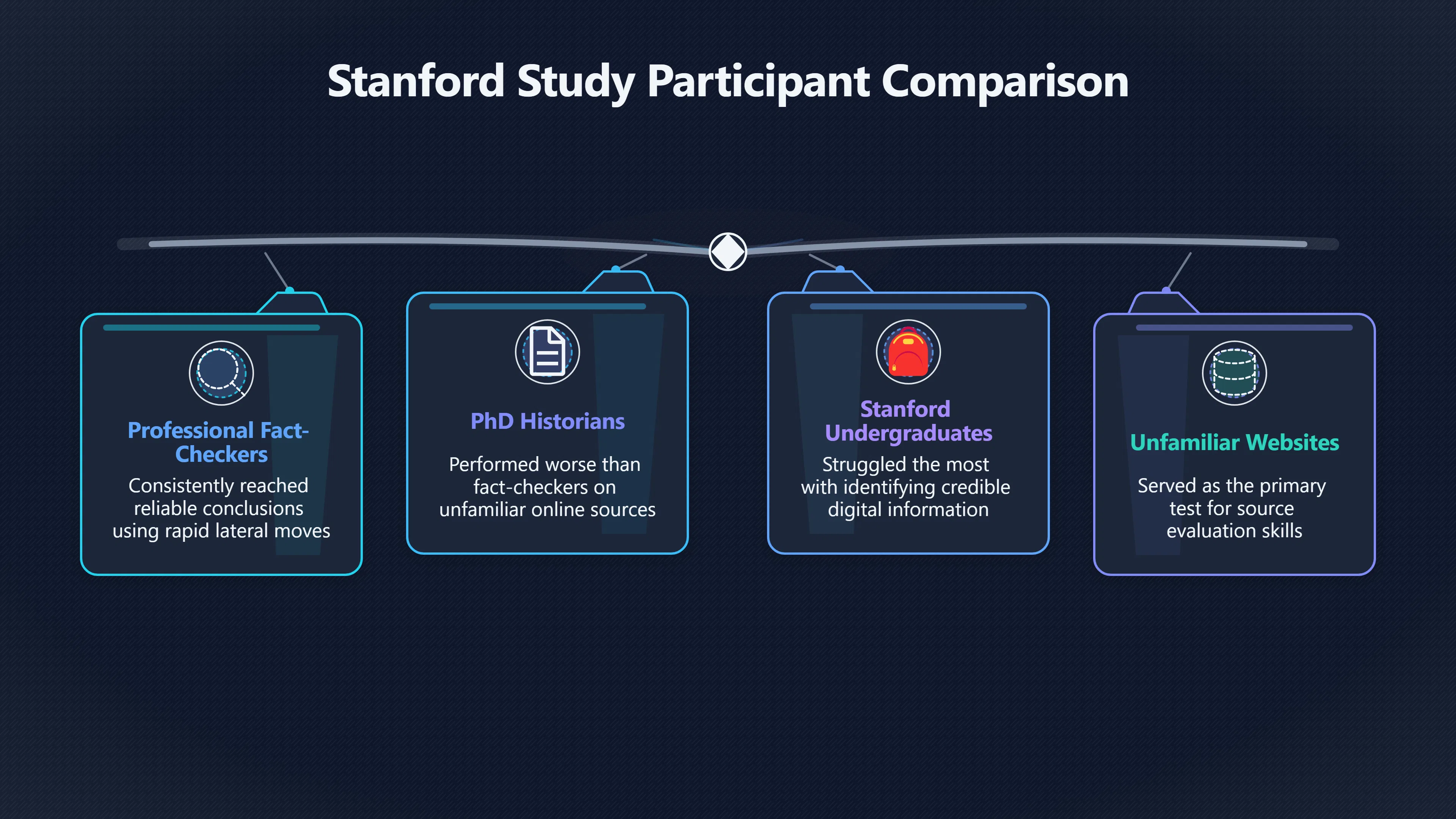
The study, conducted by Sam Wineburg and Sarah McGrew, observed 45 experienced internet users: 10 professional fact-checkers, 10 PhD historians and 25 Stanford undergraduates. Participants were asked to evaluate the credibility of live websites while explaining their thinking aloud. Researchers focused not only on whether participants reached the correct conclusion but also on how they arrived there.[Sage Journals]journals.sagepub.comhistorians, 10 professional fact checkers, and 25 Stanford University undergraduates. Analysis…Read more…
The results challenged common assumptions about expertise. Historians are highly trained in source evaluation, yet many performed worse than professional fact-checkers when assessing unfamiliar online sources. Students generally struggled the most. Fact-checkers consistently reached more reliable conclusions and often did so much faster.[Sage Journals]journals.sagepub.comhistorians, 10 professional fact checkers, and 25 Stanford University undergraduates. Analysis…Read more…
A key reason was that historians and students frequently engaged in what the researchers called “vertical reading”. They stayed within the website itself, examining its appearance, domain name, references, logos and mission statements. These are sensible habits when analysing documents, but online they can be misleading because such features are relatively easy to imitate. Fact-checkers treated these signals as weak evidence and sought outside verification instead.[SSRN+2Sage Journals]papers.ssrn.comReading Less and Learning More When Evaluating Digital…by S Wineburg · 2019 · Cited by 81 — Fact checkers read laterally, leaving…
One striking observation was that professional fact-checkers often spent only a few seconds on an unfamiliar page before opening additional tabs. Rather than asking whether a site looked trustworthy, they first asked who was behind it and what independent sources said about it.[SSRN]papers.ssrn.comReading Less and Learning More When Evaluating Digital…by S Wineburg · 2019 · Cited by 81 — Fact checkers read laterally, leaving…
The lateral moves that improved judgement
The study revealed a set of recurring behaviours that distinguished successful evaluators from less successful ones.
Leaving the page quickly. Fact-checkers routinely interrupted their reading to investigate the organisation, author or claim elsewhere on the web. They did not assume that a website could reliably explain itself.[SSRN]papers.ssrn.comReading Less and Learning More When Evaluating Digital…by S Wineburg · 2019 · Cited by 81 — Fact checkers read laterally, leaving…
Investigating the source before the content. Instead of spending time analysing an article’s argument, they first established whether the publisher was credible. Determining who funded, operated or represented a source often answered credibility questions more efficiently than analysing the text itself.[Misinformation Review]misinforeview.hks.harvard.eduMisinformation ReviewLateral reading: College students learn to critically…23 Feb 2021 — Lateral reading allowed fact checkers to eval…
Seeking independent corroboration. Fact-checkers looked for coverage from established news organisations, expert institutions and other trusted sources. They wanted to know whether claims stood up when viewed from outside the original site.[Misinformation Review]misinforeview.hks.harvard.eduMisinformation ReviewLateral reading: College students learn to critically…23 Feb 2021 — Lateral reading allowed fact checkers to eval…
Using search strategically. The researchers found that even when historians and students searched beyond a site, they often did so inefficiently. Professional fact-checkers were more deliberate. They searched for exact phrases, examined search results carefully and avoided clicking the first available link. The researchers described this behaviour as “click restraint”—pausing to inspect search results before choosing where to investigate further.[Stanford Report]news.stanford.edufact checkers outperform historians evaluating online informationStanford ReportFact checkers outperform historians when evaluating online…Oct 24, 2017 — Wineburg and McGrew observed that even histor…
These habits formed the practical basis of lateral reading: checking across the web rather than reading deeper into a single source. The study suggested that online credibility often depends less on close inspection of a page and more on placing that page within a wider information network.[SSRN]papers.ssrn.comReading Less and Learning More When Evaluating Digital…by S Wineburg · 2019 · Cited by 81 — Fact checkers read laterally, leaving…
Why reading less sometimes produced better answers
One of the study’s most counterintuitive findings was that spending more time on a website did not necessarily improve judgement. In several cases, careful readers became trapped by persuasive design features that conveyed authority without proving it. Official-looking logos, professional layouts, academic language and respectable domain names sometimes encouraged misplaced trust.[SSRN]papers.ssrn.comReading Less and Learning More When Evaluating Digital…by S Wineburg · 2019 · Cited by 81 — Fact checkers read laterally, leaving…
Fact-checkers avoided this trap by treating first impressions as unreliable. They recognised that websites can present highly curated versions of themselves. Instead of asking, “Does this page look credible?”, they asked, “What do independent sources say about this page?” That shift in questioning often allowed them to uncover hidden affiliations, advocacy agendas or credibility concerns that were invisible from the site’s own content.[Inquiry Group]cor.inquirygroup.orgInquiry GroupTeaching Lateral Reading | CORBy observing fact checkers, we found that the best way to learn about a website is lateral rea…
The study therefore challenged a longstanding assumption in information literacy education: that careful scrutiny of a single source is always the best path to truth. Online, the researchers argued, credibility often emerges from comparison across sources rather than from deeper inspection of one source in isolation.[Sage Journals]journals.sagepub.comhistorians, 10 professional fact checkers, and 25 Stanford University undergraduates. Analysis…Read more…
Limits of close reading online
The Stanford findings did not suggest that close reading is unimportant. Historians use close reading effectively when analysing documents whose provenance is already known. The problem arises when readers encounter unfamiliar online sources and try to judge them solely from internal clues.[Sage Journals]journals.sagepub.comhistorians, 10 professional fact checkers, and 25 Stanford University undergraduates. Analysis…Read more…
The study showed that traditional checklists and website-evaluation frameworks can become vulnerable when they focus heavily on surface characteristics. A site can easily create an impressive “About” page, professional branding or carefully selected references. These signals may deserve consideration, but they are insufficient on their own.[Wikipedia]WikipediaCRAAP testCRAAP test
For the broader challenge of critical thinking in the age of social media and AI, this was the study’s most important lesson. Online expertise is not merely the ability to read carefully. It is also the ability to know when to stop reading, leave the page and investigate the wider context. Professional fact-checkers succeeded not because they examined websites more thoroughly, but because they recognised that many credibility questions can only be answered outside the website itself.[SSRN+2Sage Journals]papers.ssrn.comReading Less and Learning More When Evaluating Digital…by S Wineburg · 2019 · Cited by 81 — Fact checkers read laterally, leaving…

eBay marketplace picks
Marketplace Samples
Example marketplace items related to this page. Use the search link to explore similar finds on eBay.




Endnotes
1.
Source: papers.ssrn.com
Link:https://papers.ssrn.com/sol3/papers.cfm?abstract_id=3048994
Source snippet
Reading Less and Learning More When Evaluating Digital...by S Wineburg · 2019 · Cited by 81 — Fact checkers read laterally, leaving...
2.
Source: news.stanford.edu
Title: fact checkers outperform historians evaluating online information
Link:https://news.stanford.edu/stories/2017/10/fact-checkers-outperform-historians-evaluating-online-information
Source snippet
Stanford ReportFact checkers outperform historians when evaluating online...Oct 24, 2017 — Wineburg and McGrew observed that even histor...
3.
Source: Wikipedia
Title: CRAAP test
Link:https://en.wikipedia.org/wiki/CRAAP_test
4.
Source: Wikipedia
Title: Sam Wineburg
Link:https://en.wikipedia.org/wiki/Sam_Wineburg
5.
Source: ed.stanford.edu
Title: it doesn t take long learn how spot misinformation online stanford study finds
Link:https://ed.stanford.edu/news/it-doesn-t-take-long-learn-how-spot-misinformation-online-stanford-study-finds
Source snippet
doesn't take long to learn how to spot misinformation online...19 Apr 2022 — Research from the Stanford History Education Group finds th...
6.
Source: news.stanford.edu
Title: deep lab opening nanotechnology
Link:https://news.stanford.edu/stories/2026/05/deep-lab-opening-nanotechnology
Source snippet
Deep Lab opens new frontiers in nanotech...
7.
Source: Wikipedia
Title: Stanford University
Link:https://en.wikipedia.org/wiki/Stanford_University
Source snippet
Stanford Universitya private research university in Stanford, California, United States. It was founded in 1885 by railroad magnate Le...
8.
Source: papers.ssrn.com
Title: SSRN ID4104750 code2785140
Link:https://papers.ssrn.com/sol3/Delivery.cfm/SSRN_ID4104750_code2785140.pdf?abstractid=3936112
Source snippet
Reading Open InternetCivic Online Reasoning narrows the focus by providing tools to efficiently sort through the avalanche of social and...
9.
Source: journals.sagepub.com
Link:https://journals.sagepub.com/doi/10.1177/016146811912101102
Source snippet
historians, 10 professional fact checkers, and 25 Stanford University undergraduates. Analysis...Read more...
10.
Source: cor.inquirygroup.org
Link:https://cor.inquirygroup.org/curriculum/collections/teaching-lateral-reading/
Source snippet
Inquiry GroupTeaching Lateral Reading | CORBy observing fact checkers, we found that the best way to learn about a website is lateral rea...
11.
Source: misinforeview.hks.harvard.edu
Link:https://misinforeview.hks.harvard.edu/article/lateral-reading-college-students-learn-to-critically-evaluate-internet-sources-in-an-online-course/
Source snippet
Misinformation ReviewLateral reading: College students learn to critically...23 Feb 2021 — Lateral reading allowed fact checkers to eval...
12.
Source: cor.inquirygroup.org
Link:https://cor.inquirygroup.org/curriculum/lessons/intro-to-lateral-reading/
Source snippet
to Lateral Reading | CORThis lesson introduces students to lateral reading, a strategy for investigating who's behind an unfamiliar onlin...
13.
Source: cor.inquirygroup.org
Link:https://cor.inquirygroup.org/
Source snippet
Online Reasoning - Digital Inquiry GroupFree lessons and assessments that help you teach students to evaluate online information that aff...
14.
Source: scienceofboosting.org
Title: Lateral Reading
Link:https://www.scienceofboosting.org/project/lateral-reading/
Source snippet
BoostingMay 4, 2023 — Wineburg and McGrew (2017, 2019) conducted a study with Stanford undergraduates, university professors, and profess...
Published: May 4, 2023
Additional References
15.
Source: researchgate.net
Link:https://www.researchgate.net/publication/375674630_Teaching_Lateral_Reading_Interventions_to_Help_People_Read_like_Fact_Checkers
Source snippet
Interventions to Help People Read like Fact CheckersAs reviewed by McGrew (2024), lateral reading interventions have proven highly effec...
16.
Source: youtube.com
Link:https://www.youtube.com/stanfordonline
Source snippet
Stanford OnlineYou can gain access to a world of education through Stanford Online, the Stanford School of Engineering's portal for acade...
17.
Source: pressbooks.pub
Title: Stanford undergraduates, History professors, and professional fact-checkers
Link:https://pressbooks.pub/introtocollegeresearch/chapter/students-and-disinformation/
Source snippet
Web Evaluation Skills: A “Bleak” Track RecordIn 2017, the Stanford History Education Group conducted a study, “Lateral Reading...
18.
Source: guides.lib.uiowa.edu
Title: Try to determine a consensus about the source by researching
Link:https://guides.lib.uiowa.edu/c.php?g=849536&p=6077640
Source snippet
Online Information: Lateral Reading - GuidesNov 24, 2025 — Good lateral readers use the simple techniques of the fact-checkers in the Sta...
19.
Source: researchgate.net
Link:https://www.researchgate.net/publication/356330143_Lateral_Reading_and_the_Nature_of_Expertise_Reading_Less_and_Learning_More_When_Evaluating_Digital_Information
Source snippet
methods are not necessarily exact or reliable (Wineburg and McGrew 2019).Read more...
20.
Source: phys.org
Title: 2017 10 fact checkers outperform historians online
Link:https://phys.org/news/2017-10-fact-checkers-outperform-historians-online.html
Source snippet
Fact checkers outperform historians when evaluating...24 Oct 2017 — Wineburg and McGrew observed that even historians and students who d...
21.
Source: openlearninglibrary.mit.edu
Link:https://openlearninglibrary.mit.edu/courses/course-v1%3AMITx%2B0.504x%2B3T2020/about
Source snippet
Truth From Fiction: Civic Online ReasoningUnit 2: The Two Big Fact Checker Moves: Lateral Reading & Click Restraint...
22.
Source: hendrix.edu
Link:https://www.hendrix.edu/uploadedFiles/Academics/Faculty_Resources/Teaching_and_Learning/EvaluatingDigitalInformation.pdf
Source snippet
Hendrix Collegereading less and learning more when evaluating digital...To investigate how people determine the credibility of digital i...
23.
Source: researchgate.net
Link:https://www.researchgate.net/publication/349535570_Lateral_reading_College_students_learn_to_critically_evaluate_internet_sources_in_an_online_course
Source snippet
an improve at judging the credibility of online sources.Read more...
24.
Source: facebook.com
Title: Looking to improve your study skills?
Link:https://www.facebook.com/Colombo.USembassy/posts/looking-to-improve-your-study-skills-stanford-researchers-recommend-lateral-read/10160401000077846/
Source snippet
Stanford researchers...31 Aug 2020 — Looking to improve your study skills? Stanford researchers recommend lateral reading—leaving a site...
Topic Tree