Within Influencers
When Local Trust Replaces Local Reporting
In places with weaker local journalism, familiar community voices can become trusted shortcuts for rumours and public claims.
On this page
- Why proximity feels like credibility
- How local news gaps change information habits
- Checks for neighbourhood rumours and warnings
Page outline Jump by section
Introduction
Local Facebook groups often become substitutes for verified local news when people need immediate information about road closures, crime reports, school issues, planning disputes, missing pets or emergency events. In communities where local newspapers have shrunk, closed or reduced reporting capacity, these groups can appear to offer something journalism no longer provides: constant updates from people who live nearby. The problem is that familiarity and proximity can make information feel trustworthy even when it has not been verified.
 Within the broader challenge of critical thinking in the age of social media and AI, local groups demonstrate how identity-based trust cues operate at neighbourhood level. The trusted messenger is not a celebrity influencer but a fellow resident, parent, shop owner or community volunteer. Their local status can make claims seem credible before evidence has been examined.
When Local Trust Replaces Local Reporting
Why proximity feels like credibility
People naturally place weight on information from those who appear to share their circumstances. In local Facebook groups, contributors often use real names, mention nearby streets, discuss familiar landmarks and describe events that members believe they could have witnessed themselves. These signals create a sense of authenticity.
Unlike a newspaper article, a Facebook post may come from someone who says, “I was there”, “my neighbour saw it” or “this happened outside my child’s school”. Even when evidence is incomplete, the claim feels close to everyday experience. The social relationship becomes part of the credibility assessment.
Research on Facebook groups has found that local groups frequently reflect and reinforce existing community ties and forms of social capital, meaning that trust built offline can carry into online information-sharing. People often judge claims through community relationships rather than formal verification processes.[arXiv]arxiv.orgarXiv The Geography of Facebook Groups in the United StatesThe Geography of Facebook Groups in the United StatesJanuary 29, 2022…
This can be valuable. Residents often know local conditions better than national media outlets. They may provide rapid warnings about flooding, transport disruptions or public safety concerns. However, the same trust mechanism can also allow rumours to circulate quickly because group members may assume that a familiar voice is a reliable source.
The difference between witnessing and reporting
A key distinction is that eyewitness accounts and journalism are not the same thing.
Professional local reporting typically involves:
- Verifying claims with multiple sources.
- Seeking responses from authorities or affected parties.
- Correcting errors publicly.
- Distinguishing confirmed facts from allegations.
Local Facebook groups often skip these steps. Information can spread because it is interesting, alarming or emotionally compelling rather than because it has been independently confirmed.
As a result, a post that begins as uncertainty—“I heard there was an incident near the station”—can rapidly become accepted community knowledge after repeated sharing and discussion. Rumours gain credibility through repetition and social endorsement rather than verification.
How Local News Gaps Change Information Habits
The growth of local Facebook groups as news substitutes is closely connected to the decline of local journalism.
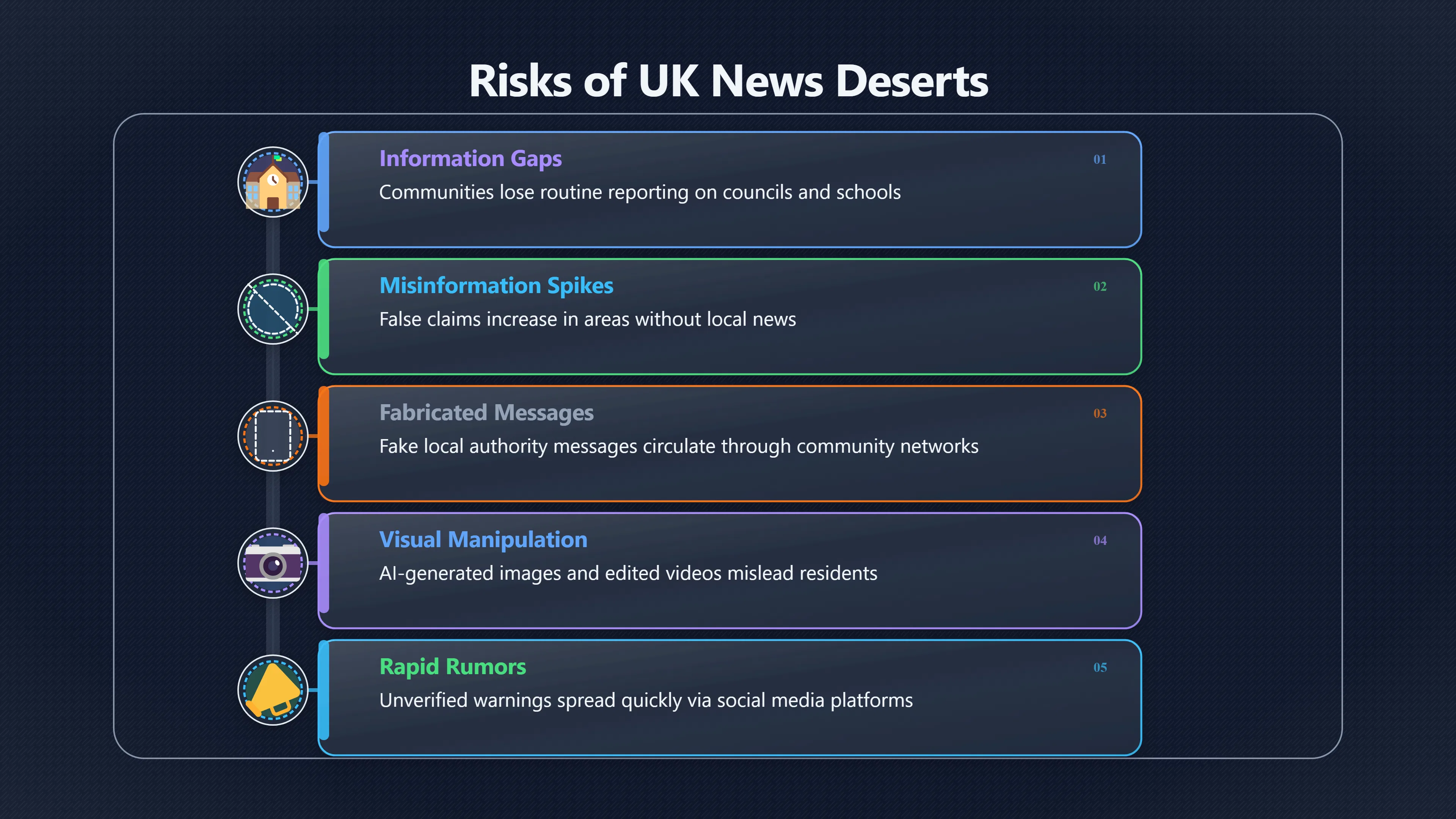
Across many countries, researchers have documented the emergence of “news deserts”: places with little or no consistent local reporting. When newspapers close or significantly reduce coverage, communities lose routine reporting on councils, schools, policing, health services and local politics.[Charitable Journalism Project]cjproject.orglocal news deserts in the ukCharitable Journalism ProjectLOCAL NEWS DESERTS IN THE UKJune 14, 2022 — 14 Jun 2022 — The Charitable Journalism Project was formed to re…
Studies and industry reports have found that people increasingly turn to Facebook and similar platforms to fill these information gaps. A UK study on local news deserts reported that many residents now obtain local information primarily through Facebook rather than local newspapers.[City St George's, University of London]citystgeorges.ac.ukCity St George's, University of LondonUK towns have become 'news deserts' as people get their…17 Jun 2022 — A new Charitable Journalis…
Recent research has highlighted the risks. Analysis by the Social Market Foundation found substantially higher levels of misinformation in local online groups located in areas with weaker local journalism. Researchers observed false claims, fabricated local authority messages, misleading images and other forms of inaccurate content circulating through community networks.[SMF+2SMF]smf.co.ukcebook groups… 1 in 5 'fake news' (19%) posts analysed on Facebook groups…
The relationship is not entirely straightforward. Some academic research has found little evidence that people in news deserts automatically consume more low-quality websites than other populations. Instead, many continue to access mainstream national news.[PMC]pmc.ncbi.nlm.nih.govAn evaluation of online information acquisition in US news…by KT Greene · 2024 · Cited by 8 — We find little evidence that those in…
However, even where national news remains available, it often does not answer highly local questions:
- Why are police vehicles on a particular street?
- What happened at last night’s council meeting?
- Is the school really changing its admissions policy?
- Is a circulating warning message genuine?
In those situations, neighbourhood groups become attractive substitutes because they provide information that national outlets rarely cover.

The speed advantage
Local Facebook groups offer something journalism often struggles to match: speed.
Residents can post photographs within seconds of an event. Witnesses can upload video immediately. Hundreds of comments may appear before any reporter arrives.
This speed creates a powerful impression that the group is the primary source of truth. Yet speed and accuracy are not the same thing. Early reports during emergencies are often incomplete or wrong. Local journalists traditionally served as a filter between raw claims and public knowledge. When that filtering layer weakens, communities increasingly perform verification themselves—sometimes successfully, sometimes not.
Why Community Consensus Can Be Misleading
One reason local rumours become persuasive is that group members often see broad agreement before they see evidence.
A warning post may receive dozens of supportive comments:
- “I heard this too.”
- “My friend mentioned it.”
- “Everyone should share this.”
These reactions can create an illusion of confirmation. In reality, many commenters may be repeating the same original claim.
This dynamic is especially important in discussions about crime, immigration, public safety, schools or local politics. Once a narrative becomes established within a group, later corrections may receive less attention than the original post.
Research examining local misinformation has found that false or misleading content can become embedded within community discussions, particularly where trusted local reporting is limited. The effect is not simply technological; it is social. People trust information because other members of their community appear to trust it.[SMF+2Smart Thinking]smf.co.ukcebook groups… 1 in 5 'fake news' (19%) posts analysed on Facebook groups…
AI-generated images, fabricated screenshots and edited videos increase this challenge. Community members may assume that locally relevant content is genuine because it concerns familiar places or institutions, even when the underlying material has been manipulated.[The Guardian]theguardian.comTopics such as immigration and Islamophobia are the most frequent subjects of false claims. The spread intensifies around elections, with…
Checks for Neighbourhood Rumours and Warnings
Local Facebook groups remain useful sources of community knowledge. The goal is not to dismiss them but to evaluate claims more carefully.
When encountering a neighbourhood rumour or warning, several checks can help:
Ask whether the source is first-hand.
Did the person witness the event directly, or are they repeating something they heard from someone else?
Look for independent confirmation.
Has a local authority, school, emergency service or established news organisation confirmed the claim?
Separate urgency from evidence.
Warnings often create pressure to share immediately. Urgency does not guarantee accuracy.
Check dates, screenshots and images.
Old incidents are frequently recirculated as new ones. Screenshots can be edited, and AI-generated images can imitate local scenes.
Watch for missing perspectives.
If a claim involves a business, school, council or individual, has anyone sought a response from them?
Be cautious with repeated anecdotes.
Multiple comments may trace back to the same original rumour rather than separate sources.
The Critical Thinking Challenge
Local Facebook groups illustrate a broader lesson about information and trust. People do not rely solely on evidence; they also rely on relationships, familiarity and shared identity. In neighbourhood groups, the trusted figure is often not an influencer with millions of followers but an ordinary resident who seems close, sincere and connected to the community.
That trust can provide valuable local knowledge. It can also encourage people to accept claims that have never undergone basic verification. As local journalism contracts in some areas, the temptation to treat community discussion as a substitute for reporting becomes stronger. Critical thinking requires recognising the difference between information that feels local and information that has actually been checked. The two often overlap, but they are not the same thing.
Amazon book picks
Further Reading
Books and field guides related to When Local Trust Replaces Local Reporting. Use these as the next step if you want deeper reading beyond the article.
Foolproof: Why We Fall for Misinformation and How to Build Im...
Addresses misinformation in community settings.


eBay marketplace picks
Marketplace Samples
Example marketplace items related to this page. Use the search link to explore similar finds on eBay.



Endnotes
1.
Source: arxiv.org
Title: arXiv The Geography of Facebook Groups in the United States
Link:https://arxiv.org/abs/2201.12513
Source snippet
The Geography of Facebook Groups in the United StatesJanuary 29, 2022...
Published: January 29, 2022
2.
Source: smf.co.uk
Link:https://www.smf.co.uk/publications/social-media-local-misinformation/
Source snippet
cebook groups... 1 in 5 'fake news' (19%) posts analysed on Facebook groups...
3.
Source: smf.co.uk
Link:https://www.smf.co.uk/fake-news-nearly-three-times-more-common-in-areas-without-local-journalism-and-spikes-during-elections-new-research-finds/
Source snippet
Fake news nearly three times more common in areas...5 days ago — Analysis of four Facebook groups in Gorton and Denton during the recent...
4.
Source: pmc.ncbi.nlm.nih.gov
Link:https://pmc.ncbi.nlm.nih.gov/articles/PMC11560965/
Source snippet
An evaluation of online information acquisition in US news...by KT Greene · 2024 · Cited by 8 — We find little evidence that those in...
5.
Source: facebook.com
Link:https://www.facebook.com/business/help/315131736305613?locale=en_GB
Source snippet
Fact-checking policies on Facebook, Instagram and ThreadsThe focus of this fact-checking programme is identifying and addressing viral mi...
6.
Source: facebook.com
Link:https://www.facebook.com/groups/384926985723985/posts/1751943585688978/
Source snippet
l news outlets, a new report has found. Research from the...Read more...
7.
Source: facebook.com
Title: The Guardian
Link:https://www.facebook.com/theguardian/photos/investigation-reveals-more-than-44-million-people-live-in-news-deserts-that-lack/1429000595924856/
Source snippet
Investigation reveals more than 4.4 million...This lack of local reporting is clearly contributing to the spread of misinformation - we...
8.
Source: facebook.com
Link:https://www.facebook.com/groups/671022767060782/posts/2243057433190633/
Source snippet
usted local news outlets, a new report has found...
9.
Source: facebook.com
Link:https://www.facebook.com/groups/enemyofthepeople/posts/10174691490960058/
Source snippet
Local journalism decline spreads misinformationHow local journalism can upend the 'fake news' narrative. Koulay... misinformation and sm...
10.
Source: youtube.com
Title: When local news disappears, social media fills the void
Link:https://www.youtube.com/watch?v=utcpwphDjdE
Source snippet
The Guardian...
11.
Source: cjproject.org
Title: local news deserts in the uk
Link:https://cjproject.org/wp-content/uploads/2022/06/local-news-deserts-in-the-uk.pdf
Source snippet
Charitable Journalism ProjectLOCAL NEWS DESERTS IN THE UKJune 14, 2022 — 14 Jun 2022 — The Charitable Journalism Project was formed to re...
Published: June 14, 2022
12.
Source: citystgeorges.ac.uk
Link:https://www.citystgeorges.ac.uk/news-and-events/news/2022/06/uk-towns-have-become-news-deserts-as-people-get-their-news-from-facebook-rather-local-papers
Source snippet
City St George's, University of LondonUK towns have become 'news deserts' as people get their...17 Jun 2022 — A new Charitable Journalis...
13.
Source: theguardian.com
Link:https://www.theguardian.com/media/2026/jun/08/social-media-groups-fuel-misinfomation-uk-news-deserts-report
Source snippet
Topics such as immigration and Islamophobia are the most frequent subjects of false claims. The spread intensifies around elections, with...
14.
Source: smartthinking.org.uk
Link:https://smartthinking.org.uk/event/local-misinformation-social-media-groups-and-the-role-of-local-journalism/
Source snippet
Local misinformation: social media groups and the role of...5 days ago — The SMF has carried out research into usage of and trust in loc...
15.
Source: theguardian.com
Title: British armed forces intercept Russian shadow fleet vessel in Channel
Link:https://www.theguardian.com/uk-news/2026/jun/14/british-forces-intercept-russian-shadow-fleet-vessel-english-channel
16.
Source: theguardian.com
Link:https://www.theguardian.com/
Source snippet
from the Guardian, the world's leading liberal voice...
17.
Source: transparency.meta.com
Link:https://transparency.meta.com/en-gb/policies/community-standards/misinformation/
Source snippet
Transparency CentreMeta regularly publishes reports to give our community visibility into Community Standards enforcement, government r...
18.
Source: pmc.ncbi.nlm.nih.gov
Link:https://pmc.ncbi.nlm.nih.gov/articles/PMC10623619/
Source snippet
by Z Adams · 2023 · Cited by 147 — Similar to disinformation, “fake news” is defined as information presented as news that is intentio...
Additional References
19.
Source: unhcr.org
Link:https://www.unhcr.org/innovation/wp-content/uploads/2022/02/Using-Social-Media-in-CBP-Chapter-6-Rumours-and-Misinformation.pdf
Source snippet
Rumors and MisinformationMisinformation and disinformation are elements of “fake news”, defined by scholars as “fabricated information th...
20.
Source: usnewsdeserts.com
Link:https://www.usnewsdeserts.com/reports/expanding-news-desert/loss-of-local-news/
Source snippet
The Loss of Local News: What It Means for CommunitiesThis report explores the loss and diminishment of local newspapers, the implications...
21.
Source: x.com
Link:https://x.com/pressgazette/status/2064262530579476726
Source snippet
The hidden threat of unchecked local misinformationA report from the Social Market Foundation has found areas deemed local news deserts h...
22.
Source: wral.com
Link:https://www.wral.com/video/social-media-news-desert-june-2026/
Source snippet
When local news disappears, social media fills the voidHowever, these platforms lack journalistic integrity, leading to rampant misinform...
23.
Source: policyalternatives.ca
Title: quality not just quantity of news outlets matter especially in rural canada
Link:https://www.policyalternatives.ca/news-research/quality-not-just-quantity-of-news-outlets-matter-especially-in-rural-canada/
Source snippet
news deserts appear to be no more susceptible to misinformation than those who are served by local news media. This may have a lot to do...
24.
Source: localnewsinitiative.northwestern.edu
Title: news deserts social media local news medill survey
Link:https://localnewsinitiative.northwestern.edu/posts/2026/02/10/news-deserts-social-media-local-news-medill-survey/
Source snippet
no local news, those in news deserts turn to social media...10 Feb 2026 — Residents who attend local government meetings aren't fully in...
25.
Source: localnewsresearchproject.ca
Title: the rise of news deserts local journalism in crisis
Link:https://localnewsresearchproject.ca/2025/10/31/the-rise-of-news-deserts-local-journalism-in-crisis/
Source snippet
1, 2025, 603 local news outlets closed in 388 communities across Canada. Only 264 have launched and survived over the...Read more...
26.
Source: youtube.com
Title: The Death of Local News is Killing American Democracy
Link:https://www.youtube.com/watch?v=VKHhdO5JUTU
Source snippet
This selection of videos directly addresses how the decline of traditional media creates "news deserts," forcing communities to rely on a...
27.
Source: tandfonline.com
Link:https://www.tandfonline.com/doi/full/10.1080/21670811.2025.2574935
Source snippet
A Community Resilience Approach to Understanding News...by JR Collier · 2025 · Cited by 1 — This research asks: what can we learn from n...
28.
Source: youtube.com
Link:https://www.youtube.com/watch?v=L1NSNYbCoew
Source snippet
When local news disappears, social media fills the void...
Topic Tree