Within Ranking
Viral Does Not Mean Verified
A post can spread because it is useful, funny, shocking or divisive, so reach should never be treated as proof.
On this page
- Why ranking success differs from accuracy
- How social proof creates false confidence
- How to separate popularity from evidence
Page outline Jump by section
Introduction
A viral post can tell you that many people saw, shared, reacted to or discussed something. It cannot, by itself, tell you whether the underlying claim is true. In social media and AI-driven feeds, ranking systems are designed primarily to predict attention and engagement, not to verify facts. A post may spread because it is useful, entertaining, surprising, emotionally charged, controversial or simply well-timed. High reach reveals distribution success; it does not prove accuracy.
 This distinction matters because people often treat popularity as a shortcut for credibility. When a claim appears everywhere, it can feel validated by sheer visibility. Yet research repeatedly shows that false or misleading information can achieve enormous reach, sometimes exceeding that of accurate information. The fact that a claim became viral is therefore a clue about how information travelled, not evidence that the claim is correct.[MIT News]news.mit.edustudy twitter false news travels faster true stories 0308MIT NewsStudy: On Twitter, false news travels faster than true stories8 Mar 2018 — A new study by three MIT scholars has found that false…
Why Ranking Success Differs from Accuracy
Algorithmic ranking systems compete for attention in crowded information environments. To decide what appears in feeds, they rely on signals such as clicks, watch time, comments, shares and other indicators that suggest a user might remain engaged. Accuracy is often not directly observable to the ranking system at the moment content is being distributed.
As a result, content can perform well for reasons unrelated to truth:
- Novelty: Unexpected claims attract attention because they stand out from routine information.
- Emotion: Anger, fear, outrage and surprise often motivate people to share content.
- Identity signalling: Users may share material that expresses group loyalties or values.
- Entertainment value: Humour, spectacle and drama can drive engagement regardless of factual quality.
- Conflict: Disagreement and controversy frequently generate comments and reactions.
These qualities can overlap with truthful reporting, but they do not depend on it. A carefully sourced investigation and a sensational rumour may both generate strong engagement signals. From a ranking perspective, both can appear successful if users interact with them extensively.[American Psychological Association+2Yale Insights]apa.orghow why misinformation spreadsAmerican Psychological AssociationHow and why does misinformation spread?29 Nov 2023 — Overall, most online misinformation originates fro…
A useful mental model is that ranking systems are usually measuring predicted attention, whereas truth requires evidence, verification and independent confirmation. The two can coincide, but they are not the same thing.
When False Information Outperforms True Information
One of the clearest demonstrations that popularity is not proof comes from research on the spread of false news online.
A large study published in Science examined approximately 126,000 stories shared by around three million users on Twitter between 2006 and 2017. Using classifications from multiple independent fact-checking organisations, the researchers found that false news spread farther, faster, deeper and more broadly than true news. False stories were significantly more likely to be retweeted and often reached much larger audiences.[Science]science.orgThe spread of true and false news onlineby S Vosoughi · 2018 · Cited by 13885 — Our analysis of all the verified true and false ru…
The researchers suggested that novelty played an important role. New, surprising information attracts attention, and people are often motivated to share information that appears unusual or remarkable. This means a claim can gain enormous visibility precisely because it is striking, not because it has been verified.[MIT News+2MIT Sloan]news.mit.edustudy twitter false news travels faster true stories 0308MIT NewsStudy: On Twitter, false news travels faster than true stories8 Mar 2018 — A new study by three MIT scholars has found that false…
The key lesson is not that viral content is usually false. Rather, it is that viral spread cannot be treated as evidence of truth. If false information can consistently achieve large-scale distribution, then popularity alone is clearly an unreliable test of accuracy.
How Social Proof Creates False Confidence
People rarely evaluate information in isolation. Instead, they often use social cues to judge credibility. Psychologists describe this tendency as social proof: when uncertainty exists, people look to the behaviour of others as a guide to what is likely to be correct or worthwhile.[The Decision Lab]thedecisionlab.comThe Decision LabSocial ProofSocial proof is a psychological phenomenon in which people look to the actions of others to determine how to…
On social media, social proof appears in many forms:
- High view counts
- Large numbers of likes
- Thousands of reposts or shares
- Trending labels
- Prominent placement in feeds
- Large follower counts
These signals are useful for estimating popularity, but people often unconsciously treat them as signals of quality or truth.
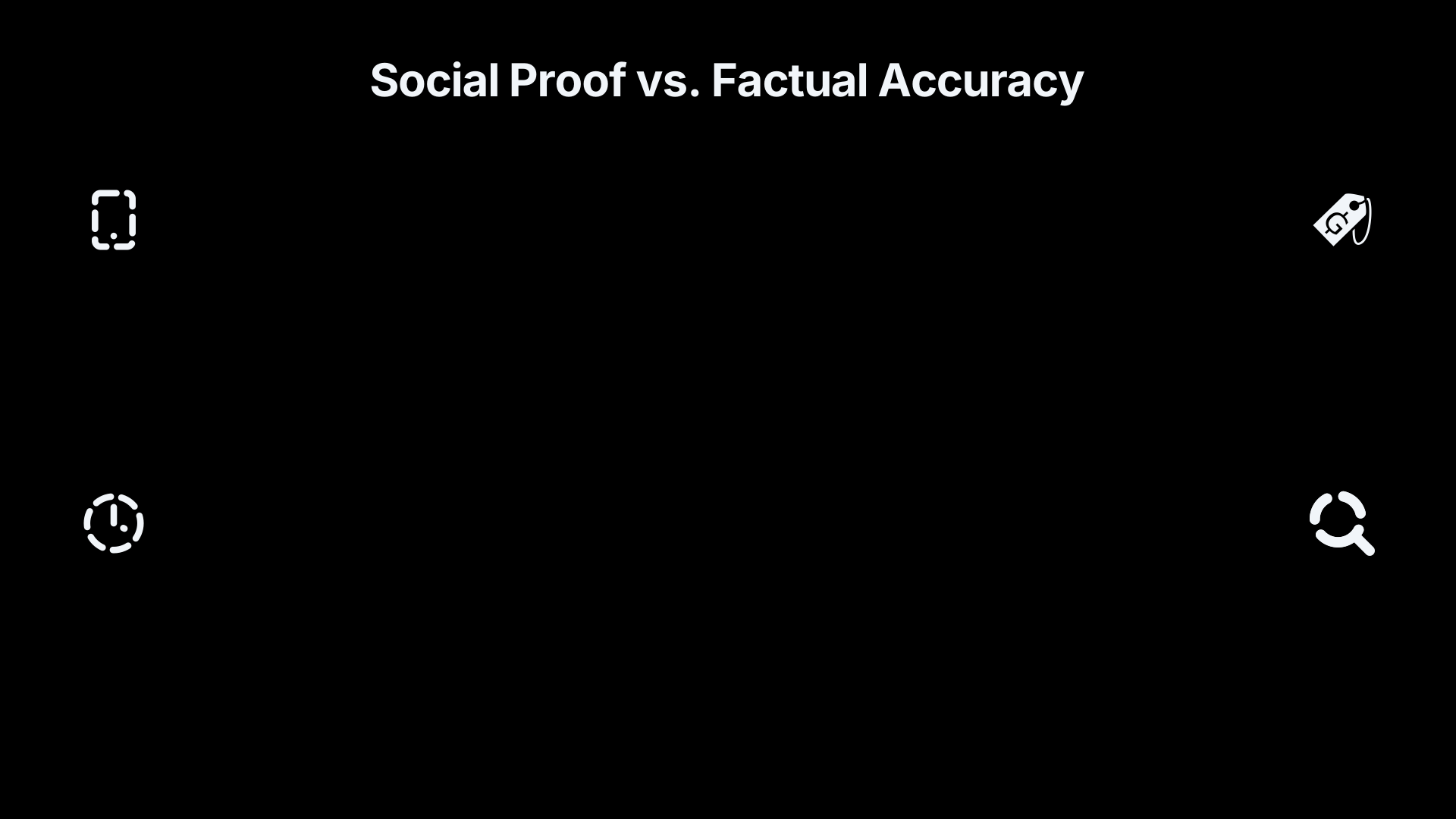
The problem is that social proof measures collective behaviour, not factual accuracy. A million people can watch a video because it is shocking. Thousands can share a claim because it confirms what they already believe. A post can trend because people are arguing against it rather than supporting it. The visible numbers reveal activity, but they do not explain why that activity occurred.[PMC]pmc.ncbi.nlm.nih.govPMCThe persuasive effects of social cues and sourceNIHby CS Traberg · 2024 · Cited by 74 — We find that social cues only impact individual judgements when they influence perceptions…
This can create a feedback loop. High engagement increases visibility. Increased visibility attracts more engagement. The growing numbers then make the content appear even more important or credible, regardless of whether the original claim was well supported.

Visibility Is Not Representativeness
Another common mistake is assuming that highly ranked content represents what most people think.
A viral post often reflects the behaviour of a particularly active subset of users rather than the broader public. Research on misinformation repeatedly finds that a relatively small number of highly active accounts can account for a disproportionate share of distribution.[Yale Insights+2American Psychological Association]insights.som.yale.eduhow social media rewards misinformationYale InsightsHow Social Media Rewards Misinformation | Yale Insights31 Mar 2023 — A majority of false stories are spread by a small numbe…
This means that:[researchgate.net]researchgate.netikelihood of adolescent consumer purchasing, 2) pop-up messages had little to no…Read more…
- A trending claim may originate from a concentrated network rather than a broad consensus.
- A highly shared opinion may not reflect majority views.
- A visible controversy may represent a small but extremely active group.
- A feed can make rare viewpoints appear common because they generate strong engagement.
Viral ranking therefore tells us something about the dynamics of attention, but not necessarily about what most people believe or what the available evidence supports.
How to Separate Popularity from Evidence
The most reliable response to viral content is to treat popularity as a separate question from truth.
When evaluating a widely shared claim, ask:
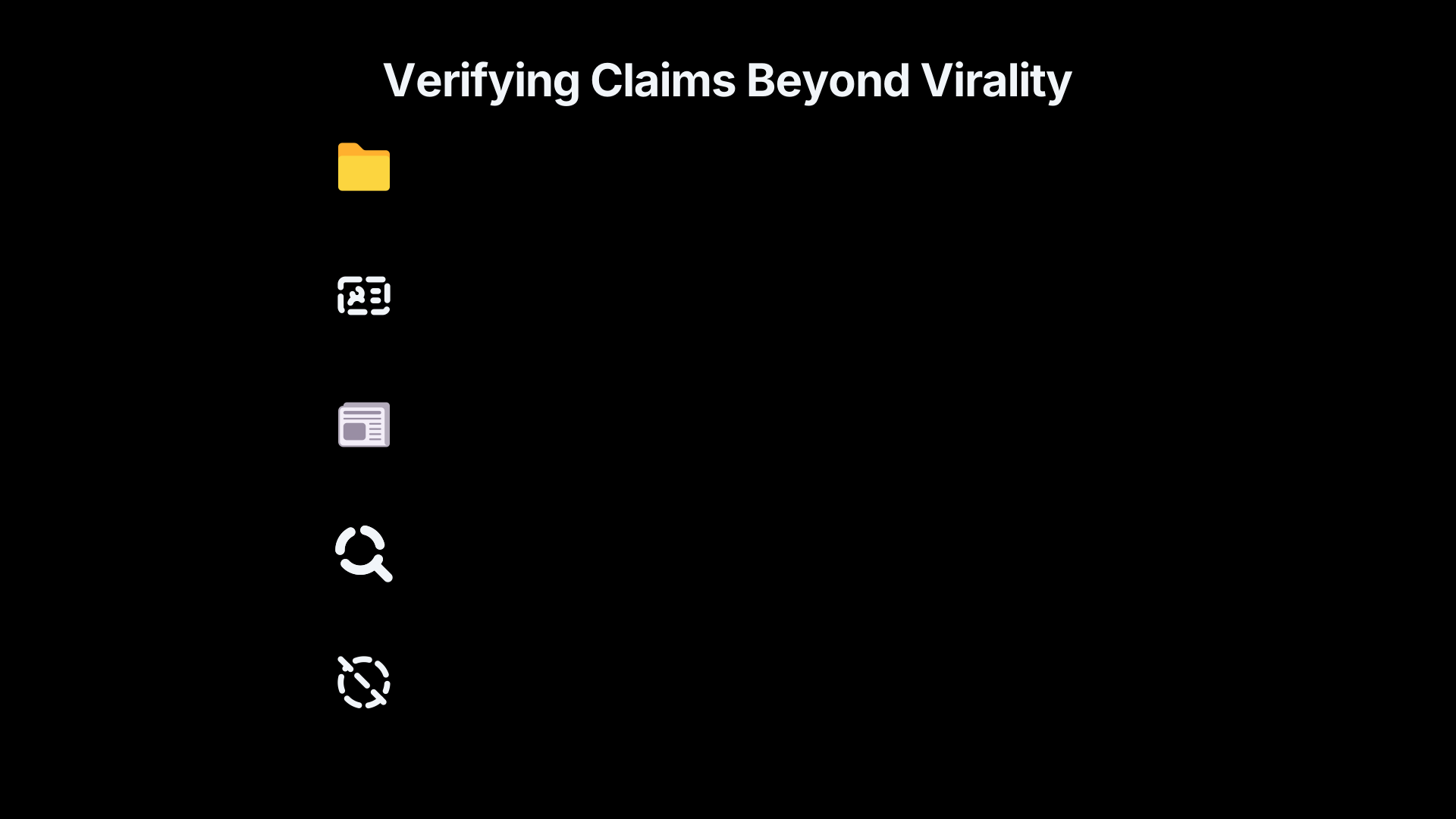
- What is the evidence? Look for original sources, documents, data or direct reporting.
- Who is making the claim? Consider expertise, incentives and track record.
- Has the claim been independently verified? Seek confirmation from multiple credible sources.
- Why might this be spreading? Consider whether novelty, outrage, humour or identity-based appeals are driving engagement.
- Would the claim remain convincing without the numbers? Ignore likes, shares and views temporarily and focus on the underlying evidence.
A useful discipline is to imagine encountering the same claim with no visible engagement metrics attached. If it would seem weak without the social signals, the popularity may be doing more persuasive work than the evidence itself.
Viral Proof Is Not Proof
In algorithmic environments, visibility and credibility are often confused because they appear together. A highly ranked post looks important, and importance can feel like evidence. Yet ranking systems mainly reveal what travelled successfully through a network of users and recommendation mechanisms.
A viral claim may be true, false, partly true, exaggerated, misunderstood or impossible to verify. Its reach tells us that distribution succeeded. Determining whether the claim is accurate requires a different process: examining evidence, checking sources and seeking independent verification.
The critical-thinking habit is simple but powerful: treat virality as a signal that something captured attention, not as proof that it earned belief. Popularity can explain why a claim found you. It cannot establish whether the claim is true.[MIT News+2Science]news.mit.edustudy twitter false news travels faster true stories 0308MIT NewsStudy: On Twitter, false news travels faster than true stories8 Mar 2018 — A new study by three MIT scholars has found that false…


eBay marketplace picks
Marketplace Samples
Example marketplace items related to this page. Use the search link to explore similar finds on eBay.




Endnotes
1.
Source: news.mit.edu
Title: study twitter false news travels faster true stories 0308
Link:https://news.mit.edu/2018/study-twitter-false-news-travels-faster-true-stories-0308
Source snippet
MIT NewsStudy: On Twitter, false news travels faster than true stories8 Mar 2018 — A new study by three MIT scholars has found that false...
2.
Source: insights.som.yale.edu
Title: how social media rewards misinformation
Link:https://insights.som.yale.edu/insights/how-social-media-rewards-misinformation
Source snippet
Yale InsightsHow Social Media Rewards Misinformation | Yale Insights31 Mar 2023 — A majority of false stories are spread by a small numbe...
3.
Source: mitsloan.mit.edu
Link:https://mitsloan.mit.edu/ideas-made-to-matter/study-false-news-spreads-faster-truth
Source snippet
MIT SloanStudy: False news spreads faster than the truthA new study published in Science finds that false news online travels “farther, f...
4.
Source: pmc.ncbi.nlm.nih.gov
Title: PMCThe persuasive effects of social cues and source
Link:https://pmc.ncbi.nlm.nih.gov/articles/PMC10879158/
Source snippet
NIHby CS Traberg · 2024 · Cited by 74 — We find that social cues only impact individual judgements when they influence perceptions...
5.
Source: mit.edu
Link:https://www.mit.edu/
Source snippet
Massachusetts Institute of TechnologySince its founding, MIT has been key to helping American science and innovation lead the worl...
6.
Source: news.mit.edu
Title: crucial human component computing and ai 0605
Link:https://news.mit.edu/2026/crucial-human-component-computing-and-ai-0605
Source snippet
crucial human component in computing and AI...
7.
Source: youtube.com
Link:https://www.youtube.com/watch?v=cIMhZGc8Nas
Source snippet
Identity in the age of social media: algorithms, influencers and attention...
8.
Source: science.org
Link:https://www.science.org/doi/10.1126/science.aap9559
Source snippet
The spread of true and false news onlineby S Vosoughi · 2018 · Cited by 13885 — Our analysis of all the verified true and false ru...
9.
Source: apa.org
Title: how why misinformation spreads
Link:https://www.apa.org/topics/journalism-facts/how-why-misinformation-spreads
Source snippet
American Psychological AssociationHow and why does misinformation spread?29 Nov 2023 — Overall, most online misinformation originates fro...
10.
Source: pubmed.ncbi.nlm.nih.gov
Link:https://pubmed.ncbi.nlm.nih.gov/29590045/
Source snippet
spread of true and false news onlineby S Vosoughi · 2018 · Cited by 13885 — We investigated the differential diffusion of all of the veri...
11.
Source: thedecisionlab.com
Link:https://thedecisionlab.com/reference-guide/psychology/social-proof
Source snippet
The Decision LabSocial ProofSocial proof is a psychological phenomenon in which people look to the actions of others to determine how to...
12.
Source: pmc.ncbi.nlm.nih.gov
Link:https://pmc.ncbi.nlm.nih.gov/articles/PMC10623619/
Source snippet
by Z Adams · 2023 · Cited by 147 — (2022) showed that news classified as misinformation can garner increased attention, gauged by the...
13.
Source: ncbi.nlm.nih.gov
Title: research news
Link:https://www.ncbi.nlm.nih.gov/search/research-news/1692
Source snippet
Twitter, fake news spreads faster... (The Los Angeles Times)Researchers find fake news reaches users up to 20 times faster than factual c...
14.
Source: washingtonpost.com
Title: Opinion | Trump says his uncle was a ‘super genius.’ D-Day proves his point
Link:https://www.washingtonpost.com/opinions/2026/06/04/john-trump-mit-engineer-who-altered-history-d-day/
15.
Source: coveo.com
Title: what is social proof
Link:https://www.coveo.com/blog/what-is-social-proof/
Source snippet
? [Types, Importance & Psychology]20 Dec 2022 — Social proof is informational social influence. It's a psychological and social phenomeno...
Additional References
16.
Source: wired.com
Link:https://www.wired.com/story/twitter-false-news-elections-scientific-study
Source snippet
The research, conducted by Sinan Aral and his colleagues at MIT, found that false news spreads more rapidly, broadly, and extensively tha...
17.
Source: sinanaral.medium.com
Link:https://sinanaral.medium.com/fake-news-about-our-fake-news-study-spread-faster-than-its-truth-just-as-we-predicted-77db6d9ca8c8
Source snippet
News about our Fake News Study Spread Faster than its...That study everyone cited with righteous glee, that misinformation spreads faste...
18.
Source: techcrunch.com
Title: false news spreads faster than truth online thanks to human nature
Link:https://techcrunch.com/2018/03/08/false-news-spreads-faster-than-truth-online-thanks-to-human-nature/
Source snippet
False news spreads faster than truth online thanks to...8 Mar 2018 — A comprehensive new study from MIT looks at a decade of tweets, and...
19.
Source: pbs.org
Title: false news travels 6 times faster on twitter than truthful news
Link:https://www.pbs.org/newshour/science/false-news-travels-6-times-faster-on-twitter-than-truthful-news
Source snippet
9 Mar 2018 — False news -- inaccurate information presented as truth or opinion presented as fact -- is 70 percent more likely to be retw...
20.
Source: vox.com
Link:https://www.vox.com/science-and-health/2018/3/8/17085928/fake-news-study-mit-science
Source snippet
On Twitter, fake news spreads faster than the truth - Vox8 Mar 2018 — False news stories travel faster and farther on Twitter than the truth...
21.
Source: researchgate.net
Link:https://www.researchgate.net/publication/378163135_The_Effects_of_Social_Proof_Marketing_Tactics_on_Nudging_Consumer_Purchase
Source snippet
ikelihood of adolescent consumer purchasing, 2) pop-up messages had little to no...Read more...
22.
Source: impulsebuyingpsychology.com
Link:https://impulsebuyingpsychology.com/social-proof/
Source snippet
Impulse Buying PsychologySocial Proof: Key Insights for Marketers5 Dec 2025 — Social proof affects your choices because it reduces uncert...
23.
Source: theguardian.com
Link:https://www.theguardian.com/commentisfree/2018/mar/19/fake-news-social-media-twitter-mit-journalism
Source snippet
A cascade starts with a Twitter user making an assertion about a topic – with...Read more...
24.
Source: news.gsu.edu
Title: new study explains why people fall for fake news
Link:https://news.gsu.edu/2025/12/05/new-study-explains-why-people-fall-for-fake-news/
Source snippet
Study Explains Why People Fall for Fake News5 Dec 2025 — In a world where misinformation spreads faster than fact, a new study is offerin...
25.
Source: reddit.com
Link:https://www.reddit.com/r/skeptic/comments/ha0brt/huge_mit_study_of_fake_news_travels_6_times_more/
Source snippet
ally triggers a stronger emotional response than actual news...Read more...
Topic Tree