Within Corroboration
When one source is not enough
Some posts need more checking because they ask people to blame, panic, donate, buy, avoid a place, or share immediately.
On this page
- Claims that demand action or blame
- Why urgency raises the evidence bar
- A quick threshold test before sharing
Page outline Jump by section
Introduction
A viral post does not automatically deserve equal levels of trust. Some claims require stronger corroboration because the potential harm of getting them wrong is much higher. When a post asks people to blame someone, panic about a threat, donate money, avoid a location, buy a product, change a health decision, or share a warning immediately, the standard of evidence should rise with the stakes.
 The key idea is simple: the more a claim could influence behaviour or damage reputations, the less sensible it is to rely on a single source, screenshot, clip, or AI-generated summary. Professional news organisations often treat major single-source claims as exceptional situations requiring special scrutiny because early information is frequently incomplete, mistaken, or misleading.[Reuters Agency]reutersagency.comReuters AgencyReuters Journalistic StandardsThe 10 Hallmarks of Reuters Journalism: Reuters journalists: Accuracy, Independence, Integrit…
Claims that demand action or blame
Not every viral claim carries the same risk. A mistaken celebrity rumour is different from a post that could trigger fear, financial loss, harassment, or public confusion.
Extra corroboration is especially important when a claim:
- Names a person or group as responsible for a crime, attack, accident, or scandal.
- Warns people to avoid a place, business, school, or neighbourhood.
- Requests urgent donations after a disaster or emergency.
- Promotes a product, treatment, investment, or safety intervention.
- Claims an election, public-health event, or security incident is unfolding.
- Pressures readers to share immediately “before it gets deleted”.
These posts often succeed because they combine emotion with urgency. The audience feels that delaying action could be harmful, so normal scepticism gets bypassed. Yet those same conditions are precisely when information is most likely to be incomplete.
A common failure mode is misidentification. After breaking events, names, photographs, locations, and motives are frequently attached to incidents before investigators have confirmed them. Once blame has spread across social media, corrections rarely travel as far as the original accusation. This is one reason professional sourcing guidance warns against turning limited information into stronger claims than the evidence supports.[AFP]afp.com20 principles of sourcing20 principles of sourcing.August 1, 2024 — 31 Jul 2024 — Do not overstate a source's importance or turn a single source into multiple…
Why urgency raises the evidence bar
Urgency is not evidence. In fact, urgency often signals that stronger verification is needed.
When information first appears online, several things tend to happen simultaneously:
- Witnesses have only partial views of events.
- Initial reports may contain errors.
- Rumours are repeated as facts.
- Old images are recirculated as current evidence.
- AI systems summarise whatever is available, whether verified or not.
- Multiple accounts repeat the same source, creating an illusion of confirmation.
The result is a dangerous mismatch: confidence rises faster than certainty.
This is why experienced journalists distinguish between being first and being correct. Reuters’ standards emphasise accuracy in sourcing and caution against presenting one source as though multiple independent sources exist. AFP similarly warns against turning a single source into multiple apparent confirmations.[Reuters Agency]reutersagency.comReuters AgencyReuters Journalistic StandardsThe 10 Hallmarks of Reuters Journalism: Reuters journalists: Accuracy, Independence, Integrit…
For ordinary social-media users, the practical implication is straightforward. If a claim carries unusually high consequences, the question should not be “How many times have I seen this?” but “How many genuinely independent confirmations exist?”
Repetition is not corroboration
One of the most misleading features of social platforms is that repetition feels like verification.
Imagine a claim appears on one account. Within an hour:
- Ten users repost it.
- Several influencers discuss it.
- AI-generated summaries describe it.
- News aggregators repeat the same wording.
To a casual reader, the claim now appears to have dozens of sources.
Yet if every version traces back to the same original post, there is still only one source.
True corroboration means separate evidence streams. Independent witnesses, official records, reporters at the scene, satellite imagery, court filings, public statements, or separate investigations can strengthen confidence because they do not all depend on the same origin point. Merely seeing the same statement repeated across platforms does not. AFP explicitly warns against presenting one source under multiple guises because doing so exaggerates the strength of the evidence.[AFP]afp.com20 principles of sourcing20 principles of sourcing.August 1, 2024 — 31 Jul 2024 — Do not overstate a source's importance or turn a single source into multiple…
A quick threshold test before sharing
When a viral claim seems urgent, a simple threshold test can prevent many mistakes.
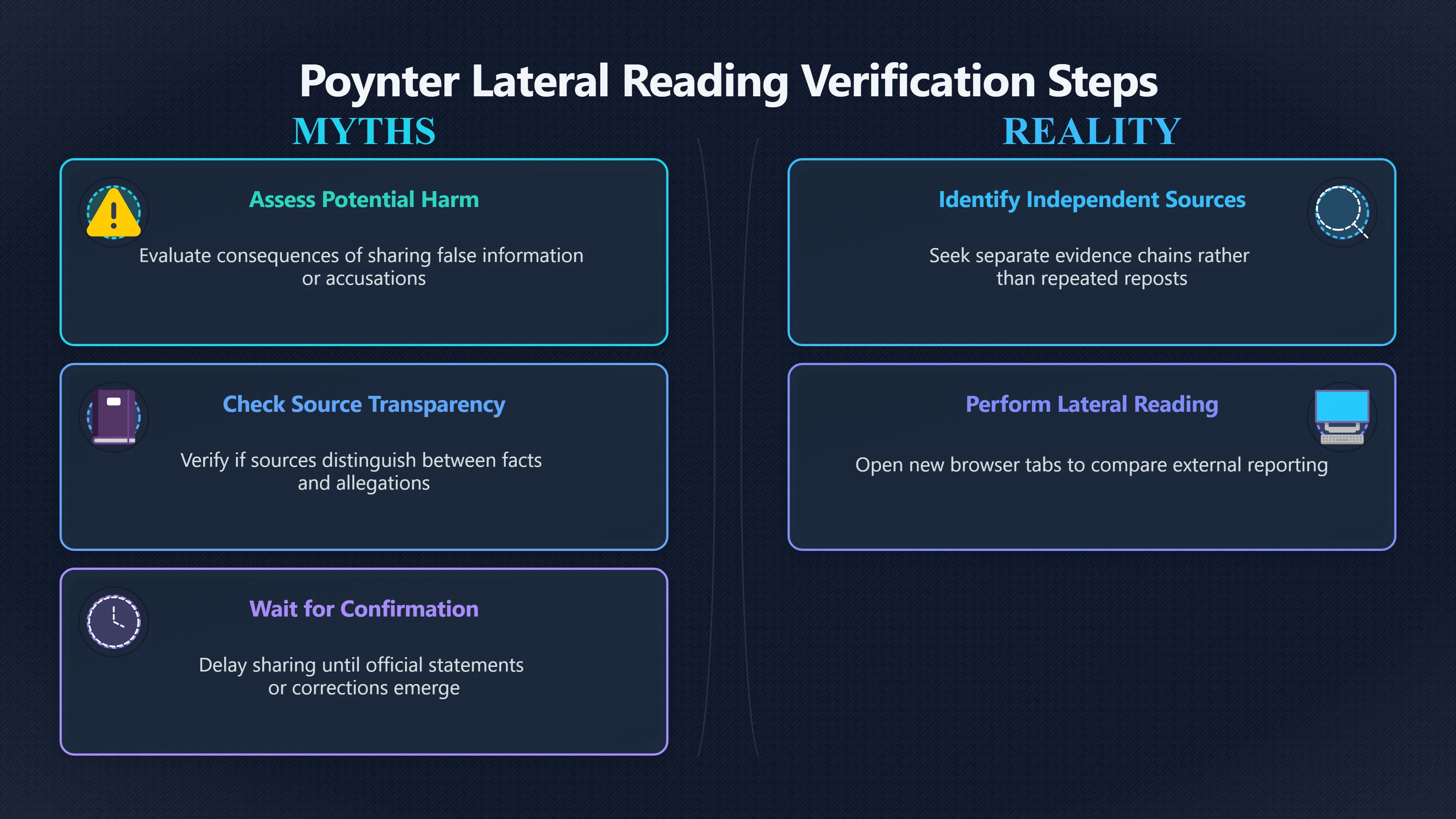
Step 1: What is the potential harm if this is wrong?
Ask what would happen if the claim turned out to be false.
Would someone be unfairly blamed? Could people lose money? Could panic spread? Might someone avoid needed medical care or make a risky decision?
Higher potential harm means stronger corroboration is required.
Step 2: Is there more than one independent source?
Do not count reposts, screenshots, reaction videos, AI summaries, or articles that merely cite one another.
Look for separate evidence chains. Independent confirmation matters more than source quantity.

Step 3: Are credible sources transparent about uncertainty?
Reliable sources usually distinguish between:
- Confirmed facts.
- Preliminary information.
- Allegations.
- Unknown details.
Overconfidence during a fast-moving story is often a warning sign rather than a mark of reliability.
Step 4: Can you verify laterally?
Media-literacy researchers and organisations such as Poynter recommend “lateral reading”: leave the original post and investigate what other credible sources say about the claim or source. Rather than studying one post more intensely, open new tabs and compare independent reporting, official statements, and fact-checks.[Poynter+2Poynter]poynter.orglateral reading the best media literacy tip to vet credible sourcesLateral reading: The best media literacy tip to vet credible…Jul 20, 2023 — Lateral reading — opening up other tabs in your bro…
Step 5: If evidence is still thin, wait
Waiting is often the most rational response to breaking claims.
A delay of thirty minutes, two hours, or a day frequently provides access to official statements, corrections, eyewitness verification, or independent reporting that was unavailable when the claim first appeared.
In many cases, the most useful critical-thinking skill is not discovering a hidden fact. It is recognising when the available evidence is not yet strong enough to justify confidence.
The practical rule
A useful rule of thumb is that evidence requirements should rise with consequences. The more a viral claim asks people to fear, blame, donate, buy, avoid, or share immediately, the more important independent corroboration becomes.
When the stakes are high, one source is rarely enough. The goal is not perfect certainty. It is avoiding the mistake of treating urgency as proof before the evidence has caught up.
Amazon book picks
Further Reading
Books and field guides related to When one source is not enough. Use these as the next step if you want deeper reading beyond the article.
Foolproof: Why We Fall for Misinformation and How to Build Im...
Explains how to resist urgent, emotionally manipulative claims.

The art of thinking clearly
Explains cognitive shortcuts that make viral claims persuasive.
eBay marketplace picks
Marketplace Samples
Example marketplace items related to this page. Use the search link to explore similar finds on eBay.


Endnotes
1.
Source: afp.com
Title: 20 principles of sourcing march 2018
Link:https://www.afp.com/sites/default/files/20_principles_of_sourcing_march_2018.pdf
Source snippet
20 sourcing principles19 May 2016 — If we believe a single source is providing information of sufficient importance, and if we are confid...
Published: march 2018
2.
Source: afp.com
Title: 20 principles of sourcing
Link:https://www.afp.com/sites/default/files/afp_-twenty_principles_of_sourcing-_july_2024.pdf
Source snippet
20 principles of sourcing.August 1, 2024 — 31 Jul 2024 — Do not overstate a source's importance or turn a single source into multiple...
Published: August 1, 2024
3.
Source: afp.com
Title: afp ethic February 2025
Link:https://www.afp.com/communication/afp_ethic_February_2025.pdf
Source snippet
AFP editorial standards and best practices4 Feb 2025 — The following document on editorial standards and best practices sets out the guid...
Published: February 2025
4.
Source: poynter.org
Title: lateral reading the best media literacy tip to vet credible sources
Link:https://www.poynter.org/fact-checking/media-literacy/2023/lateral-reading-the-best-media-literacy-tip-to-vet-credible-sources/
Source snippet
Lateral reading: The best media literacy tip to vet credible...Jul 20, 2023 — Lateral reading — opening up other tabs in your bro...
5.
Source: poynter.org
Title: Is This Legit: A media literacy skills recap
Link:https://www.poynter.org/tfcn/2023/is-this-legit-a-media-literacy-skills-recap/
Source snippet
May 11, 2023 — Lateral reading is when you leave the site where you found a claim, read across the pages “laterally” to find credible inf...
Published: May 11, 2023
6.
Source: poynter.org
Link:https://www.poynter.org/lesson-11/
Source snippet
ity of a source., and find out...
7.
Source: poynter.org
Title: lesson 5
Link:https://www.poynter.org/lesson-5/
Source snippet
Apr 17, 2026 — Use lateral reading to research a source and the evidence of a claim. This is one way to evaluate the credibility of a source...
8.
Source: poynter.org
Title: what makes a source reputable
Link:https://www.poynter.org/mediawise/misinformation-resilience-toolkit-libraries/what-makes-a-source-reputable/
Source snippet
?Dec 11, 2023 — Using lateral reading, open some tabs and search for a post or article that looks at the same topic from a different pers...
9.
Source: reuters.com
Link:https://www.reuters.com/fact-check/about/
Source snippet
About Reuters Fact CheckReuters only fact-checks claims under the categories of general news, politics, health and science, and environme...
10.
Source: liaison.reuters.com
Title: topic codes
Link:https://liaison.reuters.com/tools/topic-codes
Source snippet
CodesEnvironmental standards measure how a company's activities affect the natural environment, while social standards are concerned with...
11.
Source: reuters.com
Link:https://www.reuters.com/legal/government/us-judges-may-speak-out-against-illegitimate-criticism-ethics-panel-says-2026-02-12/
Source snippet
federal judges may advocate for greater security and defend colleagues against "illegitimate" attacks and criticism...Read more...
12.
Source: reutersagency.com
Link:https://reutersagency.com/about/standards-values/
Source snippet
Reuters AgencyReuters Journalistic StandardsThe 10 Hallmarks of Reuters Journalism: Reuters journalists: Accuracy, Independence, Integrit...
13.
Source: reutersagency.com
Link:https://reutersagency.com/about/our-trust-principles/
Source snippet
Reuters: Our Trust PrinciplesReuters is dedicated to upholding the Trust Principles and to preserving our independence, integrity, and fr...
14.
Source: libguides.dtcc.edu
Link:https://libguides.dtcc.edu/c.php?g=1450327&p=10788776
Source snippet
Reading - Information LiteracyMar 10, 2026 — Lateral reading: The best media literacy tip to vet credible sources. This is a guide from P...
15.
Source: Wikipedia
Link:https://en.wikipedia.org/wiki/Reuters
Source snippet
ReutersReuters journalists use the Standards and Values as a guide for fair presentation and disclosure of relevant interests, to "mai...
16.
Source: scribd.com
Title: Single Sourcing Vs Sole Sourcing 5m PROF
Link:https://www.scribd.com/document/631327611/Single-sourcing-vs-sole-sourcing-5m-PROF-NEW-3
Source snippet
NEW | PDFSole sourcing is associated with bigger challenges for the purchasing organisation than single sourcing: the purchasing organisa...
Additional References
17.
Source: facebook.com
Link:https://www.facebook.com/groups/higheredlearningcollective/posts/677854362845265/
Source snippet
Assessing media bias and reliability in news storiesTaking only one source of information into consideration can lead you to not think cr...
18.
Source: jdepeets.com
Link:https://www.jdepeets.com/siteassets/home/about-us/policies/jde-peets-responsible-coffee-sourcing-principles.pdf
Source snippet
RESPONSIBLE COFFEE SOURCING PRINCIPLES(Smallholder) Farmers have multiple sources of income and have an economically viable business. Whe...
19.
Source: pmi.com
Link:https://www.pmi.com/resources/docs/default-source/pmi-sustainability/responsible-sourcing-principles.pdf
Source snippet
RESPONSIBLE SOURCING PRINCIPLESThe RSP are divided into two sections. Section 1 contains a set of fundamental principles which are man- d...
20.
Source: unilever.com
Link:https://www.unilever.com/files/unilever-sustainable-agricultural-principles-2026.pdf
Source snippet
Sustainable Agriculture PrinciplesWe have developed the Principles to offer our suppliers one source of information on what principles an...
21.
Source: thomsonreuters.com
Link:https://www.thomsonreuters.com/en/about-us/trust-principles
Source snippet
The Trust PrinciplesThe Trust Principles imposed obligations on Reuters and its employees to act at all times with integrity, independenc...
22.
Source: tonysopenchain.com
Link:https://www.tonysopenchain.com/our-approach/tonys-5-sourcing-principles
Source snippet
Tony's 5 Sourcing PrinciplesTony's Open Chain leads by example through Tony's 5 Sourcing Principles. Our farmer-first approach prioritise...
23.
Source: saiplatform.org
Link:https://saiplatform.org/wp-content/uploads/2019/04/sustainable-sourcing-guide-_word_to-be-converted-to-pdf_june-2015_v06_covers_withoutannexespagestableofcontents.pdf
24.
Source: reddit.com
Link:https://www.reddit.com/r/ELATeachers/comments/1j9a57c/teaching_about_credibility/
25.
Source: education.umd.edu
Link:https://education.umd.edu/news/10-28-24-lateral-reading-new-way-assess-online-information-your-teachers-never-taught-you
Source snippet
Reading: The New Way to Assess Online Information...Oct 28, 2024 — This involves assessing the credibility of information by leaving the...
26.
Source: youtube.com
Link:https://www.youtube.com/watch?v=2UzNyz6ujH8
Source snippet
Lateral ReadingWhether you're doing research for a school project or just curious about the world, you need to know how to spot the diffe...
Topic Tree