Within Own Research
When Googling a Claim Makes It Stick
Searching to check a false claim can backfire when weak results surround the reader with repetition instead of verification.
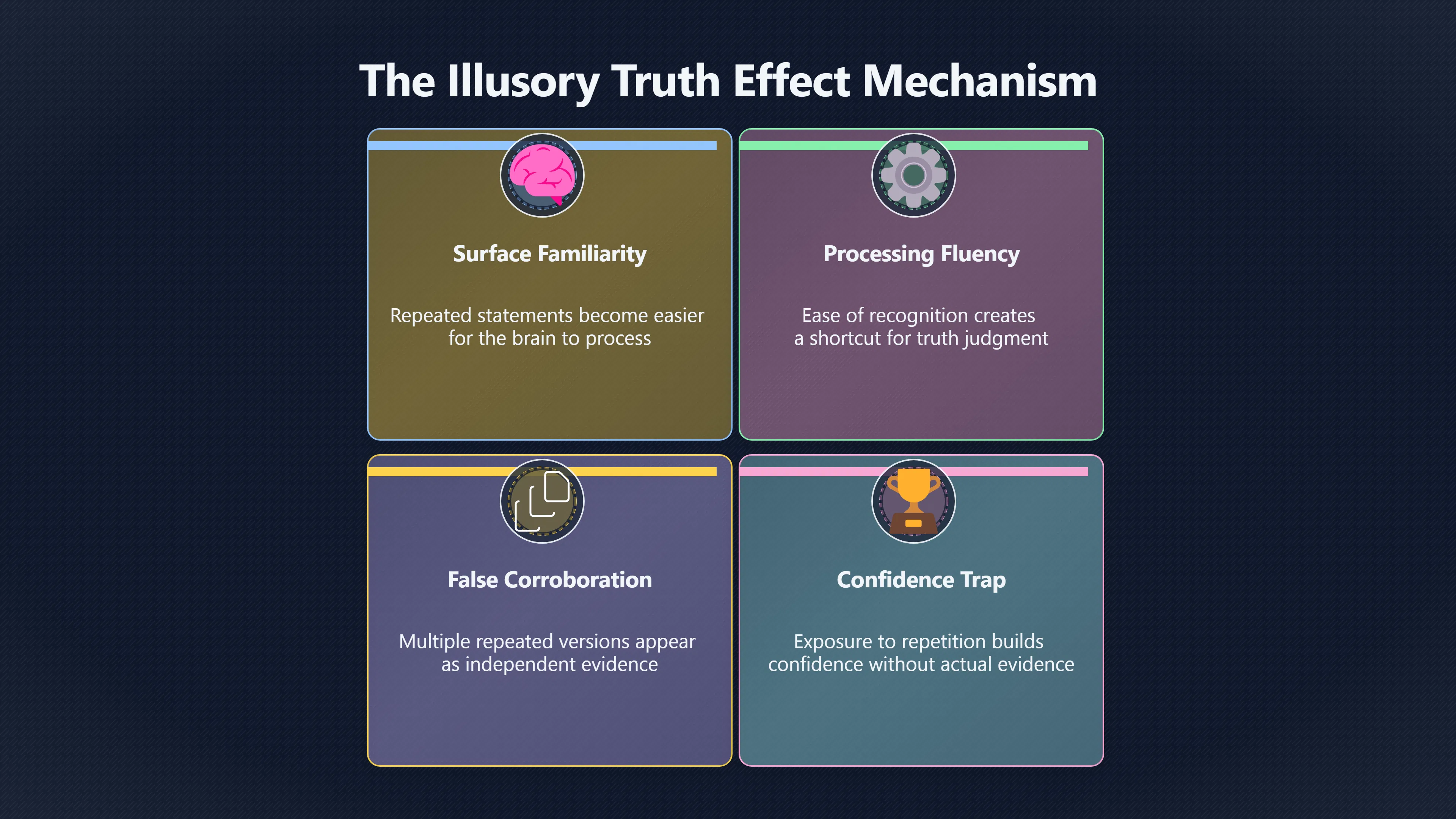
On this page
- What the false news search experiments found
- Why low quality results create false confidence
- How to verify without repeating the claim's wording
Page outline Jump by section
Introduction
Searching online to check whether a claim is true sounds like a sensible defence against misinformation. Yet research shows that this strategy can sometimes backfire. In some circumstances, people who search the web to evaluate a false news story become more likely to believe it afterwards. The problem is not that verification is useless. The problem is that many searches expose users to repetition, low-quality corroboration and misleading signals of credibility rather than reliable evidence. In an information environment shaped by search engines, social media and AI-generated content, understanding this backfire effect is an important part of doing your own research without cherry-picking.[Nature]nature.comOnline searches to evaluate misinformation can increase…by K Aslett · 2024 · Cited by 157 — Although conventional wisdom suggest…
What the false-news search experiments found
One of the most important datasets on this question comes from a series of experiments published in Nature by researchers studying how people evaluate online misinformation. Across five experiments, participants were shown news stories and asked to judge whether they were true. Some participants searched online before making their judgement. Surprisingly, searching increased belief in false stories rather than reducing it.[Nature]nature.comOnline searches to evaluate misinformation can increase…by K Aslett · 2024 · Cited by 157 — Although conventional wisdom suggest…
The effect was not uniform across all situations. Researchers found that the increase in belief was concentrated among people whose searches led them to lower-quality information. Rather than encountering authoritative corrections, these users often landed in what the researchers described as “data voids”: information spaces where the available material consists largely of low-quality pages, recycled claims, partisan commentary or weakly sourced repetition.[PubMed]pubmed.ncbi.nlm.nih.govOnline searches to evaluate misinformation can increase…by K Aslett · 2024 · Cited by 157 — Our results indicate that those who…
The finding challenges a common assumption that independent searching automatically improves accuracy. Instead, the quality of the information encountered during the search appears to matter more than the act of searching itself. When the search environment is poor, verification attempts can become another pathway for misinformation exposure.[Nature]nature.comOnline searches to evaluate misinformation can increase…by K Aslett · 2024 · Cited by 157 — Although conventional wisdom suggest…
Why low-quality results create false confidence
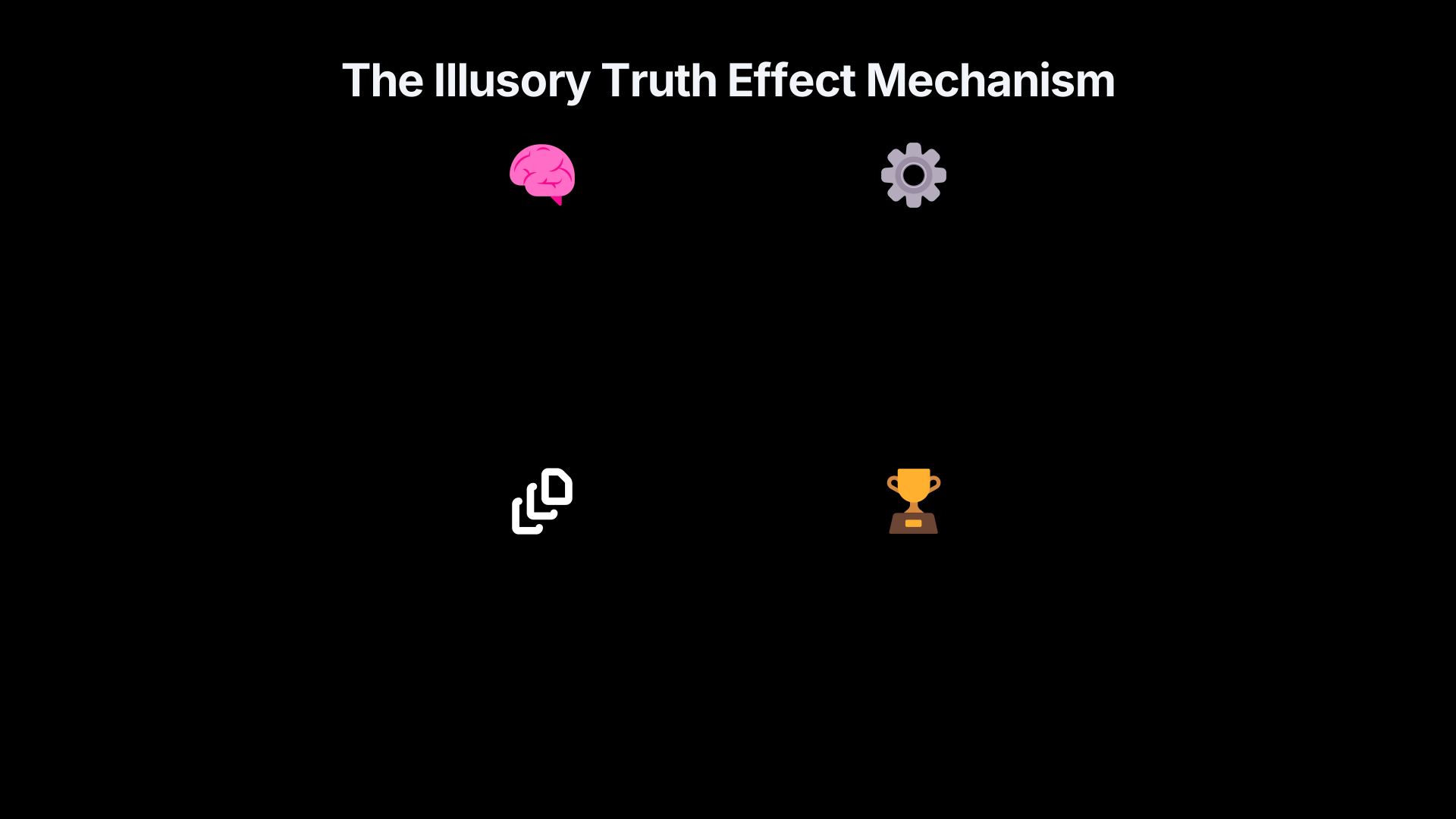
A false claim rarely appears online only once. It is often repeated across blogs, social posts, forums, copied articles and commentary videos. When someone searches for the claim, they may encounter many versions of the same allegation presented as separate pieces of evidence.
This creates a misleading impression of corroboration. Seeing ten pages repeat the same statement can feel like finding ten independent confirmations when, in reality, they may all trace back to a single unsupported source. The searcher experiences abundance, but not necessarily verification.[PubMed]pubmed.ncbi.nlm.nih.govOnline searches to evaluate misinformation can increase…by K Aslett · 2024 · Cited by 157 — Our results indicate that those who…
Psychologists have long documented the “illusory truth effect”: repeated statements feel more believable simply because they become familiar. Familiarity increases processing fluency—the sense that information is easy to recognise and understand—and people often use that feeling as a shortcut when judging truth.[PMC+2Nature]pmc.ncbi.nlm.nih.govThis finding is known as the illusory truth effect, and it is…
This matters because searching for a false claim can dramatically increase exposure to repetitions of that claim. Even when users approach the search with scepticism, repeated encounters can make the statement feel increasingly plausible. Studies have found that repetition can raise perceived truthfulness even when information is false, contradicts existing knowledge or comes from questionable sources.[PMC+2EBSCO]pmc.ncbi.nlm.nih.govThis finding is known as the illusory truth effect, and it is…
The result is a subtle psychological trap:
- The claim becomes familiar.
- Familiarity feels like credibility.
- Multiple repetitions look like multiple sources.
- The searcher leaves with greater confidence than before.
Importantly, the confidence comes from exposure rather than from strong evidence.
Why searching false claims is different from searching true ones
The Nature study found that false stories often generate a search environment that differs from the environment surrounding true stories. False claims can accumulate large numbers of low-quality pages that repeat or discuss the allegation without properly evaluating it. As a result, searching for misinformation may expose users to poorer information overall than searching for accurate news.[ResearchGate]researchgate.netResearchGate(PDF) Online searches to evaluate misinformation can…Dec 20, 2023 — Research suggests that when individuals search online…
This creates an asymmetry. A person attempting to verify a false rumour may encounter:
- Commentary discussing the rumour.
- Posts repeating the allegation.
- Content optimised for clicks rather than evidence.
- AI-generated summaries built from already unreliable material.
- Discussions treating the claim as a live controversy rather than a settled falsehood.
The user experiences a crowded information landscape, which can be mistaken for evidence that “there must be something to it”. Yet quantity and quality are different things. The search results may be numerous while still offering little reliable support.[Nature]nature.comHow online misinformation exploits 'information voids'Jan 9, 2024 — Providers of online search engines and their users need to be e…

How query wording can make the problem worse
Search behaviour is part of the story. Research examining news-verification searches suggests that the way people formulate queries affects the quality of the results they receive. Searches that simply reuse the wording of a misleading headline can pull users deeper into content ecosystems built around the claim itself.[arXiv]arxiv.orgQuery Smarter, Trust Better? Exploring Search Behaviours for Verifying News AccuracyApril 7, 2025…
For example, a search framed around a specific allegation may return pages discussing or repeating that allegation. A search framed around independent evidence, official records or expert evaluations is more likely to surface stronger sources.
This means that two people trying to check the same story can encounter very different information environments depending on how they search. The wording of the query influences what evidence becomes visible.[arXiv]arxiv.orgQuery Smarter, Trust Better? Exploring Search Behaviours for Verifying News AccuracyApril 7, 2025…
How to verify without repeating the claim’s wording
The lesson is not “never search”. The lesson is that effective verification requires a method.
Instead of searching the exact wording of a dramatic claim, try to search for the underlying evidence. Ask questions such as:
- What original document is this based on?
- Which organisation collected the data?
- What do independent experts say about the evidence?
- Has a reputable fact-checking organisation investigated it?
- Are multiple high-quality sources reporting the same facts?
When possible, search for the subject rather than the allegation. A query such as “official election results”, “clinical trial findings”, or “court ruling text” is often more informative than searching a sensational claim verbatim.
It is also useful to compare sources of different types. If the first page of results consists mainly of commentary, look for primary documents, academic research, official records or established news reporting before forming a conclusion.
The broader principle is simple: verification works best when the search process moves the reader toward better evidence. When a search merely surrounds a person with more copies of the same claim, it can create familiarity and false confidence instead of understanding. The strongest protection against this backfire effect is not searching more—it is searching better.[Nature+2PubMed]nature.comOnline searches to evaluate misinformation can increase…by K Aslett · 2024 · Cited by 157 — Although conventional wisdom suggest…
Amazon book picks
Further Reading
Books and field guides related to When Googling a Claim Makes It Stick. Use these as the next step if you want deeper reading beyond the article.
Calling Bullshit: The Art of Skepticism in a Data-Driven World
Explains how weak evidence can create false confidence.

Verified: How to Think Straight, Get Duped Less, and Make Bet...
Directly relevant to verifying claims without reinforcing them.
eBay marketplace picks
Marketplace Samples
Example marketplace items related to this page. Use the search link to explore similar finds on eBay.




Endnotes
1.
Source: nature.com
Link:https://www.nature.com/articles/s41586-023-06883-y
Source snippet
Online searches to evaluate misinformation can increase...by K Aslett · 2024 · Cited by 157 — Although conventional wisdom suggest...
2.
Source: pmc.ncbi.nlm.nih.gov
Link:https://pmc.ncbi.nlm.nih.gov/articles/PMC10794132/
Source snippet
searches to evaluate misinformation can increase its...by K Aslett · 2023 · Cited by 170 — We present consistent evidence that online se...
3.
Source: nature.com
Link:https://www.nature.com/articles/d41586-024-00030-x
Source snippet
How online misinformation exploits 'information voids'Jan 9, 2024 — Providers of online search engines and their users need to be e...
4.
Source: pmc.ncbi.nlm.nih.gov
Link:https://pmc.ncbi.nlm.nih.gov/articles/PMC8116821/
Source snippet
This finding is known as the illusory truth effect, and it is...
5.
Source: nature.com
Link:https://www.nature.com/articles/s41467-026-70041-x
Source snippet
Systematic review and meta-analysis of the evidence for an...by S Ye · 2026 — The illusory truth effect, or repetition-induced truth eff...
6.
Source: ebsco.com
Link:https://www.ebsco.com/research-starters/psychology/illusory-truth-effect
Source snippet
Illusory truth effect | Psychology | Research StartersThe illusory truth effect is a cognitive phenomenon where repeated exposure to fals...
7.
Source: researchgate.net
Link:https://www.researchgate.net/publication/376684904_Online_searches_to_evaluate_misinformation_can_increase_its_perceived_veracity
Source snippet
ResearchGate(PDF) Online searches to evaluate misinformation can...Dec 20, 2023 — Research suggests that when individuals search online...
8.
Source: arxiv.org
Link:https://arxiv.org/abs/2504.05146
Source snippet
Query Smarter, Trust Better? Exploring Search Behaviours for Verifying News AccuracyApril 7, 2025...
Published: April 7, 2025
9.
Source: nature.com
Link:https://www.nature.com/
Source snippet
First published in 1869, Nature is the world's leading multidisciplinary science journal. Nature publishes the finest peer-reviewed...
10.
Source: nature.com
Link:https://www.nature.com/articles/s44159-021-00006-y
Source snippet
The psychological drivers of misinformation belief and its...by UKH Ecker · 2022 · Cited by 1941 — In this Review, we describe the cogni...
11.
Source: nature.com
Link:https://www.nature.com/articles/s41598-026-39555-8
Source snippet
Even factual news from...Read more...
12.
Source: nature.com
Link:https://www.nature.com/articles/s41562-024-02086-1
Source snippet
Nature 625, 548–556 (2024). Article CAS PubMed Google...Read more...
13.
Source: researchgate.net
Link:https://www.researchgate.net/publication/351563163_The_effects_of_repetition_frequency_on_the_illusory_truth_effect
Source snippet
The effects of repetition frequency on the illusory truth effectRepeated information is often perceived as more truthful than new informa...
14.
Source: pubmed.ncbi.nlm.nih.gov
Link:https://pubmed.ncbi.nlm.nih.gov/38123685/
Source snippet
Online searches to evaluate misinformation can increase...by K Aslett · 2024 · Cited by 157 — Our results indicate that those who...
15.
Source: Wikipedia
Title: Illusory truth effect
Link:https://en.wikipedia.org/wiki/Illusory_truth_effect
Source snippet
Illusory truth effectRepetition makes statements easier to process relative to new, unrepeated statements, leading people to believe t...
16.
Source: pmc.ncbi.nlm.nih.gov
Link:https://pmc.ncbi.nlm.nih.gov/articles/PMC10636596/
Source snippet
illusory truth effect leads to the spread of misinformationby V Vellani · 2023 · Cited by 114 — Results of our study suggest that repeate...
17.
Source: thedecisionlab.com
Title: Illusory truth effect
Link:https://thedecisionlab.com/biases/illusory-truth-effect
Source snippet
The Decision...Illusory Truth Effect is the positive feeling when we hear information that we believe to be true because we've heard the...
18.
Source: psychologytoday.com
Title: illusory truth effect
Link:https://www.psychologytoday.com/gb/basics/illusory-truth-effect
Source snippet
12 Nov 2025 — The illusory truth effect is the tendency for any statement that is repeated frequently—whether it is factually true or not...
19.
Source: facebook.com
Link:https://www.facebook.com/Newsweek/posts/the-act-of-searching-online-to-evaluate-news-increases-belief-in-highly-popular-/736964024970711/
Source snippet
Nature 18 January 2024 Online searches to evaluate misinformation can increase...Read more...
Published: January 2024
20.
Source: linkedin.com
Link:https://www.linkedin.com/posts/tonny-johnson-15259b22_online-searches-to-evaluate-misinformation-activity-7154651783670235137-lvmY
Source snippet
Nature nature.com · 2 · Like Comment. Share. Copy...
Additional References
21.
Source: psychologicalscience.org
Link:https://www.psychologicalscience.org/news/repeating-misinformation-doesnt-make-it-true-but-does-make-it-more-likely-to-be-believed.html
Source snippet
Repeating Misinformation Doesn't Make It True, But Does...2 Sept 2020 — The illusory truth effect is the notion that repeated statements...
22.
Source: merriam-webster.com
Link:https://www.merriam-webster.com/dictionary/illusory
Source snippet
ILLUSORY Definition & Meaningillusory implies a false impression based on deceptive resemblance or faulty observation, or influenced by e...
23.
Source: niemanlab.org
Link:https://www.niemanlab.org/2024/01/asking-people-to-do-the-research-on-fake-news-stories-makes-them-seem-more-believable-not-less/
Source snippet
Asking people to “do the research” on fake news stories...8 Jan 2024 — We also find consistent evidence that searching online to evaluat...
24.
Source: dmas.lab.mcgill.ca
Link:https://dmas.lab.mcgill.ca/fung/pub/BSWF24tcss_preprint.pdf
Source snippet
Literature Review on Detecting, Verifying, and Mitigating...Overall, the literature shows that false information can generally be classi...
25.
Source: facebook.com
Title: didyouknow that misinformation often becomes believable through repetition this
Link:https://www.facebook.com/illinoissbe/posts/didyouknow-that-misinformation-often-becomes-believable-through-repetition-this-/861629286005422/
Source snippet
The “illusory” Truth Effect….28 May 2024 — DidYouKnow that Misinformation often becomes believable through repetition? This cognitive bia...
Published: May 2024
26.
Source: eufactcheck.eu
Link:https://eufactcheck.eu/blogpost/the-illusory-truth-effect-how-repeated-misinformation-sticks/
Source snippet
The illusory truth effect: how repeated misinformation sticks31 Jan 2026 — The illusory truth effect: how repeated misinformation sticks...
27.
Source: kaslett.github.io
Link:https://kaslett.github.io/Documents/Do_Your_Own_Research_Aslett_et_al.pdf
Source snippet
hing online to verify the veracity of false or misleading articles increases belief in them...Read more...
28.
Source: cddrl.fsi.stanford.edu
Title: online searches evaluate misinformation can increase its perceived veracity 0
Link:https://cddrl.fsi.stanford.edu/publication/online-searches-evaluate-misinformation-can-increase-its-perceived-veracity-0
Source snippet
Online searches to evaluate misinformation can increase its perceived veracity. Breadcrumb. All CDDRL...Read more...
29.
Source: factcheckhub.com
Link:https://factcheckhub.com/how-search-engines-are-amplifying-misinformation-study/
Source snippet
How search engines are amplifying misinformation - StudyDec 22, 2023 — The study: Online searches to evaluate misinformation can increase...
30.
Source: cam.ac.uk
Link:https://www.cam.ac.uk/stories/inoculateexperiment
Source snippet
ion can help to “inoculate” people against harmful content on social media.Read more...
Topic Tree