Within News Deserts
The Local Misinformation Numbers That Matter
The SMF analysis shows why news-related posts in local feeds can be much riskier than overall group activity suggests.
On this page
- What the study counted across platforms
- Why news related posts change the risk picture
- Limits that may understate local misinformation
Page outline Jump by section
Introduction
The Social Market Foundation (SMF) dataset is important because it measures something that is usually discussed only through anecdotes: how much misinformation appears in everyday local social media feeds. Rather than focusing on national viral stories, the study examined what people actually encounter when looking for information about their own communities. Its central finding is striking. Areas with weak local journalism experienced substantially higher levels of local misinformation, and the difference became even more pronounced when researchers looked specifically at news-related content rather than all posts.[SMF]smf.co.ukNo news is bad news June 2026 correctNo NEWs IS BAD NEWSJune 8, 2026 — 3 Jun 2026 — Two of the notable examples of misinformation's harmful impact in recent times are…
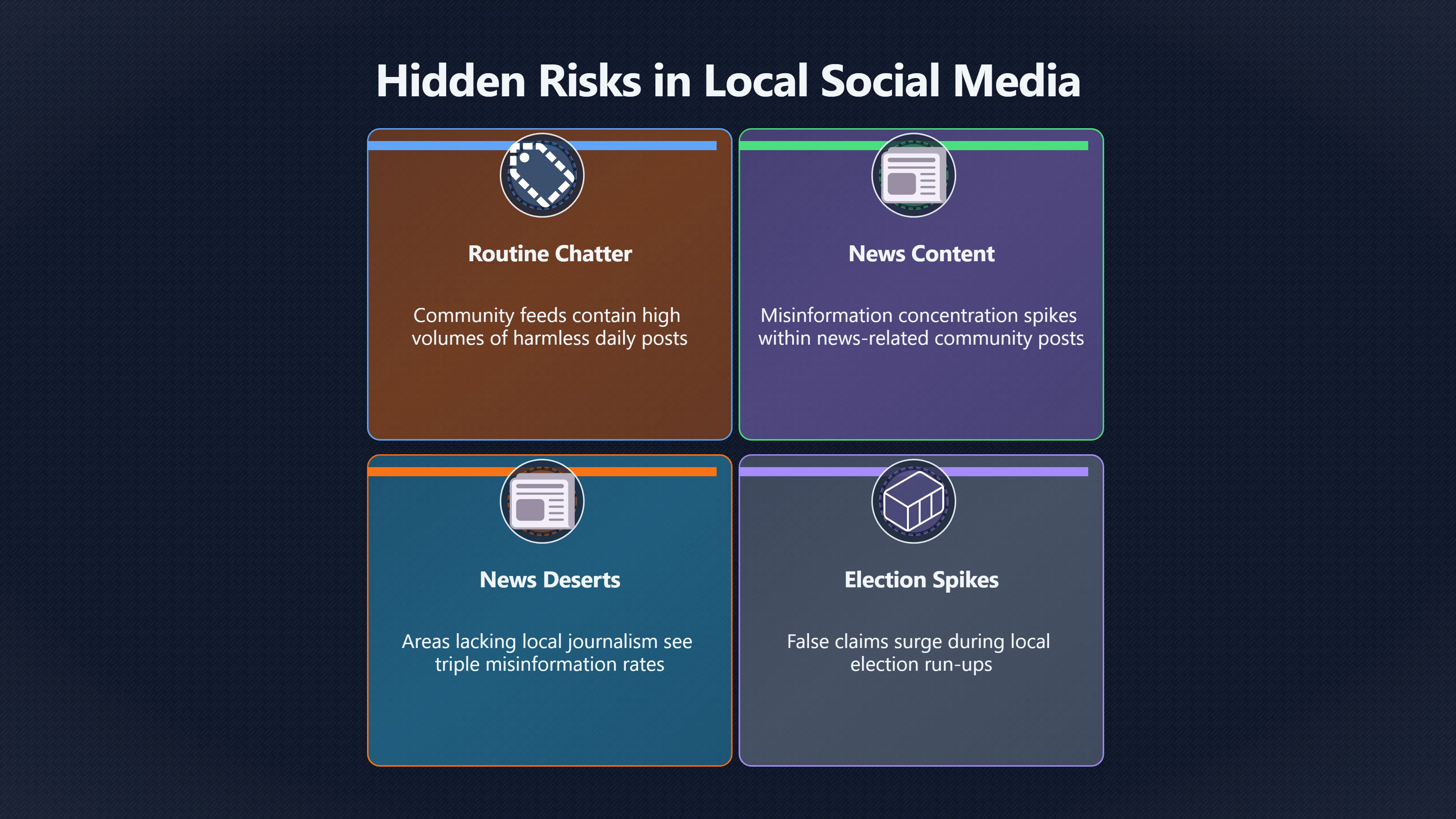
 For readers interested in critical thinking, the dataset highlights a key lesson: overall activity levels in local groups can hide the true risk. Most posts may be harmless community chatter, but the subset dealing with news, politics, public services, crime, immigration or local events contains a much higher concentration of false or misleading claims.[SMF]smf.co.ukNo news is bad news June 2026 correctNo NEWs IS BAD NEWSJune 8, 2026 — 3 Jun 2026 — Two of the notable examples of misinformation's harmful impact in recent times are…
What the study counted across platforms
The SMF analysed more than 125,000 social media posts drawn from local online spaces across the United Kingdom. Researchers sampled 95 locations and examined content appearing in local Facebook groups, location-based searches on X, and neighbourhood communities on Nextdoor. The aim was not to track a single rumour but to estimate how frequently misinformation appeared in ordinary local information environments.[The Guardian]theguardian.comTopics such as immigration and Islamophobia are the most frequent subjects of false claims. The spread intensifies around elections, with…
Several findings stand out:
- Two in five Facebook groups studied contained at least one item of misinformation within the sampled posts.
- More than four in five X searches contained at least one example.
- A smaller but still significant number of Nextdoor communities also contained misinformation.
- Areas classified as local news deserts or news “drylands” showed misinformation rates roughly three times higher than areas with stronger local news provision.[The Guardian+2SMF]theguardian.comTopics such as immigration and Islamophobia are the most frequent subjects of false claims. The spread intensifies around elections, with…
The dataset also identified recurring themes. Immigration, local politics, council decisions, public services, crime-related claims and community tensions appeared repeatedly. Some examples involved fabricated quotations, misleading graphics, manipulated images, fake council announcements and AI-generated content presented as genuine local information.[SMF]smf.co.ukNo news is bad news June 2026 correctNo NEWs IS BAD NEWSJune 8, 2026 — 3 Jun 2026 — Two of the notable examples of misinformation's harmful impact in recent times are…
A useful aspect of the dataset is that it moves beyond national debates about misinformation and focuses on highly local claims. These are often harder for outsiders to verify and more likely to be trusted because they concern familiar places, institutions and people.[SMF]smf.co.ukNo news is bad news June 2026 correctNo NEWs IS BAD NEWSJune 8, 2026 — 3 Jun 2026 — Two of the notable examples of misinformation's harmful impact in recent times are…
Why news-related posts change the risk picture
One of the most revealing findings is the difference between misinformation as a share of all content and misinformation as a share of news-related content.
At first glance, misinformation can appear relatively rare when measured against every post in a community feed. Local groups contain large volumes of routine material: lost pets, recommendations, weather updates, local business notices and social conversations. Against that background, misinformation may seem like a small fraction of overall activity.[SMF]smf.co.ukNo news is bad news June 2026 correctNo NEWs IS BAD NEWSJune 8, 2026 — 3 Jun 2026 — Two of the notable examples of misinformation's harmful impact in recent times are…
The picture changes when attention shifts to posts that function as news. The SMF found that nearly one in twenty-six news-related Facebook posts contained misinformation. On X, more than one in four news-related posts fell into that category. These figures are dramatically higher than measurements based on all posts combined.[The Guardian]theguardian.comTopics such as immigration and Islamophobia are the most frequent subjects of false claims. The spread intensifies around elections, with…
This distinction matters because people do not rely on local feeds primarily for pet photos or marketplace listings when making civic decisions. They rely on them for information about elections, council actions, schools, policing, planning disputes and community controversies. The dataset therefore suggests that the practical risk to public understanding is concentrated in exactly the type of content most likely to influence opinions and decisions.[SMF]smf.co.ukNo news is bad news June 2026 correctNo NEWs IS BAD NEWSJune 8, 2026 — 3 Jun 2026 — Two of the notable examples of misinformation's harmful impact in recent times are…
For critical thinking, the implication is straightforward: a feed that appears mostly harmless can still be a significant source of misinformation if the misleading material is clustered around news and public affairs rather than distributed evenly across all content.
What election-period data reveals
The dataset also captured an important pattern around elections. Misinformation increased as a proportion of news-related posts during local election periods. According to the SMF analysis, misinformation’s share of news-related Facebook content rose from 8.2% in the baseline period to 12.9% during the run-up to local elections, an increase of 56%.[SMF]smf.co.ukNo news is bad news June 2026 correctNo NEWs IS BAD NEWSJune 8, 2026 — 3 Jun 2026 — Two of the notable examples of misinformation's harmful impact in recent times are…
A detailed case study of the 2026 Gorton and Denton by-election illustrated how concentrated these effects can become. Researchers found misinformation levels far above the baseline measured in their broader Facebook sample. False claims targeted multiple political parties and candidates, including fabricated quotations, misleading allegations and manipulated political content.[SMF]smf.co.ukNo news is bad news June 2026 correctNo NEWs IS BAD NEWSJune 8, 2026 — 3 Jun 2026 — Two of the notable examples of misinformation's harmful impact in recent times are…
The significance of this finding is not that any single false story changed an election outcome. The study explicitly notes that such effects cannot be measured directly. Instead, the evidence shows that election periods create conditions in which misleading local political information becomes more common and more visible.[SMF]smf.co.ukNo news is bad news June 2026 correctNo NEWs IS BAD NEWSJune 8, 2026 — 3 Jun 2026 — Two of the notable examples of misinformation's harmful impact in recent times are…
For residents scrolling through local feeds, this means the periods when accurate information matters most may also be the periods when misinformation becomes harder to avoid.
Limits that may understate local misinformation
An important strength of the SMF report is that it openly discusses its limitations. Those limitations suggest the findings may actually be conservative.
Researchers note that their methodology was restricted in ways that could lead to undercounting misinformation. The analysis focused on sampled posts visible during collection rather than every piece of content circulating within a community. Private conversations, deleted material, restricted groups and rapidly spreading content outside the sampling window may not have been captured.[SMF]smf.co.ukNo news is bad news June 2026 correctNo NEWs IS BAD NEWSJune 8, 2026 — 3 Jun 2026 — Two of the notable examples of misinformation's harmful impact in recent times are…
The study also depended on manual identification of misinformation. That approach improves judgement and context compared with purely automated systems, but it inevitably means some borderline cases are excluded. Researchers generally prefer clear evidence before classifying content as misinformation, which tends to reduce false positives but can miss more subtle forms of misleading content.[SMF]smf.co.ukNo news is bad news June 2026 correctNo NEWs IS BAD NEWSJune 8, 2026 — 3 Jun 2026 — Two of the notable examples of misinformation's harmful impact in recent times are…
Another reason the figures may understate risk is that misinformation often spreads unevenly. The report found some groups with very little misinformation and others where false claims appeared much more frequently. Averages therefore mask highly exposed communities where users encounter misinformation at much higher rates than the national pattern suggests.[SMF]smf.co.ukNo news is bad news June 2026 correctNo NEWs IS BAD NEWSJune 8, 2026 — 3 Jun 2026 — Two of the notable examples of misinformation's harmful impact in recent times are…
Why this dataset matters for critical thinking
The most important contribution of the SMF dataset is that it changes the question from “Is there misinformation in local social media?” to “How much misinformation appears where people actually get local news?”
The evidence suggests that overall platform activity is a poor guide to risk. A community feed may contain thousands of ordinary posts while still exposing residents to a significant amount of misleading information about local affairs. The concentration of misinformation within news-related content, the higher rates in news deserts, and the election-period spikes all point to the same conclusion: evaluating the reliability of local information requires looking specifically at the content that performs a news function, not merely at the total volume of posts.[SMF+2SMF]smf.co.ukNo news is bad news June 2026 correctNo NEWs IS BAD NEWSJune 8, 2026 — 3 Jun 2026 — Two of the notable examples of misinformation's harmful impact in recent times are…
For anyone navigating social media in an age of AI-generated content and declining local journalism, that is the local misinformation number that matters most. The risk is not hidden in every post. It is concentrated in the posts people are most likely to use when deciding what is true about their community.[SMF]smf.co.ukNo news is bad news June 2026 correctNo NEWs IS BAD NEWSJune 8, 2026 — 3 Jun 2026 — Two of the notable examples of misinformation's harmful impact in recent times are…
Amazon book picks
Further Reading
Books and field guides related to The Local Misinformation Numbers That Matter. Use these as the next step if you want deeper reading beyond the article.
Calling Bullshit
Helps readers interpret statistics and misinformation claims responsibly.

The art of thinking clearly
Explains reasoning errors that contribute to misinformation spread.

eBay marketplace picks
Marketplace Samples
Example marketplace items related to this page. Use the search link to explore similar finds on eBay.




Endnotes
1.
Source: smf.co.uk
Title: No news is bad news June 2026 correct
Link:https://www.smf.co.uk/wp-content/uploads/2026/06/No-news-is-bad-news-June-2026-correct.pdf
Source snippet
No NEWs IS BAD NEWSJune 8, 2026 — 3 Jun 2026 — Two of the notable examples of misinformation's harmful impact in recent times are...
Published: June 2026
2.
Source: smf.co.uk
Link:https://www.smf.co.uk/fake-news-nearly-three-times-more-common-in-areas-without-local-journalism-and-spikes-during-elections-new-research-finds/
Source snippet
"Fake news nearly three times more common in areas...5 days ago — The SMF report, No news is bad news, will be published at [https://www.s..."](https://www.s...")...
3.
Source: smf.co.uk
Link:https://www.smf.co.uk/publications/social-media-local-misinformation/
Source snippet
The hidden threat of unchecked local misinformation6 days ago — Of 19 Nextdoor locations studied, 3 were found to contain misinformation...
4.
Source: facebook.com
Link:https://www.facebook.com/groups/384926985723985/posts/1751943585688978/
Source snippet
e times the national average of fake news disseminated in...Read more...
5.
Source: theguardian.com
Link:https://www.theguardian.com/media/2026/jun/08/social-media-groups-fuel-misinfomation-uk-news-deserts-report
Source snippet
Topics such as immigration and Islamophobia are the most frequent subjects of false claims. The spread intensifies around elections, with...
Additional References
6.
Source: linkedin.com
Link:https://www.linkedin.com/posts/lucianaberger_no-news-is-bad-news-the-hidden-threat-of-activity-7470426353767714817-pXqD
Source snippet
Luciana Berger's PostLuciana Berger's Post... No news is bad news: The hidden threat of unchecked local misinformation - Social Market F...
7.
Source: x.com
Link:https://x.com/SMFthinktank/status/2063902572151251135
Source snippet
The hidden threat of unchecked local misinformationOur manual analysis of 125,000+ posts across Facebook groups, X and Nextdoor found fak...
8.
Source: researchgate.net
Link:https://www.researchgate.net/publication/374753818_No_news_is_bad_news_local_news_intensity_and_firms%27_information_environments
Source snippet
follows is in the top tercile by year. Accuracy = Negative 100 times the absolute value of mean analyst...Read more...
9.
Source: holdthefrontpage.co.uk
Link:https://www.holdthefrontpage.co.uk/2026/news/fake-news-three-times-as-common-in-news-deserts-says-report/
Source snippet
three times the national average of fake news disseminated in local Facebook groups.Read more...
10.
Source: youtube.com
Title: As News Deserts Spread Across US, Trust Breaks Down | VOANews
Link:http://www.youtube.com/watch?v=F0WfJpcz4Do
Source snippet
"News deserts" misinformation local journalism “Abernathy Report" confirms the expansion of "news deserts" & misinformation Editor and Pu...
11.
Source: youtube.com
Link:http://www.youtube.com/watch?v=NVv1T5FDjvw
Source snippet
Are News Deserts Silencing Your Community? The Truth They’re Not Telling You! (w/Craig Lazzeretti)...
12.
Source: smartthinking.org.uk
Link:https://smartthinking.org.uk/event/local-misinformation-social-media-groups-and-the-role-of-local-journalism/
Source snippet
nature of misinformation found in local social media forums...
13.
Source: youtube.com
Link:http://www.youtube.com/watch?v=qTvjbiUxlfU
Source snippet
The Rise of News Deserts: Local Journalism in Crisis | Big [If True] | Full Episode...
14.
Source: smartthinking.org.uk
Link:https://smartthinking.org.uk/report/no-news-is-bad-news/
Source snippet
misinformation... No news is bad news...Read more...
15.
Source: manhattan.institute
Title: news deserts no news is bad news
Link:https://manhattan.institute/article/news-deserts-no-news-is-bad-news
Source snippet
News Deserts: No News Is Bad News2 Oct 2018 — News Deserts: No News Is Bad News. Cities · Urban Policy 2018... the spread of eye-catchin...
Topic Tree