Within Think Before Sharing
Not All Evidence Deserves Equal Weight
Studies, filings, datasets, regulator notices, named experts, leaks, and anonymous posts carry different kinds of reliability.
On this page
- Strong and weak evidence types
- Failure modes by source
- How to match evidence to claims
Page outline Jump by section
Introduction
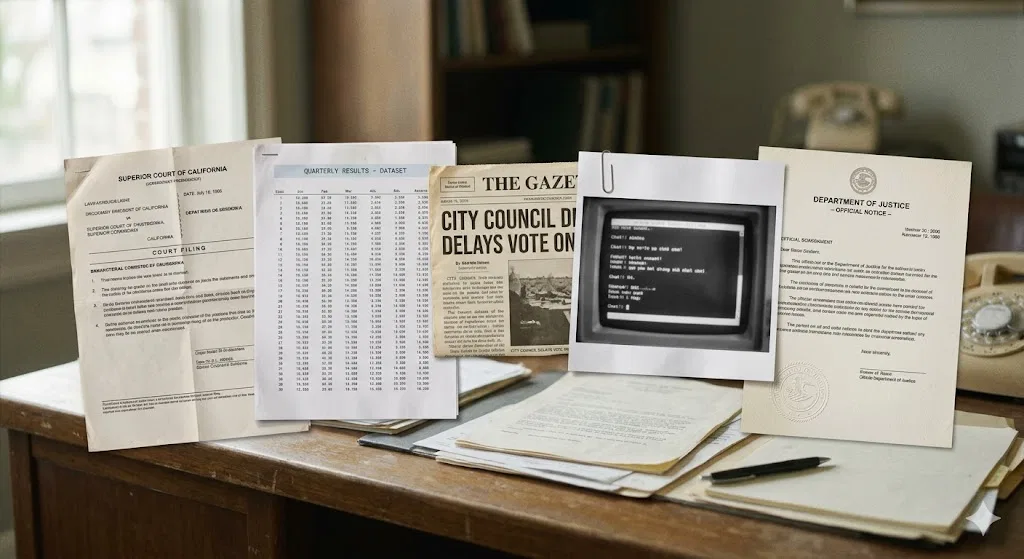
Not all evidence deserves equal weight. In a social feed, a leaked screenshot, a government notice, a peer-reviewed study, a company filing, a viral chart and an anonymous post can appear in the same visual format: a rectangle with text, an image, a share count and a comment thread. Critical thinking means refusing to let that visual sameness become evidential sameness. A strong online claim should be matched to the strongest available evidence for that kind of claim: audited filings for corporate numbers, regulator notices for enforcement actions, datasets and methods for statistical claims, direct records for events, and named expertise for interpretation. Weak evidence is not always useless, but it is often preliminary, partial or easy to manipulate.
The practical question is not “Is this source good or bad?” It is “What kind of claim is being made, and what evidence would be capable of proving it?” That distinction matters because many false or misleading posts win attention by using a real-looking source in the wrong role: a rumour presented as confirmation, a chart without a dataset, an expert opinion treated as measurement, or a screenshot treated as a document.
Why evidence feels flatter online than it really is
Online platforms strip away many of the signals that used to help readers judge evidence. A regulator’s notice, a journalist’s reconstruction, a campaign group’s allegation, a company press release and a stranger’s post can all be cropped into the same screenshot. The surrounding metrics then compete for attention: who posted it, how many people liked it, whether a favourite account endorsed it, and whether it confirms what the reader already suspected.
This flattening is especially risky in fast-moving situations. First Draft’s verification guidance warns that rumours and manipulated content are often seeded in online spaces in the hope that journalists, influencers or ordinary users will amplify them to a wider audience. It also stresses that debunking can accidentally spread a false claim further if the claim had little reach in the first place. The evidential question is therefore not only “Is this true?” but also “Has this claim been independently verified, and is repeating it necessary?”[First Draft]firstdraftnews.orgFirst Draft Verifying online information: The absolute essentialsResearch shows that even writing 'debunks' can, in some circumstances, solidify false rumours…
A related problem is the “data void”: a search or social-search space where reliable information is scarce, missing or hard to find. Data & Society’s work on data voids shows how obscure, breaking or newly coined terms can be exploited because there are few high-quality results to compete with manipulative content. In those conditions, the first available “evidence” may be not the best evidence, but simply the fastest evidence.[Data & Society]datasociety.netData & Society Data VoidsData & SocietyData VoidsNovember 18, 2019 — Data voids are one such way that search users can be led into disinformation or manipulated c…
AI makes this more acute because it can produce fluent explanations, realistic images, plausible-looking references and synthetic summaries at scale. The response should not be to distrust everything. It should be to separate the claim from its packaging and ask what kind of evidence would actually settle the matter.
Strong and weak evidence types
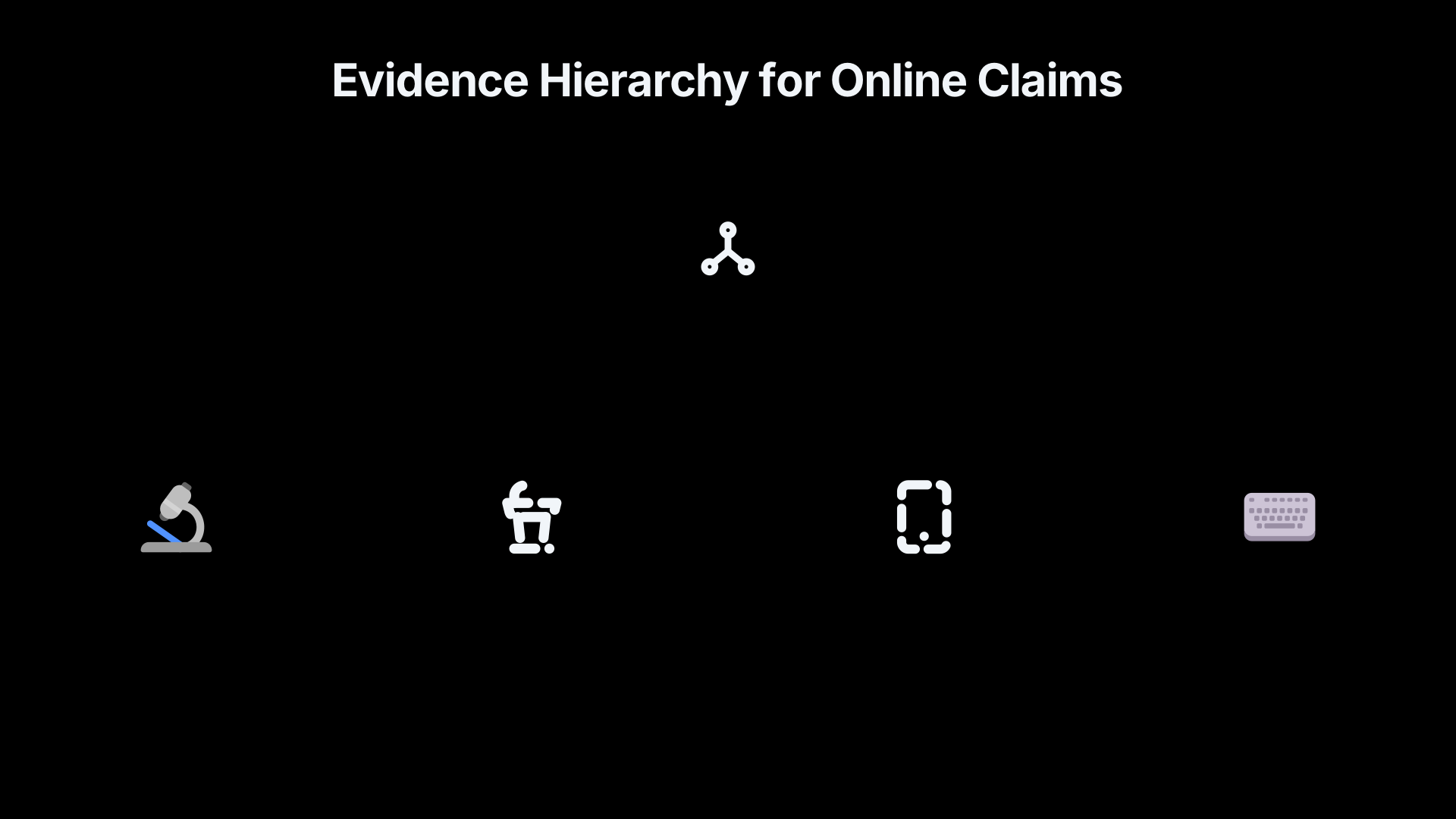
A useful evidence hierarchy for online claims is not a single ladder that works for every topic. Medical evidence, legal evidence, financial evidence, eyewitness evidence and investigative evidence are judged differently. Still, some broad principles travel well: direct evidence usually beats second-hand description; transparent methods beat unsupported assertion; independently checkable records beat screenshots; and multiple independent lines of evidence beat a single convenient item.
Records that are hard to fake or costly to misstate
For some claims, the strongest evidence is a formal record produced under legal, regulatory or institutional constraints. Public company filings, court documents, procurement records, parliamentary records, official statistics and regulator notices are not automatically perfect, but they usually carry more weight than a post summarising them. They are also often checkable: dates, identifiers, filing histories, amendments and named responsible bodies can be inspected.
Financial claims are a clear example. In the United States, the Securities and Exchange Commission warns investors to be wary of claims that the SEC has “approved” an offering, because registration does not mean the agency has endorsed the investment. That distinction is exactly why primary filings matter: they can confirm that a document exists while also showing what it does and does not prove.[Investor]investor.govalert beware claims sec has approved offeringsBeware of Claims That the SEC Has Approved Offerings30 Apr 2019 — The SEC's Office of Investor Education and Advocacy is issuing…
Regulatory notices have similar strengths and limits. The US Food and Drug Administration’s warning-letter database is a strong source for the fact that the FDA identified alleged violations at a particular time. But the FDA also cautions that matters described in warning letters may later have changed after further interaction with the recipient. A warning letter is therefore strong evidence of a regulator’s stated concern, not final proof of every underlying fact forever.[U.S. Food and Drug Administration]fda.govwarning lettersFood and Drug AdministrationWarning LettersSeptember 25, 2025 — Learn about the types of warning letters on FDA's website. Matters descri…
In the UK market context, the London Stock Exchange describes its Regulatory News Service as a route through which listed companies and their advisers fulfil disclosure obligations. For claims about what a listed company formally announced, such a disclosure channel is typically stronger than a cropped image of a tweet or an influencer’s paraphrase.[LSEG]lseg.comRegulatory News Services (RNS)RNS is the UK's leading service for regulatory news announcements. The provider of choice for companies…
Datasets and studies that reveal patterns, not isolated anecdotes
Dataset-based evidence is powerful when the claim is about scale, frequency, change over time or correlation. A single viral example can show that something happened; it cannot show how common it is. For claims such as “AI misinformation is going viral more often” or “community fact-checking reduces sharing”, the relevant evidence is not one memorable post but a dataset, a sampling method and an analysis that other researchers can scrutinise.
Research on Community Notes shows both the value and limits of this kind of evidence. A 2024 PNAS Nexus study found that people trusted contextual Community Notes more than simple misinformation flags in an experiment using real posts and notes surfaced by the platform’s bridging algorithm. Other large-scale work has found that community notes can reduce engagement with and diffusion of misleading posts.[PMC]pmc.ncbi.nlm.nih.govOpen source on nih.gov.
But the same evidence category can also reveal weaknesses. A 2026 study of consensus stability reported that 30.2% of displayed Community Notes in its dataset later lost helpful status and disappeared, suggesting that crowdsourced correction is not a simple stamp of truth. Another 2025 paper argued that Community Notes-style systems can be vulnerable to rater bias and manipulation in simulated conditions. The lesson is not that Community Notes are worthless; it is that evidence about them must distinguish between trust, speed, coverage, stability and resistance to manipulation.[arXiv]arxiv.orgOpen source on arxiv.org.
Scientific and medical claims require an even more careful match between claim and evidence. The Oxford Centre for Evidence-Based Medicine explains that levels of evidence were designed to make evidence-finding feasible and explicit, while also acknowledging that hierarchies can be used too rigidly. Cochrane’s evidence guidance similarly treats systematic reviews and well-designed trials as especially important for intervention claims, while recognising that non-randomised evidence may be relevant depending on the question.[CEBM]cebm.ox.ac.ukocebm levels of evidenceocebm levels of evidence
Named expertise that explains, but does not replace evidence
Named experts can be valuable because they understand methods, context and common traps. A virologist can explain why a lab claim is implausible; a securities lawyer can explain what a filing means; an image-forensics specialist can explain how to test a video. Expertise is especially useful when primary evidence is technical.
But expert comment is strongest when it is tied to inspectable evidence. A named expert saying “this document appears inconsistent with normal filing practice because of these features” is much stronger than a named expert saying “I doubt it” without explanation. Expertise should clarify the evidence chain, not become a substitute for it.
The same applies to journalists and open-source investigators. Bellingcat’s beginner guidance on social media verification emphasises practical checks such as searching for earlier appearances of an image, examining context and testing whether a photo or video has been misattributed. Its toolkit includes resources for verifying photos and videos, archiving pages and using satellite or mapping services. That kind of expertise is valuable because it shows the work: source, time, location, comparison and uncertainty.[bellingcat.gitbook.io]bellingcat.gitbook.ioOpen source on gitbook.io.
Eyewitness posts, leaks and anonymous claims
Eyewitness posts can be important early evidence, especially during disasters, protests, conflicts or local emergencies. They may provide the first visual record of an event. But they are also fragile: the witness may be mistaken, the time and place may be unclear, the clip may show only one angle, and reposts may detach the material from its original context.
Leaks sit in the middle of the hierarchy. A leaked document may be genuine and highly significant, but the word “leak” says nothing by itself about authenticity, completeness or motive. Stronger leaked evidence usually has verifiable metadata, corroboration from independent records, consistency with known facts, and careful reporting about what has been withheld or redacted. A screenshot of a “leak” with no provenance is weaker than a leaked document authenticated by multiple independent checks.
Anonymous posts are weaker still when used as proof. They can be useful leads, especially when they point to checkable records, but anonymity removes accountability and makes motive harder to assess. An anonymous claim should rarely be treated as a conclusion. It should be treated as a prompt for verification.

Failure modes by source
Every evidence type has characteristic ways to mislead. Strong critical thinking does not mean memorising a fixed ranking; it means knowing how each source can fail.
Official records can be real but misread. A court filing may contain allegations rather than findings. A regulator notice may describe suspected or alleged breaches rather than final adjudication. A company filing may disclose a risk without saying that the risk has already happened. The SEC’s warning about false claims of “approval” is a good example: a real registration process can be rhetorically inflated into a false endorsement.[Investor]investor.govalert beware claims sec has approved offeringsBeware of Claims That the SEC Has Approved Offerings30 Apr 2019 — The SEC's Office of Investor Education and Advocacy is issuing…
Datasets can be impressive but badly matched to the claim. A large dataset does not automatically answer the reader’s question. It may cover the wrong platform, country, language, time period or definition. The DSA Transparency Database illustrates both promise and difficulty: researchers have analysed enormous numbers of platform “statements of reasons”, but have also found variation and compliance problems that complicate interpretation.[arXiv]arxiv.orgOpen source on arxiv.org.
Charts can turn uncertainty into false precision. A chart without a source, sample, date range or definition is decoration, not evidence. Even when the underlying data is real, visual choices can exaggerate change, hide base rates or imply causation from correlation. A claim about “surging” crime, illness, fraud or censorship needs the denominator, not just the numerator.
Expertise can be overextended. A named expert is strongest inside their field and weakest when used as a general authority badge. A machine-learning researcher is not automatically an election-law expert; a doctor is not automatically an expert in pharmaceutical regulation; a journalist who has covered a country is not automatically a witness to a specific event.
News reports can be accurate but provisional. Good journalism often labels uncertainty: “according to officials”, “based on preliminary data”, “could not independently verify”. Social reposts often strip those qualifiers away. A report that says “authorities are investigating whether X happened” may become a viral claim that “X happened”.
Fact-checks can settle narrow claims but not every surrounding dispute. A fact-check might show that a specific image is old, that a quote is fabricated or that a number is wrong. It does not automatically resolve broader political, moral or scientific debates. Treat fact-checks as precise tools: strongest when they identify a concrete claim, show the evidence and explain the reasoning.
Screenshots can preserve or distort. They are easy to crop, edit, misdate or detach from context. A screenshot of a deleted post is weaker than an archived page, platform record, independent capture or multiple contemporaneous captures. If the screenshot is the only evidence, the right confidence level is usually low.
Community correction can be useful but uneven. Community Notes-style systems can add context at scale, but studies and investigations point to delays, non-publication, polarisation and vulnerability to manipulation. A visible note is evidence that a platform’s correction system has surfaced a particular context; it is not the same as a court finding, a regulator decision or a peer-reviewed study.[LSE Blogs]blogs.lse.ac.ukLSE Blogs Do Community Notes work?LSE Blogs Do Community Notes work?
How to match evidence to claims
The quickest way to improve judgement is to stop asking “Do I trust this source?” as the first question. Ask what the claim is asking you to believe. Different claims need different proof.
For a claim that a company made, lost or concealed money, look first for audited accounts, regulatory filings, formal market announcements and clearly dated company disclosures. A finance influencer’s spreadsheet may help explain the issue, but it should not outrank the filing it claims to summarise.
For a claim that a medicine, supplement or treatment works, look for systematic reviews, clinical trials, regulator assessments and clear outcome measures. Testimonials may suggest questions worth studying, but they are weak evidence of effectiveness because they cannot separate treatment effects from placebo effects, natural recovery, selection bias or selective sharing. The Oxford and Cochrane frameworks are useful here because they ask what kind of study design is capable of answering the question.[CEBM]cebm.ox.ac.ukoxford centre for evidence based medicine levels of evidence march 2009oxford centre for evidence based medicine levels of evidence march 2009
For a claim that a public event happened at a specific time and place, look for original footage, metadata where available, geolocation, weather or shadow checks, contemporaneous local reporting, official statements and independent witnesses. Bellingcat-style open-source verification is strong when it combines several of these, not when it relies on a single viral clip.[bellingcat]bellingcat.coma beginners guide to social media verificationa beginners guide to social media verification
For a claim that a platform removed, restricted or labelled content, look for platform notices, transparency databases, policy text and independent audits. The EU Digital Services Act requires online platforms to provide information about certain moderation decisions through “statements of reasons”, and trusted flaggers are designated entities that can submit notices about potentially illegal content. Those mechanisms are useful evidence, but they still require interpretation: a moderation action may show a platform decision, not necessarily the truth or falsity of the underlying post.[Digital Strategy]digital-strategy.ec.europa.euOpen source on europa.eu.
For a claim that “people are saying” something, ask for scale. Is it one account, a coordinated network, a representative survey, a trend in search data, or a measured shift in behaviour? Without that distinction, a post can turn a handful of examples into a false picture of public opinion.
For a claim that AI generated, altered or fabricated content, avoid relying only on visual intuition. Synthetic media detection remains difficult, and real footage can be dismissed with the lazy phrase “it could be AI”. Stronger assessment uses provenance, original upload history, reverse image search, cross-checks with known locations, and corroboration from independent sources. Recent reporting on deepfake-era verification has highlighted that professional investigators still rely heavily on context, source history, metadata and geolocation rather than a single magic detector.[The Verge]theverge.comThe Verge How the experts figure out what's real in the age of deepfakesExperts share a four-step process for verifying content: 1) closely examining visuals for anomalies, 2) evaluating the credibility and hi…
A practical hierarchy for everyday feeds
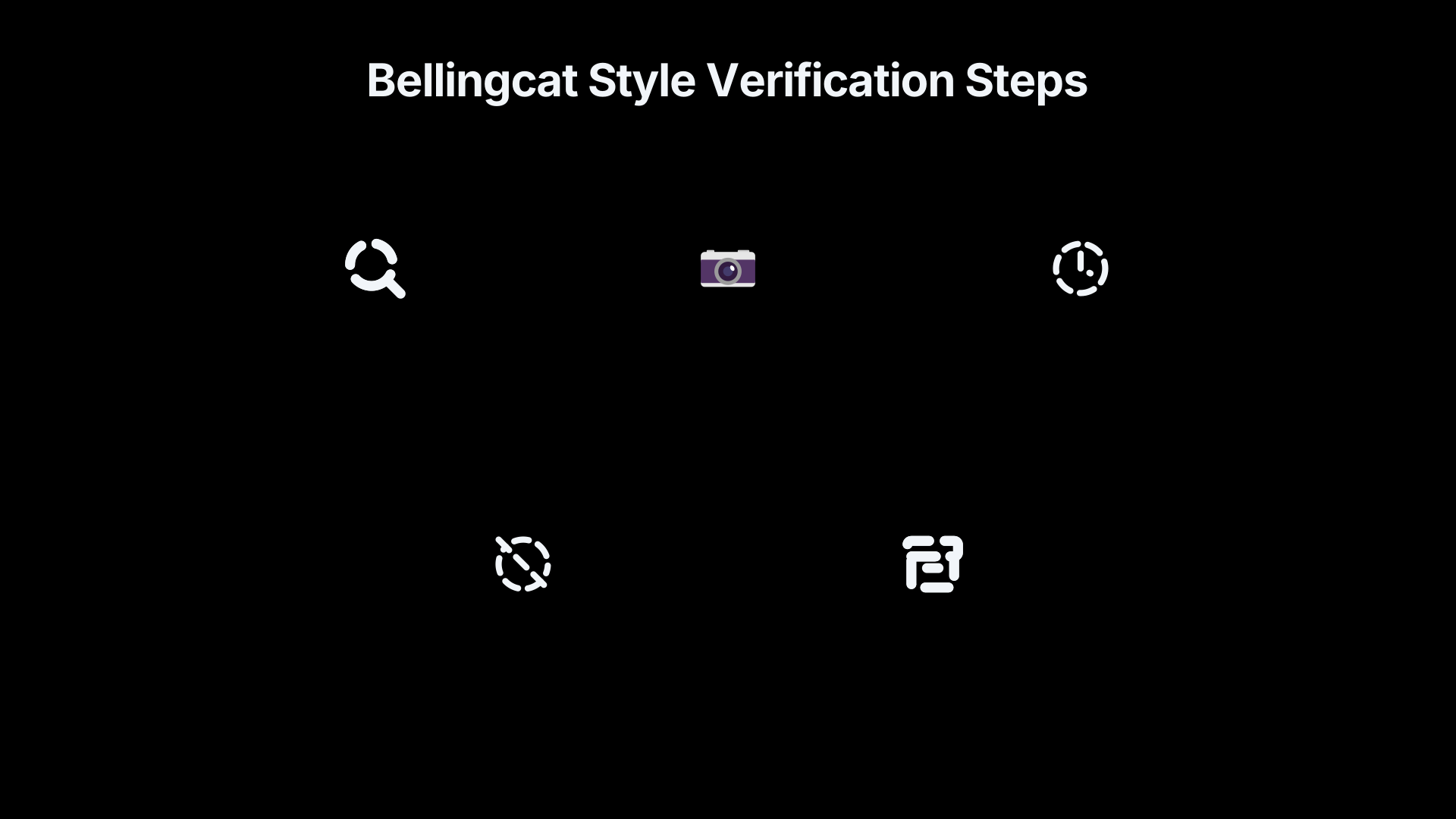
A simple hierarchy can help readers decide how much confidence to place in a claim before sharing it. It should be treated as a guide, not a law.
- Direct, inspectable primary evidence: official filings, court records, regulator notices, original datasets, archived pages, full video with provenance, or formal disclosures.
- Independent verification using multiple methods: reputable journalism, open-source investigation, peer-reviewed analysis or expert review that links evidence to reasoning.
- Transparent secondary explanation: named specialists, explainers or fact-checks that clearly cite primary material and state uncertainty.
- Single-source reporting or partial evidence: one witness, one document excerpt, one chart, one leaked screenshot, one unnamed source, or one unverified clip.
- Unsupported social claims: anonymous posts, cropped screenshots, engagement screenshots, “many people are saying”, AI-generated summaries without sources, or claims that ask readers to “do your own research” while providing no trail.
The middle categories matter because most real-world judgement happens there. Waiting for perfect evidence can be impossible during breaking news, but acting on weak evidence can cause harm. The right response is proportional confidence: save, watch, check, or share with caution rather than instantly believing or dismissing.
What changes when AI is part of the evidence chain
AI systems can help search, summarise and compare evidence, but they can also blur the evidence hierarchy by making unsupported claims sound well organised. A chatbot answer with fluent paragraphs is not itself a source. Its value depends on whether it points to reliable evidence, distinguishes primary from secondary material, and admits uncertainty where the evidence is incomplete.
This matters for both human readers and automated verification. A 2026 paper introducing the CommunityFact benchmark found that misinformation verification in the wild is multilingual, fast-moving and dependent on source selection; it reported that web access improves large language model performance, but also that web-enabled systems’ source-selection policies can be misaligned with the sources human Community Notes raters converge on. In plain terms, having access to the web is not enough. Choosing the right evidence is the hard part.[arXiv]arxiv.orgOpen source on arxiv.org.
AI also increases the supply of plausible weak evidence: fake documents, fabricated quotes, synthetic images, invented citations and polished posts that imitate professional tone. That makes boring checks more important, not less: dates, domains, authors, archives, filings, datasets, methods and independent corroboration.
The best question is not “Who posted this?”
Source reputation matters, but it is only the start. A trusted person can share a weak claim; a disliked person can link to a real document; a regulator can issue a notice that is later superseded; a dataset can be real but irrelevant; an anonymous post can be the first clue to something later proven. Evidence hierarchy is a way to avoid both gullibility and lazy dismissal.
The strongest online judgement comes from matching the proof to the claim. A claim about a legal finding needs a legal record. A claim about a trend needs data. A claim about a treatment needs clinical evidence. A claim about a video needs verification of time, place and source. A claim about what a company disclosed needs the filing or formal announcement. When the evidence offered does not fit the claim being made, the confidence level should drop, no matter how viral, polished or emotionally satisfying the post appears.

eBay marketplace picks
Marketplace Samples
Example marketplace items related to this page. Use the search link to explore similar finds on eBay.
Endnotes
1.
Source: investor.gov
Title: alert beware claims sec has approved offerings
Link:https://www.investor.gov/introduction-investing/general-resources/news-alerts/alerts-bulletins/investor-alerts/investor-alert-beware-claims-sec-has-approved-offerings
Source snippet
Beware of Claims That the SEC Has Approved Offerings30 Apr 2019 — The SEC's Office of Investor Education and Advocacy is issuing...
2.
Source: fda.gov
Title: warning letters
Link:https://www.fda.gov/inspections-compliance-enforcement-and-criminal-investigations/compliance-actions-and-activities/warning-letters
Source snippet
Food and Drug AdministrationWarning LettersSeptember 25, 2025 — Learn about the types of warning letters on FDA's website. Matters descri...
Published: September 25, 2025
3.
Source: lseg.com
Link:https://www.lseg.com/en/capital-markets/regulatory-news-service
Source snippet
Regulatory News Services (RNS)RNS is the UK's leading service for regulatory news announcements. The provider of choice for companies...
4.
Source: pmc.ncbi.nlm.nih.gov
Link:https://pmc.ncbi.nlm.nih.gov/articles/PMC11212665/
5.
Source: pmc.ncbi.nlm.nih.gov
Link:https://pmc.ncbi.nlm.nih.gov/articles/PMC12478135/
6.
Source: arxiv.org
Link:https://arxiv.org/abs/2601.14002
7.
Source: arxiv.org
Title: arXiv Community Notes are Vulnerable to Rater Bias and Manipulation
Link:https://arxiv.org/abs/2511.02615
8.
Source: cochrane.org
Link:https://www.cochrane.org/authors/handbooks-and-manuals/handbook/current/chapter-24
9.
Source: bellingcat.gitbook.io
Link:https://bellingcat.gitbook.io/toolkit
10.
Source: bellingcat.com
Title: a beginners guide to social media verification
Link:https://www.bellingcat.com/resources/2021/11/01/a-beginners-guide-to-social-media-verification/
11.
Source: arxiv.org
Link:https://arxiv.org/abs/2404.02894
12.
Source: arxiv.org
Link:https://arxiv.org/abs/2312.04431
13.
Source: cebm.ox.ac.uk
Title: oxford centre for evidence based medicine levels of evidence march 2009
Link:https://www.cebm.ox.ac.uk/resources/levels-of-evidence/oxford-centre-for-evidence-based-medicine-levels-of-evidence-march-2009
Published: march 2009
14.
Source: cochrane.org
Link:https://www.cochrane.org/learn/courses-and-resources/evidence-essentials
15.
Source: arxiv.org
Link:https://arxiv.org/abs/2605.30241
16.
Source: sec.gov
Link:https://www.sec.gov/newsroom/press-releases
17.
Source: sec.gov
Link:https://www.sec.gov/search-filings
18.
Source: bellingcat.com
Link:https://www.bellingcat.com/
19.
Source: bellingcat.com
Link:https://www.bellingcat.com/category/resources/how-tos/
20.
Source: bellingcat.com
Link:https://www.bellingcat.com/tag/verification/
21.
Source: cebm.net
Link:https://www.cebm.net/wp-content/uploads/2014/06/CEBM-Levels-of-Evidence-2.1.pdf
22.
Source: eu-digital-services-act.com
Link:https://www.eu-digital-services-act.com/Digital_Services_Act_Article_22.html
23.
Source: pnas.org
Link:https://www.pnas.org/doi/10.1073/pnas.2524004122
24.
Source: arxiv.org
Link:https://arxiv.org/html/2502.13322v1
25.
Source: arxiv.org
Link:https://arxiv.org/pdf/2512.19947
26.
Source: firstdraftnews.org
Title: First Draft Verifying online information: The absolute essentials
Link:https://firstdraftnews.org/articles/verifying-online-information-the-absolute-essentials/
Source snippet
Research shows that even writing 'debunks' can, in some circumstances, solidify false rumours...
27.
Source: firstdraftnews.org
Title: First Draft Verifying Online Information
Link:https://firstdraftnews.org/long-form-article/verifying-online-information/
Source snippet
First DraftVerifying Online Information - First Draft News22 Sept 2020 — Many agents of disinformation see coverage by established news o...
28.
Source: datasociety.net
Title: Data & Society Data Voids
Link:https://datasociety.net/wp-content/uploads/2019/11/Data-Voids-2.0-Final.pdf
Source snippet
Data & SocietyData VoidsNovember 18, 2019 — Data voids are one such way that search users can be led into disinformation or manipulated c...
Published: November 18, 2019
29.
Source: datasociety.net
Title: data voids
Link:https://datasociety.net/library/data-voids/
Source snippet
Data & SocietyData Voids29 Oct 2019 — Data Voids demonstrates how manipulators expose people to problematic content by exploiting search...
30.
Source: cebm.ox.ac.uk
Title: ocebm levels of evidence
Link:https://www.cebm.ox.ac.uk/resources/levels-of-evidence/ocebm-levels-of-evidence
31.
Source: blogs.lse.ac.uk
Title: LSE Blogs Do Community Notes work?
Link:https://blogs.lse.ac.uk/impactofsocialsciences/2025/01/14/do-community-notes-work/
32.
Source: digital-strategy.ec.europa.eu
Link:https://digital-strategy.ec.europa.eu/en/policies/trusted-flaggers-under-dsa
33.
Source: digital-strategy.ec.europa.eu
Link:https://digital-strategy.ec.europa.eu/en/policies/digital-services-act
34.
Source: theverge.com
Title: The Verge How the experts figure out what’s real in the age of [deepfakes]({{ ‘deepfakes/’ | relative_url }})
Link:https://www.theverge.com/tech/888303/photo-video-fake-news-verification-nyt-bellingway
Source snippet
Experts share a four-step process for verifying content: 1) closely examining visuals for anomalies, 2) evaluating the credibility and hi...
35.
Source: pmc.ncbi.nlm.nih.gov
Link:https://pmc.ncbi.nlm.nih.gov/articles/PMC12428072/
36.
Source: pmc.ncbi.nlm.nih.gov
Link:https://pmc.ncbi.nlm.nih.gov/articles/PMC11142451/
37.
Source: pmc.ncbi.nlm.nih.gov
Link:https://pmc.ncbi.nlm.nih.gov/articles/PMC11135712/
38.
Source: pmc.ncbi.nlm.nih.gov
Link:https://pmc.ncbi.nlm.nih.gov/articles/PMC8102978/
39.
Source: pmc.ncbi.nlm.nih.gov
Link:https://pmc.ncbi.nlm.nih.gov/articles/PMC12811808/
40.
Source: pmc.ncbi.nlm.nih.gov
Link:https://pmc.ncbi.nlm.nih.gov/articles/PMC12064251/
41.
Source: ncbi.nlm.nih.gov
Link:https://www.ncbi.nlm.nih.gov/books/NBK585583/table/ch2.Tab2/
42.
Source: euaa.europa.eu
Link:https://www.euaa.europa.eu/sites/default/files/judicial-practical-guide-coi_en.pdf
43.
Source: jmir.org
Link:https://www.jmir.org/2025/1/e69618/PDF
44.
Source: firstdraftnews.org
Link:https://firstdraftnews.org/long-form-article/first-drafts-essential-guide-to/
45.
Source: pct.libguides.com
Title: levels of evidence
Link:https://pct.libguides.com/ebm/levels-of-evidence
46.
Source: Wikipedia
Title: Community Notes
Link:https://en.wikipedia.org/wiki/Community_Notes
47.
Source: investor.bankofamerica.com
Title: select sec filings
Link:https://investor.bankofamerica.com/regulatory-and-other-filings/select-sec-filings
48.
Source: mhrainspectorate.blog.gov.uk
Title: blog.gov.uk FD A Warning Letters
Link:https://mhrainspectorate.blog.gov.uk/2025/08/08/fda-warning-letters/
49.
Source: scribd.com
Title: Bellingcat s Online Investigation Toolkit
Link:https://www.scribd.com/document/784989239/Bellingcat-s-Online-Investigation-Toolkit
50.
Source: investor.nvidia.com
Link:https://investor.nvidia.com/financial-info/sec-filings/default.aspx
51.
Source: archive.comsuregroup.com
Title: Bellingcats Digital Toolkit
Link:https://archive.comsuregroup.com/wp-content/uploads/2018/06/Bellingcats-Digital-Toolkit.pdf
52.
Source: investors.smurfitwestrock.com
Link:https://investors.smurfitwestrock.com/financials/sec-filings/default.aspx
53.
Source: invesco.com
Link:https://www.invesco.com/corporate/en/investor-relations/sec-filings.html
54.
Source: gijn.org
Link:https://gijn.org/stories/document-day-bellingcats-digital-forensics-tools/
55.
Source: stanforddaily.com
Title: On Social Media
Link:https://stanforddaily.com/2026/06/07/on-social-media/
Additional References
56.
Source: washingtonpost.com
Title: meta fact check community notes test facebook instagram
Link:https://www.washingtonpost.com/technology/2025/08/04/meta-fact-check-community-notes-test-facebook-instagram/
Source snippet
The system relies on a “bridging algorithm” where notes must be deemed “helpful” by users with differing viewpoints—a method criticized f...
57.
Source: youtube.com
Title: Evaluating Evidence: Crash Course Navigating Digital Information #6
Link:https://www.youtube.com/watch?v=hxhbOvR2TGk
Source snippet
Evaluating Information Sources - Research Skills Refresh (W24)...
58.
Source: youtube.com
Title: Evaluating Information Sources
Link:https://www.youtube.com/watch?v=9iETfTyJvew
Source snippet
How to Fact-Check Like a Journalist with First Draft's Laura Garcia...
59.
Source: youtube.com
Title: How to Fact-Check Like a Journalist with First Draft’s Laura Garcia
Link:https://www.youtube.com/watch?v=4Rh41NXo_U4
Source snippet
Evaluating Credibility of Online Sources | Week 22 Day 3...
60.
Source: ftc.gov
Link:https://www.ftc.gov/news-events/news/press-releases/2020/03/ftc-fda-send-warning-letters-seven-companies-about-unsupported-claims-products-can-treat-or-prevent
61.
Source: researchgate.net
Link:https://www.researchgate.net/publication/349535570_Lateral_reading_College_students_learn_to_critically_evaluate_internet_sources_in_an_online_course
62.
Source: researchgate.net
Link:https://www.researchgate.net/publication/375081144_Using_the_SIFT_strategy_to_enhance_the_Lateral_Reading_skills_of_undergraduate_students_for_detecting_digital_misinformation
63.
Source: cureus.com
Link:https://www.cureus.com/articles/444030-scientific-validation-of-clinically-proven-claims-compliance-focused-and-global-regulatory-insights
64.
Source: rheum.ca
Link:https://rheum.ca/wp-content/uploads/2017/11/2012CFG_AppendixB.pdf
65.
Source: researchgate.net
Link:https://www.researchgate.net/publication/318146573Credibility_in_social_media_opinions_news_and_health_information-_A_survey
Topic Tree
Follow this branch
Parent topic
Think Before SharingRelated pages 24
- Accuracy Nudge Can One Pause Stop a False Share?
- AI Tutors Should You Trust a Chatbot Tutor?
- AI Virality Why AI Misinformation Travels So Easily
- Community Notes Can the Crowd Correct the Feed?
- Corroboration Who Else Can Confirm This Claim?
- Deepfakes How to Check a Voice or Video Claim
- Emotional Posts Why Outrage Is Not Evidence
- Fake Authority When Official Looking Posts Are Not Official
- +16 more in sidebar