Within Name Claim
Why fluent AI answers still need claim naming
Fluent AI text can sound organised while blending facts, invented details, and vague assertions that must be split apart.
On this page
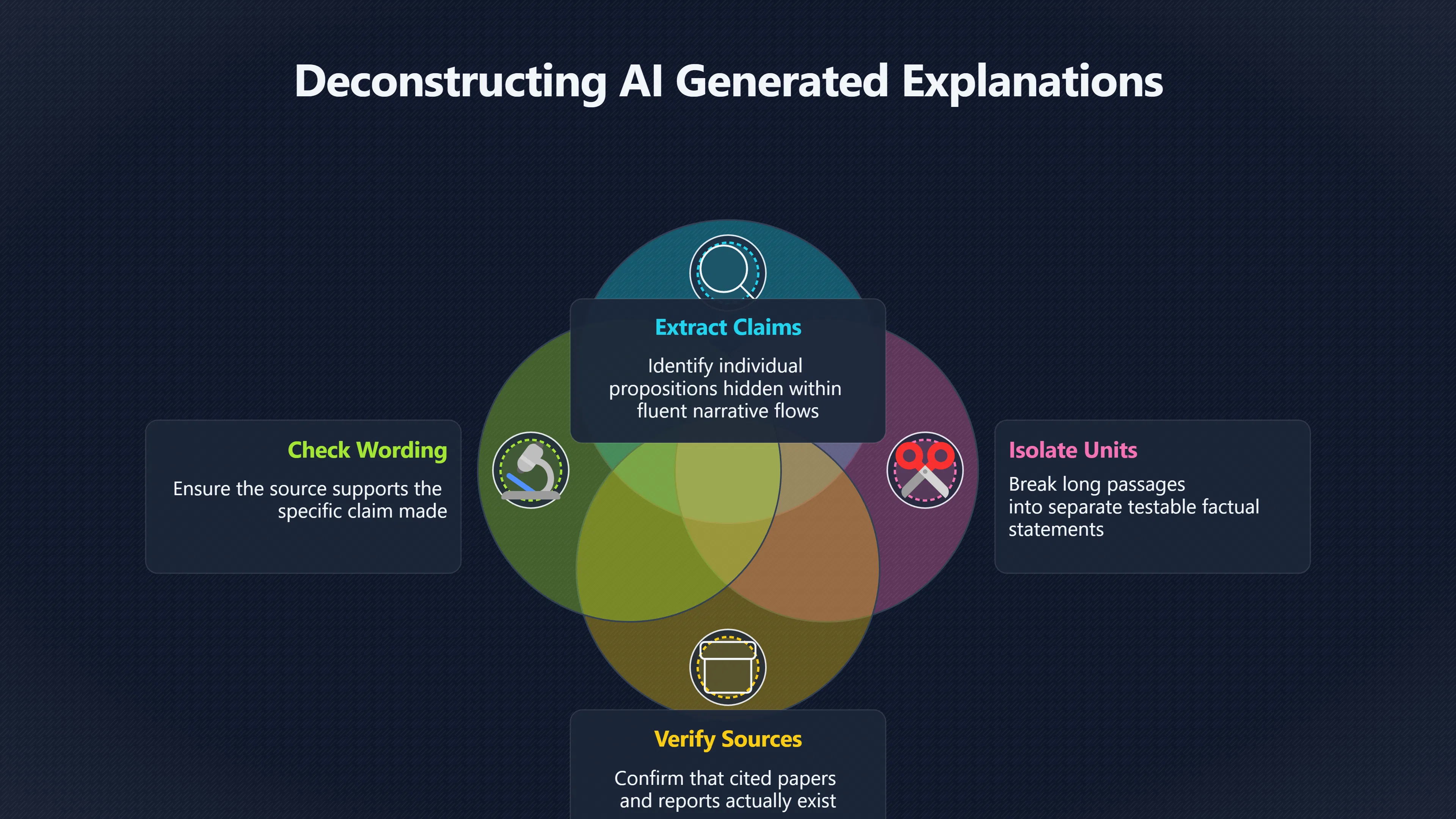
- Find the claims carrying the argument
- Break long AI text into testable units
- Check whether citations and named sources support the wording
Page outline Jump by section
Introduction
AI-generated explainers often sound more reliable than they are. The prose is smooth, the structure is tidy, and the transitions between ideas feel logical. Yet that fluency can conceal a mix of established facts, speculation, invented details and vague assertions. The result is a familiar critical-thinking problem: readers may accept a conclusion before they have identified the specific claims that support it.
 This matters because large language models are designed to produce plausible language, not to distinguish perfectly between verified facts and unsupported statements. Researchers and AI developers have repeatedly documented cases where systems generate false information, fabricated references or misleading explanations while presenting them in a confident, authoritative style.[Wikipedia+2Business Insider]WikipediaHallucination (artificial intelligenceHallucination (artificial intelligence
In the broader practice of claim naming before fact-checking, AI-generated explainers create a special challenge. The first task is not to decide whether the entire explanation is trustworthy. It is to identify the individual claims carrying the argument.
Find the claims carrying the argument
One reason AI-generated explanations can be misleading is that they often bundle many different types of statements together.
Consider an AI-generated paragraph about a health policy, scientific finding or historical event. Within a few sentences it may contain:
- A verifiable fact.
- An interpretation of that fact.[businessinsider.com]businessinsider.comThis test-centric optimization encourages models to provide confident but potentially incorrect outputs, rather than abstaining when unsu…
- A causal explanation.
- A prediction.
- An implied judgement about significance.
Because these elements are woven together smoothly, readers may treat them as equally supported. The explanation feels coherent, so the support for each statement is rarely examined separately.
A useful question is: which sentence would have to be true for the argument to work?
For example, an AI-generated explanation might state:
A recent study showed that the policy reduced crime by 30%, which demonstrates that similar measures should be adopted nationwide.
That single sentence contains at least three separate claims:
- A study exists.
- The study reported a 30% reduction.
- The result justifies nationwide adoption.
Only after separating those claims can a reader evaluate them individually. The first two may be factual questions. The third is an interpretation.
Fluent AI text often encourages readers to accept the package rather than inspect the parts.
Why fluency creates a credibility illusion
Humans routinely use presentation quality as a shortcut for judging credibility. Clear writing, organised structure and confident wording can create an impression of expertise even when evidence is weak.
This becomes important with AI because language models are specifically optimised to generate coherent and persuasive text. Research on AI-generated persuasion has shown that AI systems can produce arguments capable of influencing attitudes and opinions, particularly when they present information densely and confidently.[PMC+2The Guardian]pmc.ncbi.nlm.nih.govPMCHow persuasive is AI-generated propaganda?NIHby JA Goldstein · 2024 · Cited by 210 — Similarly, research in psychology has shown that people are more likely to believe misin…
The danger is not merely that an AI invents a fact. It is that the invention is embedded inside a professionally written explanation.
Readers are often trained to look for obvious warning signs such as poor grammar, spelling mistakes or disorganised reasoning. AI systems frequently remove those signals. The writing can resemble a carefully edited article even when key factual elements are unsupported.
This is why claim naming matters. Instead of asking whether the explanation sounds convincing, ask what specific proposition the sentence is asking you to believe.
Break long AI text into testable units
Long AI-generated explainers can create the illusion that dozens of facts have been established when only a few have actually been verified.
A practical method is to divide the text into testable units.
Take a paragraph and rewrite it as separate statements:
- Event X happened.
- Person Y said statement Z.
- The event caused outcome A.
- Experts agree on conclusion B.
Each statement can then be checked independently.
This process often reveals that some parts are much stronger than others. An AI explanation may correctly describe an event while overstating its causes. It may accurately summarise a study while exaggerating the certainty of the findings. It may report a real statistic while attaching an unsupported explanation to it.
Researchers studying AI hallucinations frequently note that errors are not always dramatic fabrications. Many are partial distortions that combine real information with incorrect details, making them harder to detect than entirely fictional claims.[Wikipedia+2arXiv]WikipediaHallucination (artificial intelligenceHallucination (artificial intelligence
The longer the explanation becomes, the more important this decomposition step becomes. A thousand-word answer may contain dozens of individual factual claims hidden inside a single narrative flow.
Watch for vague authority signals
AI-generated explainers often rely on authority cues that sound impressive but remain difficult to verify.
Examples include:
- “Studies have shown…“[cdn.openai.com]cdn.openai.comwhy language models hallucinateSun et al. (2025) cite factors such as…Read more…
- “Experts generally agree…”
- “Researchers increasingly believe…”
- “Evidence suggests…”
- “According to recent reports…”
These phrases are not necessarily wrong. The problem is that they often leave the underlying claim unnamed.
A reader should ask:
- Which study?
- Which experts?
- Which reports?
- What evidence?
- How recent?
If the explanation cannot answer those questions, the authority signal may be functioning more as persuasion than as evidence.
This is especially important because AI systems can generate statements that sound academically grounded even when the supporting source is unclear or absent. The surface appearance of expertise can exceed the actual evidential support.
Check whether citations and named sources support the wording
The presence of citations does not automatically solve the problem.
Recent investigations and academic research have documented cases in which AI-generated content included fabricated references, altered titles, incorrect attributions or citations that did not support the claims being made. Researchers have also observed large numbers of non-existent citations appearing in AI-assisted scholarly writing.[Taylor & Francis Online+3TechRadar+3arXiv]techradar.comThe report contained 45 citations, with only five found to be accurate; the rest were either fabricated, distorted, or misleading. GPTZer…
When an AI-generated explainer includes sources, two separate checks are useful:
Does the source exist?
The first question is basic but essential. Verify that the paper, report, article or dataset actually exists.
Studies examining AI-generated references have repeatedly found fabricated citations and incorrect bibliographic details.[PMC+2Wikipedia]pmc.ncbi.nlm.nih.govby J Linardon · 2025 · Cited by 14 — One type of hallucination generated by LLMs that has received increasing attention among research…
Does the source support the exact wording?
Even when a source is real, the AI may overstate what it says.
For example:
- A study finding a correlation becomes proof of causation.
- A preliminary result becomes a settled conclusion.
- A limited sample becomes evidence about an entire population.
- A disputed finding becomes expert consensus.
The source may support part of the sentence while not supporting the broader conclusion.
The critical question is not whether a citation appears. It is whether the cited source justifies the precise claim being made.
When confidence is the warning sign
Many readers assume uncertainty signals weakness and confidence signals reliability. AI-generated explainers can reverse that intuition.
Research into AI hallucinations suggests that language models are often rewarded for producing answers rather than admitting uncertainty. As a result, they may generate confident responses even when information is incomplete or unavailable.[Business Insider]businessinsider.comThis test-centric optimization encourages models to provide confident but potentially incorrect outputs, rather than abstaining when unsu…
A confident tone therefore provides little evidence that a claim is true.
In practice, some of the most trustworthy explanations are those that clearly identify uncertainty:
- What is known.
- What remains disputed.
- What evidence is missing.
- What assumptions are being made.
When an AI-generated explainer presents every point with equal certainty, readers should be especially careful about separating established facts from interpretation.
The key habit: extract before evaluating
The central defence against fuzzy AI-generated claims is simple. Do not fact-check the explanation as a whole. Extract the claims first.
An AI-generated answer may contain accurate information, useful summaries and legitimate insights. The risk arises when fluency causes unsupported statements to blend into verified ones.
By naming the claims, breaking long passages into testable units and checking whether cited sources actually support the wording used, readers can evaluate the substance rather than the style. In an environment where AI can generate persuasive explanations at scale, that distinction becomes one of the most important critical-thinking habits a reader can develop.
Amazon book picks
Further Reading
Books and field guides related to Why fluent AI answers still need claim naming. Use these as the next step if you want deeper reading beyond the article.
Calling Bullshit
Directly addresses evaluating claims, evidence, statistics, and misleading presentations.
Thinking, Fast and Slow
Helps readers identify reasoning errors and separate persuasive fluency from evidence.
eBay marketplace picks
Marketplace Samples
Example marketplace items related to this page. Use the search link to explore similar finds on eBay.
Endnotes
1.
Source: Wikipedia
Title: Hallucination (artificial intelligence)
Link:https://en.wikipedia.org/wiki/Hallucination_%28artificial_intelligence%29
2.
Source: pmc.ncbi.nlm.nih.gov
Title: PMCHow persuasive is AI-generated propaganda?
Link:https://pmc.ncbi.nlm.nih.gov/articles/PMC10878360/
Source snippet
NIHby JA Goldstein · 2024 · Cited by 210 — Similarly, research in psychology has shown that people are more likely to believe misin...
3.
Source: arxiv.org
Link:https://arxiv.org/abs/2601.04925
4.
Source: arxiv.org
Link:https://arxiv.org/abs/2602.05930
Source snippet
Compound Deception in Elite Peer Review: A Failure Mode Taxonomy of 100 Fabricated Citations at NeurIPS 2025...
5.
Source: techradar.com
Link:https://www.techradar.com/pro/a-major-kpmg-report-on-ai-was-found-to-be-chock-full-of-ai-hallucinations
Source snippet
The report contained 45 citations, with only five found to be accurate; the rest were either fabricated, distorted, or misleading. GPTZer...
6.
Source: arxiv.org
Link:https://arxiv.org/abs/2605.07723
Source snippet
[2605.07723] LLM hallucinations in the wild: Large-scale...by Z Zhao · 2026 — We find a sharp rise in non-existent references following...
7.
Source: pmc.ncbi.nlm.nih.gov
Link:https://pmc.ncbi.nlm.nih.gov/articles/PMC12658395/
Source snippet
by J Linardon · 2025 · Cited by 14 — One type of hallucination generated by LLMs that has received increasing attention among research...
8.
Source: arxiv.org
Link:https://arxiv.org/html/2604.09960v1
Source snippet
Distinguishing AI-Generated and Human-Written Fake...Apr 10, 2026 — This study examines linguistic, structural, and emotional difference...
9.
Source: arxiv.org
Link:https://arxiv.org/html/2602.17671v1
Source snippet
AI Hallucination from Students' Perspective: A Thematic...11 Jan 2026 — Ten percent of the comments indicated that students experienced...
10.
Source: arxiv.org
Link:https://arxiv.org/pdf/2311.15544
Source snippet
The effect of source disclosure on evaluation of AI-...by S Lim · 2023 · Cited by 120 — Overall, the results of this series of studies s...
11.
Source: arxiv.org
Link:https://arxiv.org/html/2602.05867v1
Source snippet
The Case of the Mysterious CitationsDec 16, 2025 — It is not possible to prove that a citation error was generated through an LLM halluci...
12.
Source: arxiv.org
Link:https://arxiv.org/html/2502.04426v2
Source snippet
How LLMs Assess News Credibility and BiasJul 10, 2025 — This study examined how Large Language Models (LLMs) assess the reliability of news...
13.
Source: Wikipedia
Title: Large language model
Link:https://en.wikipedia.org/wiki/Large_language_model
Source snippet
Large language modelA large language model (LLM) is a neural network trained on a vast amount of text for natural language processing...
14.
Source: Wikipedia
Title: Artificial intelligence
Link:https://en.wikipedia.org/wiki/Artificial_intelligence
Source snippet
Artificial intelligenceArtificial intelligence (AI) is the capability of computational systems to perform tasks typically associated w...
15.
Source: businessinsider.com
Link:https://www.businessinsider.com/why-ai-chatbots-hallucinate-openai-chatgpt-anthropic-claude
Source snippet
This test-centric optimization encourages models to provide confident but potentially incorrect outputs, rather than abstaining when unsu...
16.
Source: theguardian.com
Link:https://www.theguardian.com/technology/2025/dec/04/chatbots-sway-political-opinions-substantially-inaccurate-study
Source snippet
The study, involving nearly 80,000 participants in the UK, evaluated 19 different AI models—including ChatGPT and Elon Musk's Grok—by hav...
17.
Source: tandfonline.com
Link:https://www.tandfonline.com/doi/full/10.1080/08989621.2026.2645390
Source snippet
Taylor & Francis OnlineHallucinated citations produced by generative artificial...by DB Resnik · 2026 — A hallucinated citation may supp...
18.
Source: pmc.ncbi.nlm.nih.gov
Link:https://pmc.ncbi.nlm.nih.gov/articles/PMC12964124/
Source snippet
and sharing intentions of human- and AI-generated...by Á Stefkovics · 2026 · Cited by 2 — Our findings show that fake news is consistent...
19.
Source: pmc.ncbi.nlm.nih.gov
Link:https://pmc.ncbi.nlm.nih.gov/articles/PMC12698521/
Source snippet
the persuasion mechanism of AI-generated rumors...by Z Hou · 2025 · Cited by 1 — The core issue is that AI tools enable anyone to easily...
20.
Source: pubmed.ncbi.nlm.nih.gov
Link:https://pubmed.ncbi.nlm.nih.gov/41223407/
Source snippet
Although previous...Read more...
21.
Source: pmc.ncbi.nlm.nih.gov
Link:https://pmc.ncbi.nlm.nih.gov/articles/PMC11681264/
Source snippet
NIHby M Özer · 2024 · Cited by 38 — AI hallucination is a phenomenon where AI generates a convincing, contextually coherent but ent...
22.
Source: OpenAI
Link:https://openai.com/
Source snippet
comOpenAI | OpenAIWe believe our research will eventually lead to artificial general intelligence, a system that can solve human-level pr...
23.
Source: OpenAI
Title: why language models hallucinate
Link:https://openai.com/index/why-language-models-hallucinate/
Source snippet
comWhy language models hallucinate5 Sept 2025 — Hallucinations are plausible but false statements generated by language models. They can...
24.
Source: cdn.openai.com
Title: why language models hallucinate
Link:https://cdn.openai.com/pdf/d04913be-3f6f-4d2b-b283-ff432ef4aaa5/why-language-models-hallucinate.pdf
Source snippet
Sun et al. (2025) cite factors such as...Read more...
25.
Source: nngroup.com
Title: ai hallucinations
Link:https://www.nngroup.com/articles/ai-hallucinations/
Source snippet
What Designers Need to Know7 Feb 2025 — A hallucination occurs when a generative AI system generates output data that seems plausible but...
Additional References
26.
Source: thehonores.com
Link:https://thehonores.com/ai-citation-hallucinations-hidden-threat-scientific-publishing/
Source snippet
AI Citation Hallucinations: A Hidden Threat to Scientific...7 days ago — AI citation hallucinations are introducing [fake references]({{ 'fake-references/' | relative_url }}) into...
27.
Source: medicaldialogues.in
Link:https://medicaldialogues.in/amp/medicine/news/ai-hallucinations-and-fake-citations-threaten-trust-in-biomedical-research-experts-warn-171270
Source snippet
AI Hallucinations and Fake Citations Threaten Trust in...1 day ago — Most affected papers contained one or two fabricated citations, but...
28.
Source: axios.com
Link:https://www.axios.com/2026/05/30/ai-accuracy-chatbots-hallucinations
Source snippet
As reliance on AI increases across sectors like research, education, and especially health care, the likelihood of users overlooking cost...
29.
Source: scet.berkeley.edu
Link:https://scet.berkeley.edu/why-hallucinations-matter-misinformation-brand-safety-and-cybersecurity-in-the-age-ofgenerative-ai/
Source snippet
Hallucinations Matter: Misinformation, Brand Safety...2 May 2024 — In our age of generative AI, the technology's propensity to create fa...
Published: May 2024
30.
Source: misinforeview.hks.harvard.edu
Title: new sources of inaccuracy a conceptual framework for studying ai hallucinations
Link:https://misinforeview.hks.harvard.edu/article/new-sources-of-inaccuracy-a-conceptual-framework-for-studying-ai-hallucinations/
Source snippet
A conceptual framework for...by A Shao · 2025 · Cited by 10 — Fact-checking struggles with subtle hallucinations like fake citations (Zh...
31.
Source: livescience.com
Title: Live Science AI hallucinates more frequently as it gets more advanced
Link:https://www.livescience.com/technology/artificial-intelligence/ai-hallucinates-more-frequently-as-it-gets-more-advanced-is-there-any-way-to-stop-it-from-happening-and-should-we-even-try
Source snippet
OpenAI's latest reasoning models, o3 and o4-mini, showed higher hallucination rates than earlier versions, sparking concerns about the re...
32.
Source: nature.com
Title: Researchers who use hallucinated references to face arXiv
Link:https://www.nature.com/articles/d41586-026-01595-5
Source snippet
Hallucinated citations highest in social sciences preprints site. Subjects. Publishing · Scientific...Read more...
33.
Source: mdpi.com
Title: Using nine LLMs, we generated a dataset of 74,196 analyse
Link:https://www.mdpi.com/2306-5729/11/5/122
Source snippet
Evaluating the Integrity of LLM-Generated Citationsby P Picazo-Sanchez · 2026 — In this paper, we investigate hallucinations of LLMs when...
34.
Source: researchgate.net
Link:https://www.researchgate.net/publication/385671387_Comparing_the_Willingness_to_Share_for_Human-generated_vs_AI-generated_Fake_News
Source snippet
n human-generated fake news, but both tend to be shared equally.Read more...
35.
Source: ibm.com
Link:https://www.ibm.com/think/topics/artificial-intelligence
Source snippet
rning, comprehension, problem solving, decision-making...
Topic Tree