Within Source Tracing
When a real source does not prove the claim
A working link can still mislead when it supports the general subject but not the specific sentence beside it.
On this page
- Why topical relevance is not enough
- Claim by claim matching in AI answers
- How broad sources get stretched into precise claims
Page outline Jump by section
Introduction
A citation can be genuine, relevant, and clickable yet still fail its most important job: proving the sentence beside it. This is one of the most common source-tracing problems in AI-assisted answers. The model finds material about the right subject, then attaches that source to a claim that is more specific, stronger, or simply different from what the source actually says.
 For readers, this creates a subtle risk. A broken link is easy to spot. A real source that discusses the same topic feels trustworthy, even when it does not support the exact statement being made. Research on AI source attribution shows that modern systems can achieve high rates of link validity and topical relevance while performing much worse when evaluators check whether the cited source truly supports the factual claim.[arXiv]arxiv.orgCited but Not Verified: Parsing and Evaluating Source Attribution in LLM Deep Research AgentsMay 7, 2026…
In the context of critical thinking and AI, source tracing therefore requires more than asking whether a citation exists. The key question is whether the source proves the specific claim.
Why topical relevance is not enough
Many readers perform what might be called a topic check. They click a citation, see that the page discusses the same general subject, and conclude that the evidence has been verified.
That shortcut often fails.
Imagine an AI answer states:
A study found that social media use increases depression by 40%.
The citation leads to a real paper about social media and mental health. The topic matches. However, the paper may never report a 40% increase, may discuss correlation rather than causation, or may focus on a different population entirely. The source is relevant, but it does not support the precise claim.
This distinction appears repeatedly in evaluations of AI-generated citations. Researchers studying source attribution in large-language-model research agents found a significant gap between citation relevance and factual support. Models frequently linked to material that was topically connected while failing factual verification against the cited content itself.[arXiv]arxiv.orgCited but Not Verified: Parsing and Evaluating Source Attribution in LLM Deep Research AgentsMay 7, 2026…
The result is a form of evidential drift. The reader sees a real source discussing the right area and assumes that the source confirms every nearby statement.
Claim-by-claim matching in AI answers
Source tracing works best when performed at the level of individual claims rather than entire paragraphs.
A practical way to think about it is to separate three questions:
- Does the source exist?
- Is the source about the same topic?
- Does the source support this exact statement?
The third question is the one most often skipped.
Consider an AI-generated paragraph containing several factual assertions:
- a date
- a percentage
- a causal explanation
- a prediction
A single broad citation may accompany the entire paragraph. Yet the source may only support one of those four points.
Researchers at MIT’s Computer Science and Artificial Intelligence Laboratory highlighted this problem when discussing AI citation systems. They noted that users often receive source links but must manually determine which specific evidence supports which specific statement. Their work on citation tracing was motivated partly by the difficulty of identifying the exact source passage behind a generated claim.[MIT CSAIL]csail.mit.educitation tool offers new approach trustworthy ai generated contentMIT CSAILCitation tool offers a new approach to trustworthy AI-…9 Dec 2024 — Existing AI assistants often provide source links, but us…
For source tracing, the correct unit of analysis is not the article, report, or webpage. It is the individual claim.
How broad sources get stretched into precise claims
AI systems frequently encounter large documents containing many related facts. During generation, the model may compress, paraphrase, and combine information. This creates opportunities for a source to be stretched beyond what it actually establishes.
Several common patterns appear repeatedly.
Turning a general finding into a numerical claim
A source may conclude that an effect exists.
The AI answer may convert that into a precise percentage, ranking, or measurement not found in the original material.
The topic remains correct, but the added precision is unsupported.
Turning correlation into causation
A cited article might report that two variables are associated.
The AI answer may state that one causes the other.
The source discusses the right subject, yet the claim becomes stronger than the evidence allows.
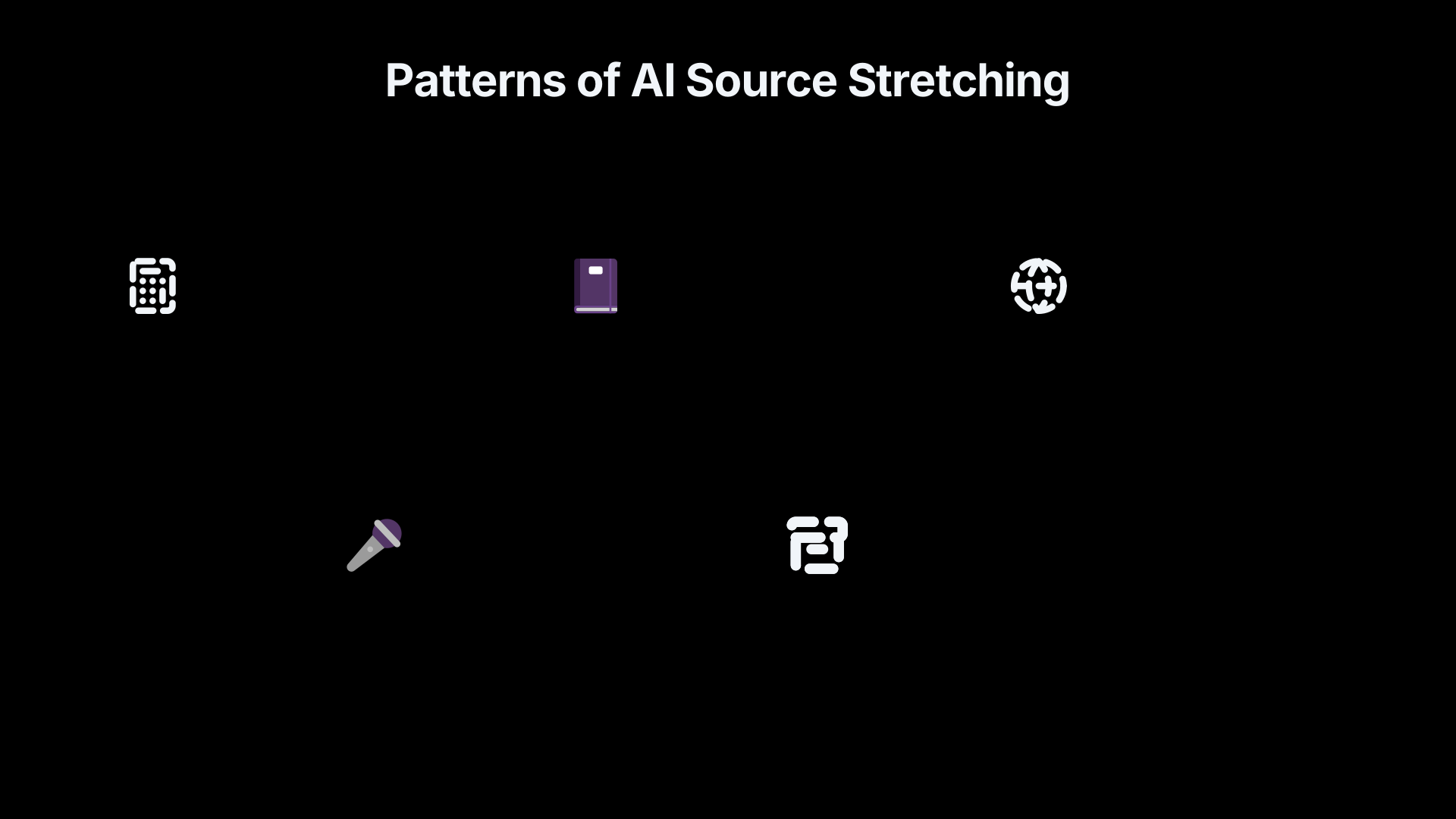
Turning a limited study into a universal rule
A paper examining a small group, region, or timeframe may be cited as proof of a general principle.
The source exists and is relevant, but the answer removes important limits and qualifications.
Turning expert opinion into established fact
An article may quote an analyst, researcher, or commentator.
The AI answer may present the opinion as a settled conclusion.
Again, the citation is real. The evidential status has changed.
These shifts are especially difficult to notice because the citation itself looks legitimate. The problem lies in the relationship between the source and the claim.
Why readers often miss the mismatch
The danger of topic-matched but claim-mismatched citations comes partly from human psychology.
Studies examining trust in AI-generated answers found that citations increase user trust even when the citations are random or incorrect. Trust tends to fall when users actually inspect the sources.[arXiv]arxiv.orgarXiv Citations and Trust in LLM Generated ResponsesCitations and Trust in LLM Generated ResponsesJanuary 2, 2025…
This matters because a relevant-looking citation creates a powerful impression of verification. Most readers do not conduct detailed claim-by-claim comparisons between the answer and the source.
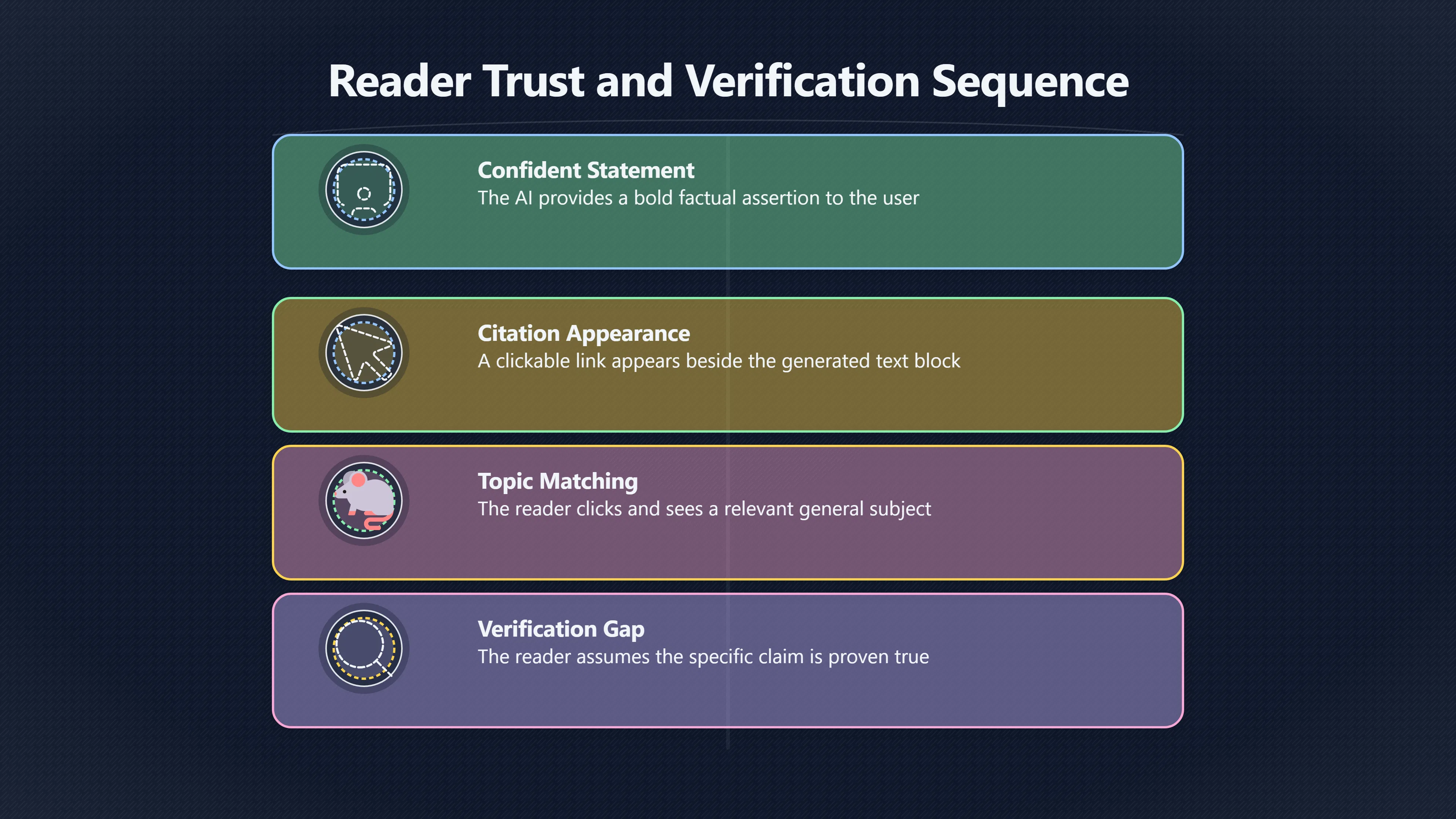
The sequence often looks like this:
- The AI provides a confident statement.
- A citation appears beside it.
- The reader clicks the citation.
- The source discusses the same topic.
- The reader assumes the claim has been verified.
The crucial final step—checking whether the exact statement appears or follows logically from the source—is frequently skipped.
Real-world signs of the problem
The issue is visible not only in research settings but also in public-facing AI systems and AI-generated reports.
The Tow Center for Digital Journalism found that several AI search systems frequently cited the wrong article or misattributed information, creating situations where readers were directed to real content that did not properly support the generated answer.[Columbia Journalism Review]cjr.orgwe compared eight ai search engines theyre all bad at citing newsColumbia Journalism ReviewAI Search Has a Citation Problem6 Mar 2025 — The generative search tools we tested had a common tendency to cit…
Recent investigations into AI-generated reports have revealed related problems. Analyses of high-profile documents have identified citations that were real but distorted through incorrect attribution, altered titles, or misleading descriptions of source content.[TechRadar]techradar.comTech Radar A major KPMG report on AI was found to be chock-full of…AI hallucinations Yesterday — A recent investigation by GPTZero hasThe report contained 45 citations, with only five found to be accurate; the rest were either fabricated, distorted, or misleading. GPTZer…
These examples illustrate a broader lesson: citation failures are not limited to fabricated references. A real source can still be evidence used incorrectly.
A quick test for readers
When checking an AI-generated citation, avoid asking only:
Is this source about the same subject?
Instead ask:
If I removed the AI answer and read only this source, would I reasonably reach the same conclusion?
If the answer is no, the citation may be providing topical cover rather than genuine support.
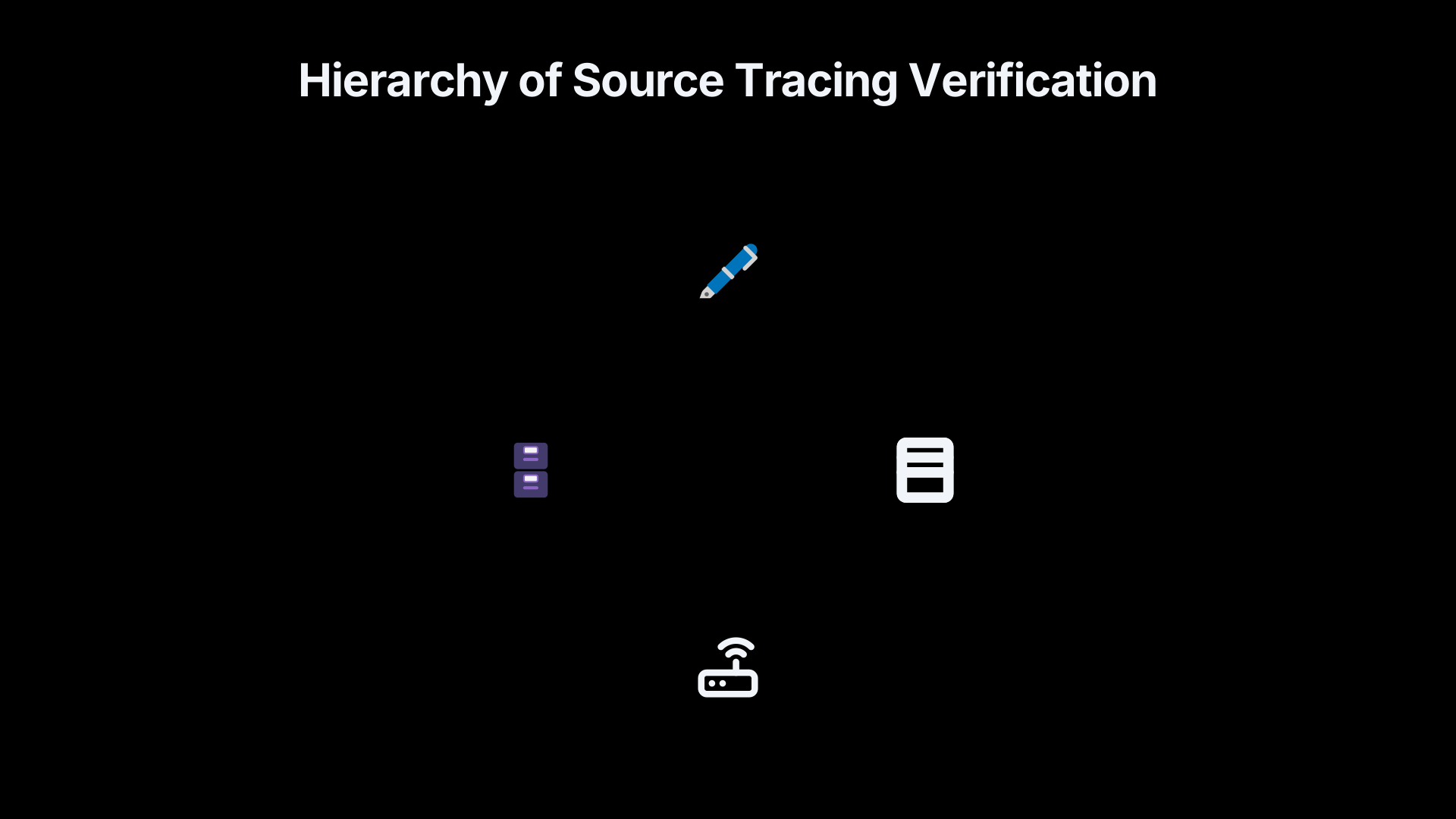
Three quick checks are especially useful:
- Look for the exact statistic or number. If it is missing, the claim may be overstated.
- Check the scope. Does the source apply to the same population, location, or timeframe?
- Check the strength of the conclusion. Does the source merely discuss, suggest, correlate, or speculate where the AI answer asserts certainty?
These checks take only a few moments but often reveal whether a citation is functioning as evidence or merely as decoration.
The core lesson for source tracing
When evaluating AI-assisted answers, a working citation is only the beginning of verification. The central question is not whether the source discusses the topic. It is whether the source supports the specific claim being made.
Research on AI attribution increasingly points to the same weakness: systems can appear reliable because their citations are accessible and relevant while still failing factual verification at the claim level.[arXiv]arxiv.orgCited but Not Verified: Parsing and Evaluating Source Attribution in LLM Deep Research AgentsMay 7, 2026…
For critical thinkers, the habit that matters is claim-by-claim matching. A source that talks about the right subject is not automatically evidence for the statement beside it. The difference between those two things is where many AI citation errors hide.
Amazon book picks
Further Reading
Books and field guides related to When a real source does not prove the claim. Use these as the next step if you want deeper reading beyond the article.
Calling Bullshit
Focuses on matching claims to evidence rather than accepting superficial support.
How to Lie with Statistics
Shows how real data can be stretched into misleading claims.
Thinking, Fast and Slow
Explains cognitive biases that make unsupported inferences seem convincing.
Bad Science
Examines cases where evidence is cited but conclusions exceed what the data supports.
eBay marketplace picks
Marketplace Samples
Example marketplace items related to this page. Use the search link to explore similar finds on eBay.
Endnotes
1.
Source: arxiv.org
Link:https://arxiv.org/abs/2605.06635
Source snippet
Cited but Not Verified: Parsing and Evaluating Source Attribution in LLM Deep Research AgentsMay 7, 2026...
Published: May 7, 2026
2.
Source: arxiv.org
Link:https://arxiv.org/html/2605.06635v1
Source snippet
Parsing and Evaluating Source Attribution in LLM Deep...7 May 2026 — Unlike methods that verify claims in isolation, our framework close...
Published: May 2026
3.
Source: csail.mit.edu
Title: citation tool offers new approach trustworthy ai generated content
Link:https://www.csail.mit.edu/news/citation-tool-offers-new-approach-trustworthy-ai-generated-content
Source snippet
MIT CSAILCitation tool offers a new approach to trustworthy AI-...9 Dec 2024 — Existing AI assistants often provide source links, but us...
4.
Source: arxiv.org
Title: arXiv Citations and Trust in LLM Generated Responses
Link:https://arxiv.org/abs/2501.01303
Source snippet
Citations and Trust in LLM Generated ResponsesJanuary 2, 2025...
Published: January 2, 2025
5.
Source: techradar.com
Link:https://www.techradar.com/pro/a-major-kpmg-report-on-ai-was-found-to-be-chock-full-of-[ai-hallucinations
Source snippet
The report contained 45 citations, with only five found to be accurate; the rest were either fabricated, distorted, or misleading. GPTZer...
6.
Source: cjr.org
Title: we compared eight ai search engines theyre all bad at citing news
Link:https://www.cjr.org/tow_center/we-compared-eight-ai-search-engines-theyre-all-bad-at-citing-news.php
Source snippet
Columbia Journalism ReviewAI Search Has a Citation Problem6 Mar 2025 — The generative search tools we tested had a common tendency to cit...
Additional References
7.
Source: researchgate.net
Link:https://www.researchgate.net/publication/404626821_Cited_but_Not_Verified_Parsing_and_Evaluating_Source_Attribution_in_LLM_Deep_Research_Agents
Source snippet
(PDF) Cited but Not Verified: Parsing and Evaluating...by H Onweller · 2026 — We introduce the first source attribution evaluation frame...
8.
Source: medium.com
Link:https://medium.com/intuitively-and-exhaustively-explained/ai-generated-in-text-citations-intuitively-and-exhaustively-explained-fb85566c233a
Source snippet
AI Generated In-Text Citations — Intuitively and...The FraudX Platform allows users to view indicators of Fraud and also observe key pie...
9.
Source: linkedin.com
Link:https://www.linkedin.com/posts/haileyonweller_cited-but-not-verified-parsing-and-evaluating-activity-7458497480423403520-NQj0
Source snippet
Parsing Source Attribution in LLM Research AgentsExcited to share our new paper, “Cited but Not Verified: Parsing and Evaluating Source A...
10.
Source: yext.com
Link:https://www.yext.com/research/ai-citation-behavior-across-models
11.
Source: medium.com
Link:https://medium.com/%40yaseenmd/why-your-ai-cites-real-sources-that-never-said-that-ff6292aade76
12.
Source: themoonlight.io
Link:https://www.themoonlight.io/review/cited-but-not-verified-parsing-and-evaluating-source-attribution-in-llm-deep-research-agents
Source snippet
summary worldwide for the paper titled Cited but Not Verified: Parsing and Evaluating Source Attribution in LLM...
13.
Source: averi.ai
Title: the geo playbook 2026 getting cited by llms (not just ranked by google)
Link:https://www.averi.ai/blog/the-geo-playbook-2026-getting-cited-by-llms-%28not-just-ranked-by-google%29
Source snippet
The GEO Playbook 2026: Getting Cited by LLMs (Not Just...11 Sept 2025 — Research shows that including citations, quotations from relevan...
14.
Source: facebook.com
Link:https://www.facebook.com/groups/671022767060782/posts/1856355311860849/
Source snippet
AI search engines fail to provide correct news citations> According to a [new study conducted by the Tow Center for Digital Journalism](h...
15.
Source: is2digital.com
Title: When AI doesn’t cite sources, that’s a red flag requiring
Link:https://www.is2digital.com/insights/practical-guide-fact-checking-ai-responses
Source snippet
A Practical Guide to Fact-Checking AI Responses14 Oct 2025 — When AI cites sources, verify they're authoritative and appropriate for your...
16.
Source: researchgate.net
Title: 387670773 Citations and Trust in LLM Generated Responses
Link:https://www.researchgate.net/publication/387670773_Citations_and_Trust_in_LLM_Generated_Responses
Source snippet
(PDF) Citations and Trust in LLM Generated Responses2 Jan 2025 — We found a significant increase in trust when citations were present, a...
Topic Tree