Within Influencers
When 'People Like US' Becomes Proof
A claim can feel safer than it is when it comes from someone who seems to understand your group or experience.
On this page
- Why belonging changes credibility judgments
- Where lived experience helps and where it stops
- How to test a claim without dismissing identity
Page outline Jump by section
Introduction
A claim does not become true because it comes from “one of us”. Yet on social media, shared identity often acts as a powerful credibility shortcut. When a creator appears to share our background, values, struggles, profession, culture or life experience, we may feel that they understand realities outsiders miss. That feeling can be valuable. Communities that have been ignored, misrepresented or excluded often rely on people with lived experience to surface problems that institutions overlook.
 The difficulty arises when identity shifts from a reason to listen to a reason to stop questioning. In those moments, weak claims can receive less scrutiny than they would if they came from a stranger. Research on social identity, trust and misinformation suggests that people frequently judge information through social belonging as well as factual content, especially in online environments where credibility cues are limited.[Vrije Universiteit Amsterdam+2Nature]research.vu.nlPrevious research suggests that interpersonal perceptions of…Read more…
Why Belonging Changes Credibility Judgments
People rarely evaluate every claim from scratch. Social media presents more information than anyone can fully verify, so audiences rely on shortcuts. One of the strongest shortcuts is group membership.
A person who seems to share our experiences can feel more trustworthy because we expect them to understand our concerns and act in ways that benefit the group. Social identity research has long found that people are more willing to trust those they perceive as members of their own group. Shared identity creates expectations of reciprocity, understanding and common interests.[Vrije Universiteit Amsterdam]research.vu.nlPrevious research suggests that interpersonal perceptions of…Read more…
This becomes especially important in online spaces. A creator may signal identity through language, humour, appearance, profession, health status, political affiliation, religion, location or personal history. Once audiences classify someone as “people like us”, the question can subtly change from “Is this claim supported?” to “Why would one of us mislead us?” That shift lowers the perceived need for verification.
Research on misinformation susceptibility also shows that social cues influence judgments when they create a sense that trusted others accept the information. People often use perceived consensus as evidence, even when consensus itself may be unreliable.[Nature]nature.comThe persuasive effects of social cues and source effects on…by CS Traberg · 2024 · Cited by 74 — Each of these studies aimed to…
The result is a protective effect around certain claims. Evidence standards become uneven. A weak claim from an in-group source may receive the benefit of the doubt, while a stronger claim from an outsider may face harsher scrutiny.
Where Lived Experience Helps and Where It Stops
One of the most common misunderstandings in discussions of critical thinking is the idea that recognising the limits of lived experience means dismissing lived experience. It does not.
Lived experience can provide information that formal expertise cannot. Patients may notice patterns in healthcare systems. Teachers may understand classroom realities better than distant policymakers. Residents may identify local problems before journalists or officials do. Research on lived-experience roles increasingly recognises that personal experience can generate valuable forms of knowledge that institutions need.[wellcomeopenresearch.org+2PMC]wellcomeopenresearch.orgDocument: How lived experience expertise shapes…13 Jul 2024 — Read the full document on Wellcome Open Research: How lived experience e…
However, lived experience answers different questions from evidence-based claims.[pmc.ncbi.nlm.nih.gov]pmc.ncbi.nlm.nih.govLived experience researchers and…
For example:
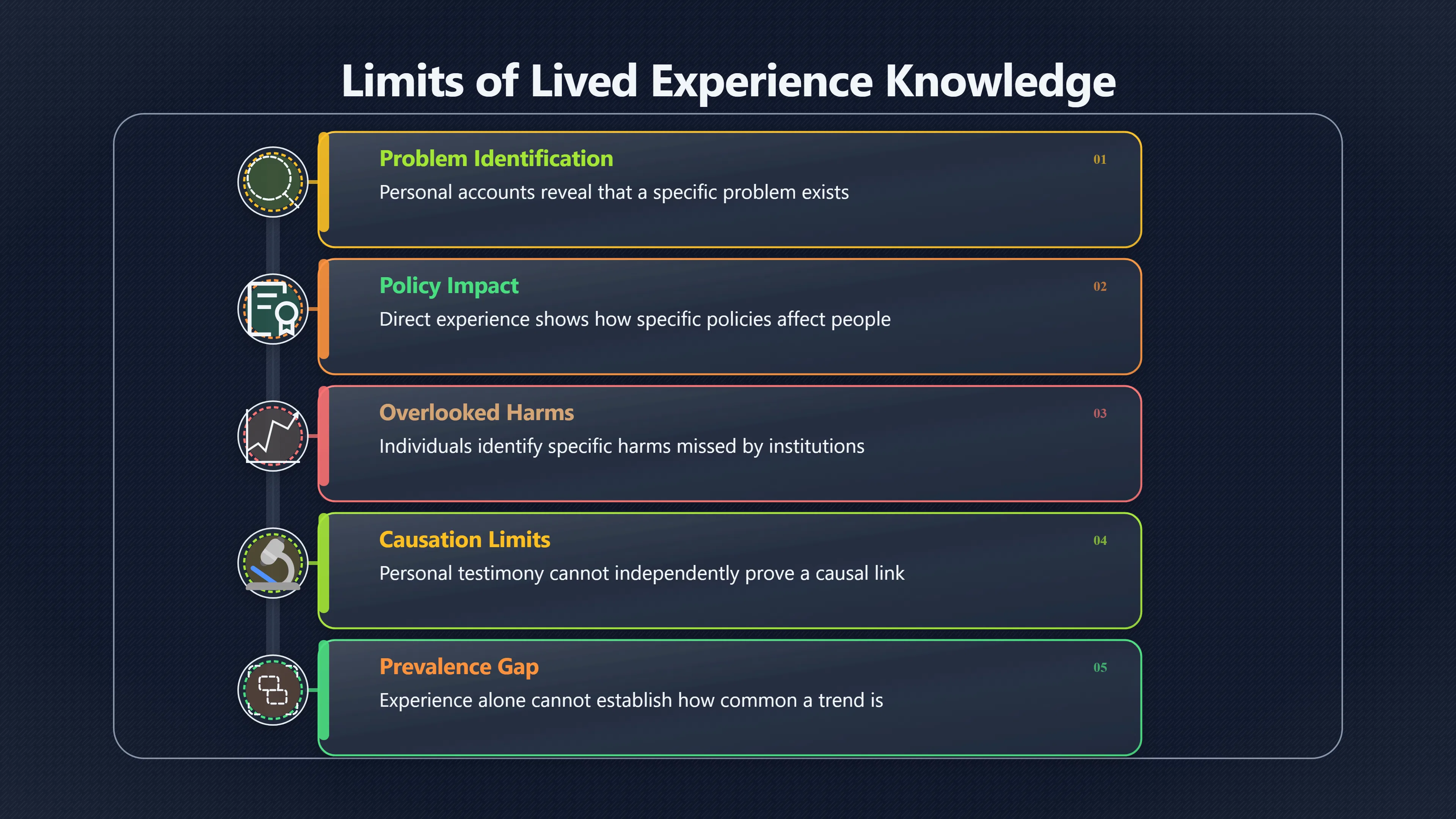
- Lived experience can show that a problem exists.[pmc.ncbi.nlm.nih.gov]pmc.ncbi.nlm.nih.govLived experience researchers and…
- It can reveal how a policy affects people.
- It can identify overlooked harms or benefits.
- It cannot by itself establish how common something is.
- It cannot by itself prove causation.
- It cannot by itself determine whether a proposed explanation is correct.
A person may accurately describe what happened to them while drawing an incorrect conclusion about why it happened. This distinction matters because online audiences often merge personal testimony and general claims into a single package.
Consider a creator who says, “I experienced this treatment and it harmed me.” That is a claim about experience. If the creator then says, “Therefore the treatment harms most people and experts are hiding it,” the second claim requires additional evidence. Shared identity can make audiences accept both claims together even though they require different standards of proof.
Scholars examining lived expertise have repeatedly noted that experience is valuable but not unlimited. It contributes a perspective; it does not automatically settle factual disputes.[Bristol University Press Digital]bristoluniversitypressdigital.comarticle p578.xmlBristol University Press DigitalDisability lived experience and expertise: recognising the…by S Clifton · 2025 · Cited by 12 — As peop…
How Weak Claims Become Protected
The mechanism is not usually blind loyalty. It is often a series of small credibility boosts that accumulate.
A weak claim can become resistant to scrutiny when several factors combine:
Shared experience. The speaker appears to understand the audience’s situation firsthand.
Moral trust. Followers believe the speaker is acting for the group’s benefit.
Identity signalling. Agreeing with the claim becomes associated with belonging.
Social reinforcement. Other community members repeat the claim.
Defensive framing. Criticism is portrayed as an attack on the group rather than an evaluation of the evidence.
Research on identity-driven misinformation highlights how narratives can become embedded in group loyalties and grievances, making factual challenges feel socially threatening rather than informative.[Sage Journals]journals.sagepub.comSage JournalsDisinformation and Echo Chambersby C Diaz Ruiz · 2023 · Cited by 344 — This article investigates how disinformation circulat…
At that point, scrutiny becomes harder. A request for evidence may be interpreted as disrespect. A correction may be seen as siding with outsiders. The discussion shifts from “Is this true?” to “Whose side are you on?”
That transformation is particularly common in tightly connected online communities where trust is built through ongoing interaction rather than formal expertise. Studies of social media credibility show that trustworthiness, relatability and social influence often shape judgments alongside, and sometimes ahead of, evidence quality.[ResearchGate]researchgate.netResearch Gate Assessing the Credibility of Health Information from SocialAssessing the Credibility of Health Information from Social…October 16, 2025 — Findings show that credibility judgments ar…
Why This Matters in Social Media and AI Environments
Identity-based trust has become more influential as information environments become more personalised.
Many people now encounter news, health advice, financial guidance and AI-related claims through creators who feel familiar rather than through traditional institutions. Local online groups, niche communities and influencer networks can become primary sources of information. Recent research in the UK has warned that highly trusted local online communities can become significant channels for misinformation when strong verification norms are absent.[The Guardian]theguardian.comThe Guardian'Killer of trust': social media groups fuel misinformation in UK, report findsTopics such as immigration and Islamophobia are the most frequent subjects of false claims. The spread intensifies around elections, with…
AI may intensify this dynamic. Generative tools make it easier to create persuasive content that imitates the language, concerns and cultural style of particular groups. A message does not need to be factually strong if it feels socially authentic. The appearance of shared identity can be manufactured at scale.
This does not mean identity-based trust is irrational. In many situations it remains useful. The problem is that the cue can be exploited. The same psychological mechanism that helps people find relevant voices can also shield unsupported claims from normal critical examination.
How to Test a Claim Without Dismissing Identity
Critical thinking works best when it separates respect for the speaker from evaluation of the claim.
A useful approach is to ask three questions:
What Is the Claim Actually About?
First identify whether the statement concerns:
- Personal experience
- A general trend
- A causal explanation
- A factual prediction
- A claim about hidden motives or conspiracies
Different claims require different evidence. Personal testimony may be enough for the first category, but not for the others.
What Evidence Would Convince Someone Outside the Group?
Imagine presenting the claim to a reasonable person who does not share the identity or experience involved.
Would there be supporting data, documents, studies, records, photographs, expert analysis or independent reporting? If the claim becomes persuasive only when group membership is assumed, that is a signal to investigate further.
Is Criticism Being Directed at the Evidence or the Person?
One warning sign appears when responses focus entirely on who is speaking rather than what supports the claim.
Statements such as:
- “You cannot question them.”
- “Only insiders can evaluate this.”
- “Disagreeing proves you are against us.”
may indicate that identity is being used as a shield against scrutiny.
Respecting lived experience does not require suspending standards of evidence. In fact, treating communities seriously often means applying the same standards to their claims that would be applied elsewhere.
The Key Distinction
Shared identity can be an excellent reason to listen. It can reveal experiences, perspectives and problems that would otherwise remain invisible. But it is not proof.
The central critical-thinking challenge is recognising the difference between a claim that deserves attention and a claim that has been demonstrated. Social media often compresses those two steps into one. When “people like us” becomes evidence in itself, weak claims can survive longer than they should. The most reliable response is not cynicism toward identity, but consistency: listen carefully, value experience, and then ask the same question that every claim ultimately faces—what supports it?
Amazon book picks
Further Reading
Books and field guides related to When 'People Like Us' Becomes Proof. Use these as the next step if you want deeper reading beyond the article.
Foolproof: Why We Fall for Misinformation and How to Build Im...
Examines misinformation through social and psychological mechanisms.


eBay marketplace picks
Marketplace Samples
Example marketplace items related to this page. Use the search link to explore similar finds on eBay.




Endnotes
1.
Source: nature.com
Link:https://www.nature.com/articles/s44159-021-00006-y
Source snippet
The psychological drivers of misinformation belief and its...by UKH Ecker · 2022 · Cited by 1941 — Misinformation has been identified as...
2.
Source: researchgate.net
Link:https://www.researchgate.net/publication/335950236_Your_fake_news_our_facts_Identity-based_motivation_shapes_what_we_believe_share_and_accept
Source snippet
ResearchGate(PDF) Your fake news, our facts: Identity-based motivation...20 Sept 2019 — The psychology of fake news: Accepting, sharing...
3.
Source: nature.com
Link:https://www.nature.com/articles/s41598-024-54030-y
Source snippet
The persuasive effects of social cues and source effects on...by CS Traberg · 2024 · Cited by 74 — Each of these studies aimed to...
4.
Source: wellcomeopenresearch.org
Link:https://wellcomeopenresearch.org/documents/9-373
Source snippet
Document: How lived experience expertise shapes...13 Jul 2024 — Read the full document on Wellcome Open Research: How lived experience e...
5.
Source: pmc.ncbi.nlm.nih.gov
Link:https://pmc.ncbi.nlm.nih.gov/articles/PMC10127294/
Source snippet
Lived experience researchers and...
6.
Source: researchgate.net
Title: Research Gate Assessing the Credibility of Health Information from Social
Link:https://www.researchgate.net/publication/396635279_Assessing_the_Credibility_of_Health_Information_from_Social_Media_Influencers_A_Systematic_Review_and_a_Model_of_Young_Adults%27_Evaluation_Behaviors
Source snippet
Assessing the Credibility of Health Information from Social...October 16, 2025 — Findings show that credibility judgments ar...
Published: October 16, 2025
7.
Source: researchgate.net
Link:https://www.researchgate.net/publication/385002756_The_Roles_of_Identity-_and_Belief-Driven_Motivated_Reasoning_and_Source_Credibility_in_Persuasion_on_Climate_Change_Policy
Source snippet
credibility but because credibility judgments are equally susceptible to directional motivated reasoning.... misinformation with pre-emp...
8.
Source: research.vu.nl
Link:https://research.vu.nl/ws/portalfiles/portal/2077094/178795.pdf
Source snippet
Previous research suggests that interpersonal perceptions of...Read more...
9.
Source: bristoluniversitypressdigital.com
Title: article p578.xml
Link:https://bristoluniversitypressdigital.com/view/journals/evp/21/4/article-p578.xml
Source snippet
Bristol University Press DigitalDisability lived experience and expertise: recognising the...by S Clifton · 2025 · Cited by 12 — As peop...
10.
Source: journals.sagepub.com
Link:https://journals.sagepub.com/doi/10.1177/07439156221103852
Source snippet
Sage JournalsDisinformation and Echo Chambersby C Diaz Ruiz · 2023 · Cited by 344 — This article investigates how disinformation circulat...
11.
Source: theguardian.com
Link:https://www.theguardian.com/media/2026/jun/08/social-media-groups-fuel-misinfomation-uk-[news-deserts
Source snippet
Topics such as immigration and Islamophobia are the most frequent subjects of false claims. The spread intensifies around elections, with...
Additional References
12.
Source: natoassociation.ca
Link:https://natoassociation.ca/why-we-believe-the-psychology-of-misinformation-and-the-fragility-of-collective-consciousness/
Source snippet
Why We Believe: The Psychology of Misinformation and...3 Feb 2026 — A growing body of research suggests that susceptibility to misinform...
13.
Source: sicherheitsrelevante-forschung.org
Link:https://www.sicherheitsrelevante-forschung.org/the-persuasive-effects-of-social-cues-and-source-effects-on-misinformation-susceptibility/
Source snippet
The persuasive effects of social cues and source...10 Jul 2024 — Specifically, high and low engagement cues ('likes') reduced misinforma...
14.
Source: nsun.org.uk
Title: understanding the identity of lived experience researchers and providers
Link:https://www.nsun.org.uk/understanding-the-identity-of-lived-experience-researchers-and-providers/
Source snippet
NSUN websiteUnderstanding the identity of lived experience researchers...11 Aug 2022 — Lived experience researcher and provider roles re...
15.
Source: livrepository.liverpool.ac.uk
Title: UNDERSTANDING THE IDENTITY OF LIVED EXPERIENCE RESEARCHERS
Link:https://livrepository.liverpool.ac.uk/3169342/1/UNDERSTANDING%20THE%20IDENTITY%20OF%20LIVED%20EXPERIENCE%20RESEARCHERS.pdf
Source snippet
the identity of lived experience researchers...by V Gupta · 2022 · Cited by 116 — The aim of the review is to identify how identity has...
16.
Source: tandfonline.com
Link:https://www.tandfonline.com/doi/full/10.1080/0144929X.2026.2635512
Source snippet
Full article: Enhancing mis- and disinformation detection...by MT Whitty · 2026 — Unlike disinformation, which is intentionally misleadi...
17.
Source: linkedin.com
Link:https://www.linkedin.com/pulse/experience-social-media-credibility-what-actually-counts-castle-low-ig4bc
Source snippet
any one person's experience with their therapist is extremely subjective...
18.
Source: henryjacksonsociety.org
Title: HJS The Psychology of Disinformation Report
Link:https://henryjacksonsociety.org/wp-content/uploads/2026/05/HJS-The-Psychology-of-Disinformation-Report.pdf
Source snippet
HJS 'The Psychology of Disinformation' Report.indd14 May 2026 — Unlike misinformation (which is shared in the misguided belief that it is...
Published: May 2026
19.
Source: royalsocietypublishing.org
Title: The Misleading count an identity based
Link:https://royalsocietypublishing.org/rstb/article/379/1897/20230040/109417/The-Misleading-count-an-identity-based
Source snippet
The Misleading count: an identity-based intervention to...by C Pretus · 2024 · Cited by 44 — For instance, actual reporting of fake news...
20.
Source: youtube.com
Title: Why People Believe Misinformation: The Psychology of Fear | Beyond the Books
Link:https://www.youtube.com/watch?v=_7otmig_7Co
Source snippet
"Why do people fall for disinformation?[https://www.youtube.com/watch?v=uzHgtTN7JSo..."](https://www.youtube.com/watch?v=uzHgtTN7JSo...")...
21.
Source: pmc.ncbi.nlm.nih.gov
Link:https://pmc.ncbi.nlm.nih.gov/articles/PMC11588074/
Source snippet
to online misinformation: A systematic meta...by M Sultan · 2024 · Cited by 131 — We synthesized 31 studies to uncover how key demograph...
Topic Tree