Within Not Cynicism
When familiar claims start feeling true
Repeated claims can start to feel true, so cynical readers still need to check whether many posts share one real source.
On this page
- How repetition changes perceived accuracy
- Why cynical readers are still vulnerable
- How to trace whether posts repeat or corroborate
Page outline Jump by section
Introduction
One of the most important lessons in critical thinking is that familiarity is not evidence. In social feeds, group chats, recommendation algorithms and AI-assisted content systems, the same claim can appear repeatedly in slightly different forms. After enough exposure, people often experience the claim as more credible, not because new evidence has appeared, but because the claim has become familiar.
 Psychologists call this the illusory truth effect: repeated statements tend to be judged as more accurate than unfamiliar ones, even when repetition adds no new information. Research has found this effect across trivia statements, news headlines, misinformation and conspiracy-related claims. The result is a subtle but powerful challenge for anyone trying to think critically online: seeing a claim many times is not the same as seeing it independently confirmed.[PMC+2PMC]pmc.ncbi.nlm.nih.govThis finding is known as the illusory truth effect, and it is…
How repetition changes perceived accuracy
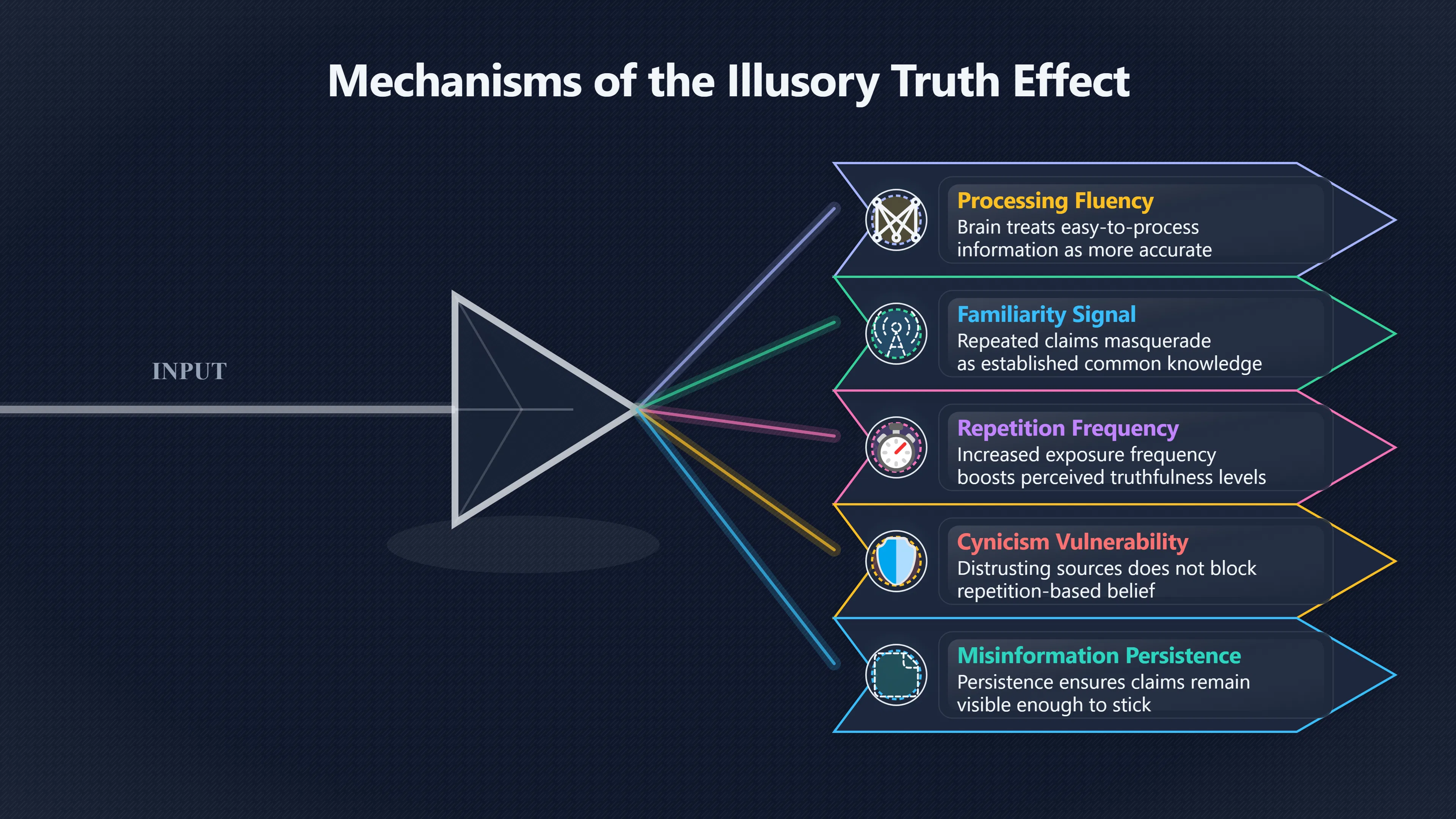
The mechanism is surprisingly simple. When people encounter information repeatedly, it becomes easier for the brain to process. Psychologists refer to this ease as processing fluency. Because true information is often familiar in everyday life, people learn to treat fluency as a rough signal of accuracy. The problem is that repetition can create the same feeling whether a statement is true or false.[PMC+2Springer Link]pmc.ncbi.nlm.nih.govThis finding is known as the illusory truth effect, and it is…
The key point is that the brain does not automatically distinguish between two different reasons a statement feels easy to process:
- It is easy because it is well-supported and widely known.
- It is easy because it has simply been repeated many times.
When those two signals become confused, familiarity can masquerade as evidence. Studies consistently show that repeated statements are rated as truer than new statements despite repetition providing no additional proof.[PMC]pmc.ncbi.nlm.nih.govPMCA Longitudinal Study of the Illusory Truth EffectNIHby EL Henderson · 2021 · Cited by 85 — Repeated statements are rated as subjectively truer than comparable new statements, even…
This effect can appear after remarkably little exposure. Research has found that even limited repetition can increase perceived truthfulness, helping explain why misinformation can spread effectively through sharing, reposting and repeated references.[EBSCO]ebsco.comIllusory truth effect | Psychology | Research StartersThe illusory truth effect is a cognitive phenomenon where repeated exposure to…
Why cynical readers are still vulnerable
A common assumption is that cynical people are protected because they distrust information. The evidence suggests otherwise.
The illusory truth effect does not depend on someone being naturally trusting. Research reviews report that repetition can increase belief in claims that are implausible, misleading or inconsistent with prior knowledge. In some studies, people became more likely to accept repeated statements even when they possessed relevant knowledge that should have helped them reject the claim.[PubMed+2wires.onlinelibrary.wiley.com]pubmed.ncbi.nlm.nih.govThe illusory truth effect: A review of how repetition…by J Udry · 2024 · Cited by 136 — Repetition increases belief in informati…
This matters because cynicism often focuses on distrusting sources rather than examining evidence. A cynical reader may dismiss journalists, institutions or experts while still absorbing claims encountered repeatedly through friends, influencers, memes or discussion threads. The familiar claim can gradually feel like common knowledge despite never having been properly verified.
Online environments amplify this risk. A user may see the same assertion:
- In multiple social media posts.[dictionary.cambridge.org]dictionary.cambridge.orgEnglish meaning - Cambridge Dictionary5 days ago — not real and based on illusion… Their hopes of a peaceful solution turned out to…
- In screenshots shared across platforms.
- In group chats.
- In AI-generated summaries trained on similar online material.
- In commentary videos that all reference one original rumour.
The repetition creates a sense that “everyone is talking about it”. Yet the underlying evidence may still be a single weak source.
Critical thinking requires asking whether a claim has become familiar because it is true or merely because it has circulated widely.
When many voices are really one source
One of the most common mistakes online is treating repeated claims as independent confirmation.
Imagine a rumour appears in one post. Other accounts repeat it. News aggregators quote those posts. Discussion forums react to them. AI systems summarise the resulting conversation. By the time the claim reaches a user, it may appear to have dozens or hundreds of apparent sources.
In reality, the information chain may still trace back to a single unverified origin.
This distinction is central to evidence evaluation:
Repetition means the same claim appears many times.
Corroboration means independent sources arrive at the same conclusion using separate evidence.
Only corroboration increases confidence in a claim. Repetition alone does not.
For example, ten posts all citing the same screenshot provide less evidential weight than two genuinely independent investigations reaching similar conclusions through different methods. Critical thinkers therefore ask not only how many people are saying this? but also where did they get it from?
A useful example from misinformation research
Research on misinformation repeatedly shows that repeated exposure increases perceived truthfulness and can encourage further sharing. In other words, repetition does not merely affect belief; it can help claims spread through social networks.[PMC]pmc.ncbi.nlm.nih.govThe illusory truth effect leads to the spread of misinformationby V Vellani · 2023 · Cited by 122 — In particular, we demonstrate that…
Studies examining climate-related claims provide a concrete illustration. Researchers found that repeating climate-related statements increased perceived truthfulness for both scientifically accurate claims and climate-sceptical claims. Participants could be nudged towards greater acceptance simply through prior exposure. The finding highlights that familiarity influences judgement regardless of whether the underlying statement is supported by evidence.[The Guardian]theguardian.comThe research, published in Plos One, was led by Mary Jiang from the Australian National University and highlighted the "illusory truth…
This is why misinformation campaigns often rely on persistence rather than proof. The goal is not always to provide compelling evidence. Sometimes it is enough to ensure that a claim remains visible long enough to become familiar.
How to tell repetition from corroboration
The most practical defence is not blanket scepticism but source tracing.
When encountering a widely repeated claim, ask:
- What is the earliest identifiable source?
Can the claim be traced to a document, dataset, witness, study or official statement?
- Are later posts adding evidence or merely repeating the claim?
Rewording does not create verification.
- Do supposedly separate sources rely on the same origin?
Independent-looking accounts often cite each other in a circular pattern.
- Has anyone provided primary evidence?
Original records matter more than summaries of summaries.
- Would the claim still seem convincing if you had only seen it once?
This question helps separate evidence from familiarity.
These checks are especially valuable in environments where algorithms reward engagement. High visibility can make information feel established long before it has been adequately tested.

Familiarity is a signal, not proof
The feeling that something is true often arrives before the evidence has been examined. Repetition exploits that gap by transforming familiarity into a shortcut for judgement.
Critical thinking does not require ignoring familiar claims. Familiarity can be useful because many true ideas are repeated. The mistake is treating familiarity itself as evidence. A claim becomes stronger when independent sources provide new support, not when the same assertion echoes through feeds, chats and AI-generated summaries.
In the age of social media and AI, one of the most valuable habits is therefore a simple question: am I seeing many pieces of evidence, or am I seeing the same claim many times? The answer often determines whether apparent consensus reflects genuine corroboration or merely the persuasive power of repetition.
eBay marketplace picks
Marketplace Samples
Example marketplace items related to this page. Use the search link to explore similar finds on eBay.




Endnotes
1.
Source: pmc.ncbi.nlm.nih.gov
Link:https://pmc.ncbi.nlm.nih.gov/articles/PMC8116821/
Source snippet
This finding is known as the illusory truth effect, and it is...
2.
Source: link.springer.com
Link:https://link.springer.com/article/10.1186/s41235-021-00301-5
Source snippet
Springer LinkThe effects of repetition frequency on the illusory truth effectby A Hassan · 2021 · Cited by 409 — This finding is known as...
3.
Source: ebsco.com
Link:https://www.ebsco.com/research-starters/psychology/illusory-truth-effect
Source snippet
Illusory truth effect | Psychology | Research StartersThe illusory truth effect is a cognitive phenomenon where repeated exposure to...
4.
Source: pmc.ncbi.nlm.nih.gov
Link:https://pmc.ncbi.nlm.nih.gov/articles/PMC10636596/
Source snippet
The illusory truth effect leads to the spread of misinformationby V Vellani · 2023 · Cited by 122 — In particular, we demonstrate that...
5.
Source: wires.onlinelibrary.wiley.com
Link:https://wires.onlinelibrary.wiley.com/doi/10.1002/wcs.1573
Source snippet
The effects of repeating false and misleading information...Aug 22, 2021 — Repetition increases belief in false information, even when t...
6.
Source: illusory.io
Link:https://www.illusory.io/
Source snippet
Modern proxies for data-led operationsIllusory makes it easier to retrieve online data and perform complex tasks. Train AI lan...
7.
Source: link.springer.com
Link:https://link.springer.com/article/10.3758/s13423-025-02836-w
Source snippet
repetition increase perceived truth equally for...by SM Bowes · 2026 — Repetition increases the perceived truth of information. This ill...
8.
Source: youtube.com
Title: Illusory Truth Effect
Link:https://www.youtube.com/watch?v=cXFxRkjZNiw
Source snippet
The Illusion of Truth...
9.
Source: pmc.ncbi.nlm.nih.gov
Title: PMCA Longitudinal Study of the Illusory Truth Effect
Link:https://pmc.ncbi.nlm.nih.gov/articles/PMC8194981/
Source snippet
NIHby EL Henderson · 2021 · Cited by 85 — Repeated statements are rated as subjectively truer than comparable new statements, even...
10.
Source: pubmed.ncbi.nlm.nih.gov
Link:https://pubmed.ncbi.nlm.nih.gov/38113667/
Source snippet
The illusory truth effect: A review of how repetition...by J Udry · 2024 · Cited by 136 — Repetition increases belief in informati...
11.
Source: Wikipedia
Title: Illusory truth effect
Link:https://en.wikipedia.org/wiki/Illusory_truth_effect
Source snippet
Illusory truth effectRepetition makes statements easier to process relative to new, unrepeated statements, leading people to believe t...
12.
Source: theguardian.com
Link:https://www.theguardian.com/australia-news/article/2024/aug/08/repeating-climate-denial-claims-makes-them-seem-more-credible-australian-led-study-finds
Source snippet
The research, published in *Plos One*, was led by Mary Jiang from the Australian National University and highlighted the "illusory truth...
13.
Source: thedecisionlab.com
Title: Illusory truth effect
Link:https://thedecisionlab.com/biases/illusory-truth-effect
Source snippet
The Decision...Fake news and social polarization. Fake News Illusory Truth Effect. The evidence suggests that global politics have alrea...
14.
Source: pmc.ncbi.nlm.nih.gov
Link:https://pmc.ncbi.nlm.nih.gov/articles/PMC10204694/
Source snippet
could increase the perceived truth of conspiracy...by J Béna · 2023 · Cited by 32 — Interestingly, research has found that repetition in...
15.
Source: dictionary.cambridge.org
Link:https://dictionary.cambridge.org/dictionary/english/illusory
Source snippet
English meaning - Cambridge Dictionary5 days ago — not real and based on illusion... Their hopes of a peaceful solution turned out to...
16.
Source: brodhub.eu
Title: Illusory Truth Effect
Link:https://brodhub.eu/en/media-literacy/illusory-truth-effect/
Source snippet
BROD16 Nov 2023 — The illusory truth effect is a cognitive bias wherein repetition increases the perceived truthfulness of a statement, r...
17.
Source: psychologytoday.com
Title: illusory truth effect
Link:https://www.psychologytoday.com/gb/basics/illusory-truth-effect
Source snippet
12 Nov 2025 — The illusory truth effect is the tendency for any statement that is repeated frequently—whether it is factually true or not...
18.
Source: psychologytoday.com
Title: illusory truth effect
Link:https://www.psychologytoday.com/us/basics/illusory-truth-effect
Source snippet
Nov 12, 2025 — The illusory truth effect is the tendency for any statement that is repeated frequently—whether it is factually true or no...
19.
Source: dictionary.findlaw.com
Link:https://dictionary.findlaw.com/definition/illusory.html
Source snippet
FindLaw Dictionary of Legal Termsterm: Illusory. illusory adj.: likely to mislead or deceive: false deceptive [an plea bargain leading...
Additional References
20.
Source: dictionary.com
Link:https://www.dictionary.com/browse/illusory
Source snippet
ILLUSORY Definition & Meaningadjective · causing illusion; deceptive; misleading. Synonyms: false, specious, fallacious · of the nature o...
21.
Source: merriam-webster.com
Link:https://www.merriam-webster.com/dictionary/illusory
Source snippet
ILLUSORY Definition & Meaningillusory implies a false impression based on deceptive resemblance or faulty observation, or influenced by e...
22.
Source: fs.blog
Link:https://fs.blog/illusory-truth-effect/
Source snippet
The Illusory Truth EffectIt's why fake news spreads and retractions of misinformation don't work. In this post, we're going to look at ho...
23.
Source: researchgate.net
Link:https://www.researchgate.net/publication/351563163_The_effects_of_repetition_frequency_on_the_illusory_truth_effect
Source snippet
The effects of repetition frequency on the illusory truth effectRepeated information is often perceived as more truthful than new informa...
24.
Source: leadalchemists.com
Link:https://www.leadalchemists.com/marketing-psychology/illusory-truth-effect/
25.
Source: news.vanderbilt.edu
Link:https://news.vanderbilt.edu/2020/10/06/study-shows-that-repeated-statements-are-more-often-judged-to-be-true-regardless-of-a-persons-age-or-prior-knowledge/
Source snippet
shows that repeated statements are more often...6 Oct 2020 — When adults hear a statement repeated twice, they are more likely to think...
26.
Source: researchgate.net
Title: 343265427 Repetition Increases Perceived Truth Even for Known Falsehoods
Link:https://www.researchgate.net/publication/343265427_Repetition_Increases_Perceived_Truth_Even_for_Known_Falsehoods
Source snippet
(PDF) Repetition Increases Perceived Truth Even for...1 July 2020 — Two experiments showed that overall, mere repetition indeed increase...
Published: July 2020
27.
Source: youtube.com
Link:https://www.youtube.com/watch?v=0pWLKQtpZOw
Source snippet
How To Say IllusoryPronunciation of Illusory: Learn how to pronounce the word Illusory. Definition and meaning were removed to avoid copy...
28.
Source: eufactcheck.eu
Link:https://eufactcheck.eu/blogpost/the-illusory-truth-effect-how-repeated-misinformation-sticks/
Source snippet
The illusory truth effect: how repeated misinformation sticks31 Jan 2026 — The illusory truth effect: how repeated misinformation sticks...
29.
Source: en.wiktionary.org
Link:https://en.wiktionary.org/wiki/illusory
Source snippet
from Middle French illusorie (modern French illusoire), derived from Latin illūsōrius (“mocking, ironical”)...
Topic Tree