Within Think Before Sharing
When Local Feeds Replace Local News
Local groups can become fertile ground for false authority messages when reliable local journalism is weak or absent.
On this page
- Why local gaps matter
- Fake authority and community groups
- How to check local claims
Page outline Jump by section
Introduction
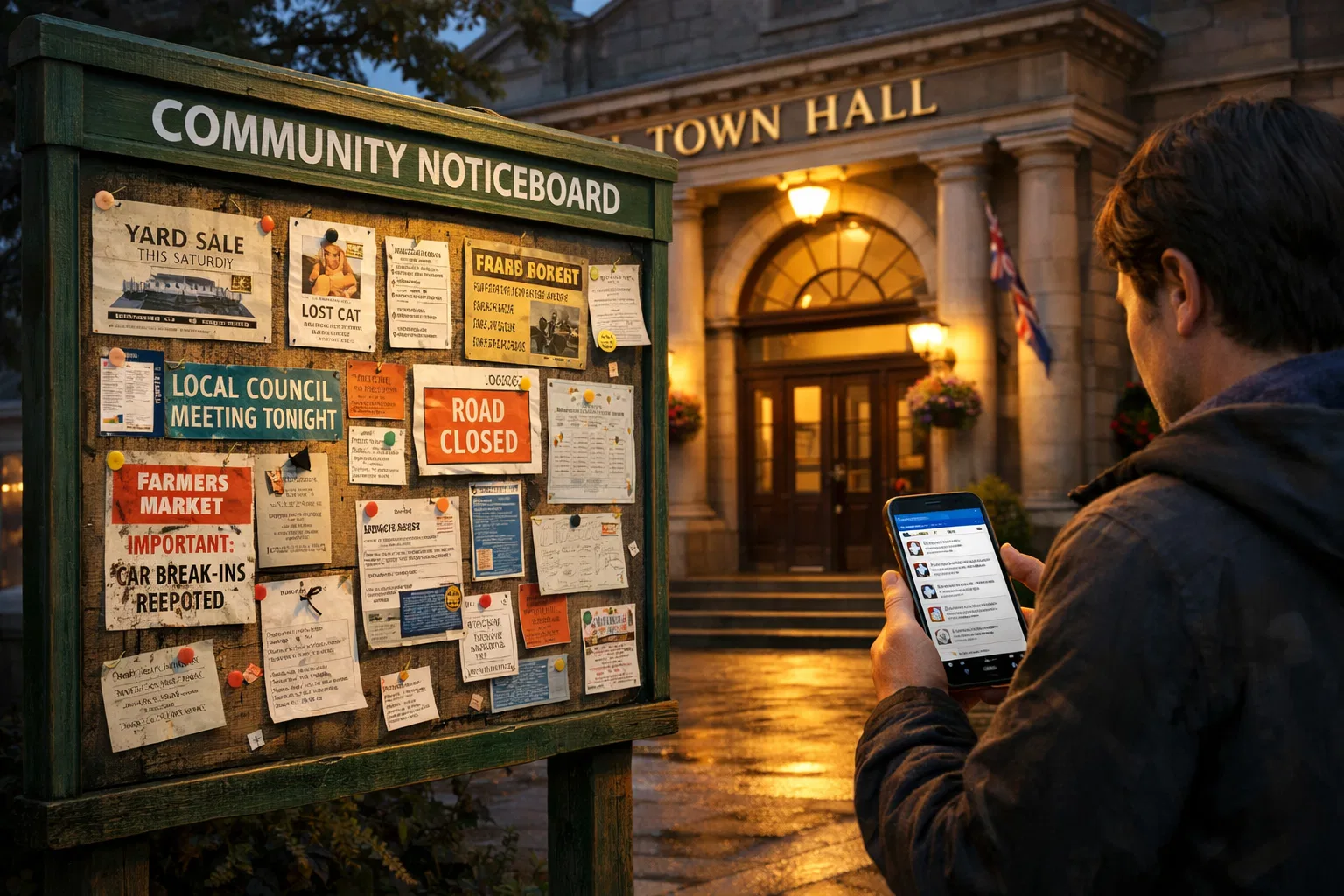
News deserts are places where reliable local journalism is weak, shrunken or absent. In those gaps, neighbourhood Facebook groups, WhatsApp chats, Nextdoor threads, local influencer accounts and search snippets can become the practical news system: fast, familiar and often useful, but unevenly checked. That matters because local claims feel more believable than distant national rumours. A post about a school, a road closure, a candidate, a crime, a GP surgery or a council decision can look credible simply because it names a familiar street or appears in a group full of neighbours.
The critical-thinking risk is not that every local group is malicious. It is that weak local reporting removes a shared reference point. When nobody is routinely attending council meetings, checking police statements, asking councillors for evidence, or correcting rumours in public, false authority can flourish. Recent UK research found misinformation rates were roughly three times higher in news deserts or “drylands” than in better-served local news areas, while US research continues to show widening local news deserts as newspapers close and digital replacements do not arrive evenly.[SMF]smf.co.ukNo news is bad news June 2026 correctNo news is bad news June 2026 correct
Why local gaps matter
Local journalism does a kind of work that national news, search engines and social media do not easily replace. It turns scattered public information into a record people can check: what the council actually voted for, what police have confirmed, which services are moving rather than closing, which candidate said what, and whether a viral claim has been misunderstood. Without that routine reporting, people may still be surrounded by information, but less of it has been verified by someone with a duty to correct errors.
The scale of the gap is substantial. Northwestern University’s 2025 State of Local News report says US news deserts are widening, newspaper closures continue, and the number of counties without local news has risen to 213. The same report notes that digital-only outlets are growing, but that growth does not automatically replace the geographic reach, institutional memory and meeting coverage lost when long-standing local papers close.[Local News Initiative]localnewsinitiative.northwestern.edustate of local newsLocal News InitiativeThe State of Local News 2025 | Local News Initiative…
A useful way to think about a news desert is not “no information”, but “no dependable local checking layer”. People still hear things: from neighbours, campaign pages, police updates, school emails, council social posts, influencers, local businesses and community groups. The problem is that those fragments arrive without a stable local newsroom to test them against documents, meetings and named officials.
The consequences go beyond rumour. A 2026 UK government-commissioned review of local news provision reported that interviewees from local newspapers and local authorities saw news deserts as a risk linked to misinformation, community tensions, reduced civic engagement, weaker local economic outcomes, and less scrutiny of local authorities. The same review found strong agreement that non-journalistic social media cannot simply replace local journalism.[GOV.UK]GOV.UKLocal news provision and local public service performanceLocal news provision and local public service performance
Local news also acts as a deterrent. The UK review summarised research linking newspaper closures to higher municipal borrowing costs, more federal corruption charges, increased corporate violations and reduced reporting of local toxic emissions when plants were farther from newspaper headquarters. These findings are not all “misinformation studies” in the narrow sense, but they show why the local information environment matters: when scrutiny thins out, errors, evasions and unchecked claims have more room to operate.[GOV.UK]GOV.UKLocal news provision and local public service performanceLocal news provision and local public service performance
When community feeds become unofficial newsrooms
Local social media works because it feels close. A post from someone in the same town can feel more relevant than a professionally written article about national politics. It may include a photo from a familiar road, a voice note from a parent, a screenshot from a council page, or a claim that begins with “my mate works there”. That social proximity can be helpful in emergencies, but it can also make weak evidence feel stronger than it is.
The Social Market Foundation’s 2026 UK report analysed more than 125,000 posts across Facebook, X, Nextdoor and Reddit to examine local misinformation. It found that 41% of local Facebook groups and 81% of X searches in its sample contained at least one piece of misinformation in the last 1,000 posts. The report also cautioned that removed posts may have been missed, so its results may understate the problem.[SMF]smf.co.ukNo news is bad news June 2026 correctNo news is bad news June 2026 correct
The important detail is not just the raw percentage of all posts. Most local group posts are not “news” at all; they are lost pets, recommendations, adverts, warnings, jokes and complaints. But when the SMF separated out news-related posts, it found that almost 1 in 20 news-related Facebook posts were misinformation, while on X the ratio was over 1 in 4. That means a person who uses a local group mainly for practical news may encounter a much riskier information diet than the overall group average suggests.[SMF]smf.co.ukNo news is bad news June 2026 correctNo news is bad news June 2026 correct
Local feeds also create a speed problem. A local rumour can move from “Has anyone heard?” to “This is what the council is hiding” within hours. By the time an official correction appears, the original post may have been screenshotted, reposted elsewhere, edited, or embedded in a broader story about corruption, immigration, crime, schools or elections. Critical thinking becomes harder because people are not judging a single claim; they are judging a fast-changing social narrative.
Fake authority and community groups
False authority is one of the biggest risks in local misinformation. It happens when a claim borrows the appearance of a trusted institution or local insider without earning that trust. Examples include a fake council notice, a manipulated screenshot of a local newspaper article, a post that says “police have confirmed” without linking to police, an anonymous account using “news” in its name, or a paid verification badge that looks like official credibility.
The SMF report uses “misinformation” broadly because intent is often hard to judge. It distinguishes misinformation from deliberate disinformation, but notes that disinformation can later be reshared by ordinary people who believe it is true. It also lists common forms of information disorder, including false context, imposter content, manipulated content and fabricated content. These categories are especially relevant locally because a small change to context can mislead: an old police photo can be presented as last night’s incident, or a real council consultation can be reframed as a secret final decision.[SMF]smf.co.ukNo news is bad news June 2026 correctNo news is bad news June 2026 correct
Elections make this sharper. In the SMF’s UK analysis, misinformation as a share of news-related posts in studied Facebook groups rose from 8.2% to 12.9% around local elections, a 56% increase. In the Gorton and Denton by-election case, misinformation across four local Facebook groups was reported as 26 times higher than in the wider Facebook analysis, though the report warns that it cannot say how far misinformation affected votes.[SMF]smf.co.ukNo news is bad news June 2026 correctNo news is bad news June 2026 correct
The local form can be more damaging than generic national misinformation because it attaches to real people and places. The SMF found posts about council issues, local politics, scams, immigration and Islamophobia, including cases where councillors had to intervene to explain that a library was being moved rather than lost entirely. It also documented a local debunk by the Manchester Evening News after a misleading claim about Green candidate Hannah Spencer’s home circulated during the Gorton and Denton campaign.[SMF]smf.co.ukNo news is bad news June 2026 correctNo news is bad news June 2026 correct
The 2024 Southport-related riots in the UK show how false claims can connect local tragedy to national and platform-level amplification. A UK parliamentary inquiry states that anti-immigration demonstrations and riots between 30 July and 7 August 2024 were driven in part by false claims spreading on social media about the killing of three children in Southport. LSE research later described how verified X accounts, AI-generated images and false claims helped give racist conspiracy narratives a more credible appearance and wider reach.[UK Parliament Committees]committees.parliament.ukUK Parliament Committees Social media, misinformation and harmful algorithmsUK Parliament CommitteesSocial media, misinformation and harmful algorithms - Committees - UK Parliament…
This is the core critical-thinking challenge: local misinformation often does not look like a wild conspiracy at first. It looks like a warning, a screenshot, a neighbourhood tip, a “just asking questions” post, or a claim from someone who seems embedded in the community.
Why “just search it” is not always enough
Searching can help, but local misinformation often thrives precisely because the searchable record is thin. A national falsehood may have multiple fact-checks, explainers and official statements. A rumour about a town council, a local candidate, a school closure, or a neighbourhood crime may have only a few low-quality search results, many of them copied from the same social posts.
Researchers sometimes call this a “data void”: a space where there is demand for information but little reliable content to satisfy it. In a local data void, the first confident-looking page or post can gain authority because there is little else to compare it with. This matters more as generative AI summaries and search snippets increasingly package information into fluent answers. A system may sound confident even when it is drawing from a sparse or polluted local source base.
There is also a trust paradox. Pew Research Center found in 2025 that US adults still trusted local news organisations more than national news organisations or social media sites, but that trust in local news had fallen from 82% in 2016 to 70% in 2025. Social media trust was lower overall, yet younger adults were much closer to parity between national news and social media trust. A community may therefore lose local reporting at the same time as more people rely on platforms to fill the gap.[Pew Research Center]pewresearch.orgOpen source on pewresearch.org.
The lesson is not that searches are useless. It is that local claims need a different checking method from broad public issues. The right question is not only “Can I find a link?” but “Can I find an independent, accountable source close enough to the event to know, and transparent enough to correct mistakes?”
How to check local claims
Local verification does not require professional training, but it does require slowing down. A claim about a place you know can feel urgent precisely because it might affect you. That is when a short checking routine matters most.
Use these checks before sharing or acting on a local claim:
- Find the original source. Do not rely on a screenshot of a screenshot. Look for the first post, document, meeting agenda, police update, council notice, court listing, school message or candidate statement.
- Separate “happened” from “explained”. A photo of police cars may prove police attended; it does not prove the cause, suspect, motive or outcome. A council agenda may prove an item was discussed; it does not prove the decision has already been made.
- Check official channels without treating them as perfect. Police, councils, schools, NHS bodies and election offices can make mistakes or communicate poorly, but they are still important primary sources. Compare what they say with independent local reporting where available.
- Look for accountable local journalism. A credible local report usually names the reporter or outlet, distinguishes confirmed facts from claims, links or refers to documents, gives right of reply where needed, and corrects errors visibly.
- Be wary of borrowed authority. Words such as “official”, “breaking”, “insider”, “confirmed”, “local news” or a blue tick do not prove anything by themselves. Check whether the account has a history of real local reporting or mostly reposts outrage, rumours and memes.
- Watch for old material with a new caption. Reverse-search an image, check dates, look for weather, signage, uniforms, street furniture and earlier uses of the same clip. Local rumours often reuse real material in a false context.
- Ask what would change your mind. Before arguing in a local group, decide what evidence would settle the point: a council minute, a police statement, a planning application, a school letter, a court record, or a direct correction from the named organisation.
- Avoid “visibility sharing”. Sharing a false post to condemn it can still spread it. Where possible, summarise the correction without reposting the original image, or link to a reliable debunk rather than amplifying the rumour.
The same discipline applies to AI tools. A chatbot can help draft questions to ask a council, explain how to read a planning document, or summarise a long meeting paper that you provide. It should not be treated as proof that a local claim is true, especially where the public record is sparse or rapidly changing.

What stronger local information looks like
The answer to local misinformation is not simply “more moderation”. Moderation can remove some false or harmful content, but a healthy local information environment also needs positive supply: reporters, public records, clear official communication, transparent community moderation and residents who know how to check before sharing.
There are practical signs that a community has better local information resilience. Council meetings are reported in plain language. Local reporters or newsletters explain what is confirmed and what is still uncertain. Facebook group moderators require sources for serious allegations. Public bodies correct rumours quickly and visibly. Residents know where to find planning applications, election information, court outcomes and emergency updates. Local outlets collaborate rather than merely chase platform traffic.
The UK government review found strong support for the BBC-backed Local Democracy Reporting Service, which places reporters in local newsrooms to cover councils and local public bodies, especially where traditional local journalism has declined. Interviewees still raised concerns about limited resources, but the scheme was widely seen as effective and necessary for keeping local decisions visible.[GOV.UK]GOV.UKLocal news provision and local public service performanceLocal news provision and local public service performance
There is also a role for community groups themselves. Local groups are not doomed to be misinformation engines. They can be useful civic spaces when they set rules for evidence, label rumours clearly, remove impersonation, avoid inflammatory speculation during emergencies, and encourage links to primary sources. The goal is not to make every neighbour behave like a journalist. It is to stop the group from rewarding the fastest and angriest version of events.
The critical-thinking takeaway
News deserts make misinformation more likely not because residents are unusually gullible, but because the checking infrastructure around them has weakened. When local reporting disappears, people still need answers about crime, roads, schools, planning, health services, elections and public money. Social feeds fill that need quickly, but they do not automatically provide verification, correction or accountability.
The safest habit is to treat local claims as both important and unfinished. Important, because they may affect real neighbours and decisions. Unfinished, because a familiar place name, a confident caption or a community-group share is not the same as evidence. In the age of social media and AI, critical thinking starts with a pause: who knows this, how do they know it, and where is the local record that can be checked?


eBay marketplace picks
Marketplace Samples
Example marketplace items related to this page. Use the search link to explore similar finds on eBay.




Endnotes
1.
Source: smf.co.uk
Title: No news is bad news June 2026 correct
Link:https://www.smf.co.uk/wp-content/uploads/2026/06/No-news-is-bad-news-June-2026-correct.pdf
Published: June 2026
2.
Source: localnewsinitiative.northwestern.edu
Title: state of local news
Link:https://localnewsinitiative.northwestern.edu/projects/state-of-local-news/2025/
Source snippet
Local News InitiativeThe State of Local News 2025 | Local News Initiative...
3.
Source: GOV.UK
Title: Local news provision and local public service performance
Link:https://www.gov.uk/government/publications/local-news-provision-and-local-public-service-performance/local-news-provision-and-local-public-service-performance
4.
Source: committees.parliament.uk
Title: UK Parliament Committees Social media, misinformation and harmful algorithms
Link:https://committees.parliament.uk/work/8641/social-media-misinformation-and-harmful-algorithms/news/
Source snippet
UK Parliament CommitteesSocial media, misinformation and harmful algorithms - Committees - UK Parliament...
5.
Source: lse.ac.uk
Link:https://www.lse.ac.uk/research/research-for-the-world/society/x-undermined-democracy-uk-riots
6.
Source: localnewsinitiative.northwestern.edu
Title: news deserts social media local news medill survey
Link:https://localnewsinitiative.northwestern.edu/posts/2026/02/10/news-deserts-social-media-local-news-medill-survey/
7.
Source: localnewsinitiative.northwestern.edu
Title: state of local news
Link:https://localnewsinitiative.northwestern.edu/projects/state-of-local-news/
8.
Source: medill.northwestern.edu
Link:https://www.medill.northwestern.edu/news/2025/news-deserts-hit-new-high-and-50-million-have-limited-access-to-local-news-study-finds.html
9.
Source: news.northwestern.edu
Title: newspapers close decline in local journalism
Link:https://news.northwestern.edu/stories/2022/06/newspapers-close-decline-in-local-journalism
10.
Source: committees.parliament.uk
Link:https://committees.parliament.uk/writtenevidence/86625/html/
11.
Source: hansard.parliament.uk
Title: uk Misinformation: Social Market Foundation Report
Link:https://hansard.parliament.uk/Lords/2026-06-11/debates/DAA58E64-9358-4158-98CF-835D680E3097/MisinformationSocialMarketFoundationReport
12.
Source: parliament.uk
Link:https://www.parliament.uk/business/commons/committee-corridor-podcast/committee-corridor-local-journalism/
13.
Source: facebook.com
Link:https://www.facebook.com/pewresearch/posts/what-information-do-americans-trust-%E2%84%B9%EF%B8%8F-across-all-age-groups-trust-in-national-a/1212234420772616/
14.
Source: facebook.com
Link:https://www.facebook.com/InternationalFederationofJournalists/posts/usa-in-local-news-deserts-the-public-relies-heavily-on-social-media-and-other-no/1395851992582256/
15.
Source: facebook.com
Link:https://www.facebook.com/LocalNewsInitiative/
16.
Source: facebook.com
Link:https://www.facebook.com/groups/384926985723985/posts/1751943585688978/
17.
Source: facebook.com
Title: The Guardian
Link:https://www.facebook.com/theguardian/photos/investigation-reveals-more-than-44-million-people-live-in-news-deserts-that-lack/1429000595924856/
18.
Source: facebook.com
Link:https://www.facebook.com/groups/671022767060782/posts/2243057433190633/
19.
Source: facebook.com
Link:https://www.facebook.com/groups/enemyofthepeople/posts/10174691490960058/
20.
Source: facebook.com
Link:https://www.facebook.com/AlmaEconomics/photos/when-a-community-loses-its-local-paper-what-else-is-the-community-at-risk-of-los/946377358151305/
21.
Source: pew.org
Title: media mistrust has been growing for decades does it matter
Link:https://www.pew.org/en/trend/archive/fall-2024/media-mistrust-has-been-growing-for-decades-does-it-matter
22.
Source: pew.org
Link:https://www.pew.org/en/trust/archive/fall-2020/americans-who-get-news-mainly-on-social-media-are-less-knowledgeable-and-less-engaged
23.
Source: pew.org
Title: the future of news
Link:https://www.pew.org/en/trust/archive/winter-2026/the-future-of-news
24.
Source: pew.org
Title: americans deepening mistrust of institutions
Link:https://www.pew.org/en/trend/archive/fall-2024/americans-deepening-mistrust-of-institutions
25.
Source: time.com
Title: local government disinformation essay
Link:https://time.com/7020151/local-government-disinformation-essay/
26.
Source: pewresearch.org
Link:https://www.pewresearch.org/short-reads/2025/10/29/how-americans-trust-in-information-from-news-organizations-and-social-media-sites-has-changed-over-time/
27.
Source: smf.co.uk
Link:https://www.smf.co.uk/publications/social-media-local-misinformation/
28.
Source: smf.co.uk
Link:https://www.smf.co.uk/fake-news-nearly-three-times-more-common-in-areas-without-local-journalism-and-spikes-during-elections-new-research-finds/
29.
Source: smf.co.uk
Link:https://www.smf.co.uk/events/local-misinformation/
30.
Source: pewresearch.org
Link:https://www.pewresearch.org/
31.
Source: pewresearch.org
Title: social media and news fact sheet
Link:https://www.pewresearch.org/journalism/fact-sheet/social-media-and-news-fact-sheet/
32.
Source: pewresearch.org
Link:https://www.pewresearch.org/topic/news-habits-media/
33.
Source: pewresearch.org
Title: facts fact checking
Link:https://www.pewresearch.org/topic/news-habits-media/media-society/misinformation/facts-fact-checking/
34.
Source: pewresearch.org
Link:https://www.pewresearch.org/topic/news-habits-media/media-society/misinformation/
35.
Source: pewresearch.org
Link:https://www.pewresearch.org/topic/news-habits-media/media-society/media-attitudes/trust-in-media/
36.
Source: pewresearch.org
Title: Vance is among 1.5% of Americans who have converted to Catholicism
Link:https://www.pewresearch.org/short-reads/2026/06/05/vance-is-among-1-5-of-americans-who-have-converted-to-catholicism/
37.
Source: pewresearch.org
Link:https://www.pewresearch.org/topic/internet-technology/technology-policy-issues/misinformation-online/page/2/
38.
Source: youtube.com
Link:https://www.youtube.com/watch?v=d56aO2Dr2to
39.
Source: jstor.org
Link:https://www.jstor.org/publisher/prc
Additional References
40.
Source: usnewsdeserts.com
Link:https://www.usnewsdeserts.com/reports/expanding-news-desert/loss-of-local-news/
Source snippet
The Loss of Local News: What It Means for CommunitiesThis report explores the loss and diminishment of local newspapers, the implications...
41.
Source: usnewsdeserts.com
Title: expanding news desert
Link:https://www.usnewsdeserts.com/reports/expanding-news-desert/
Source snippet
The Loss of Local NewsThe Expanding News DesertOur 2018 report, The Expanding News Desert, delves deeper into the implications for commun...
42.
Source: youtube.com
Title: When newspapers disappear: Taxes rise, voting drops
Link:https://www.youtube.com/watch?v=0kLrFwGpsHQ
Source snippet
What is a "News Desert" and how it directly impacts communities in North Carolina...
43.
Source: youtube.com
Title: The Decline of Local News and the Rise of Polarization
Link:https://www.youtube.com/watch?v=iiZZh2XTI2w
Source snippet
When newspapers disappear: Taxes rise, voting drops...
44.
Source: theguardian.com
Link:https://www.theguardian.com/media/2026/jun/08/social-media-groups-fuel-misinfomation-uk-news-deserts-report
45.
Source: researchgate.net
Link:https://www.researchgate.net/publication/384388667_Where_Is_Local_News_Dying_Off_Mechanisms_Behind_the_Formation_of_Local_News_Deserts_in_the_United_States
46.
Source: holdthefrontpage.co.uk
Link:https://www.holdthefrontpage.co.uk/2026/news/fake-news-three-times-as-common-in-news-deserts-says-report/
47.
Source: worldjusticeproject.org
Link:https://worldjusticeproject.org/world-justice-challenge/local-news-deserts-mapping-loss-local-media-sources
48.
Source: instagram.com
Link:https://www.instagram.com/p/DXevDInjGE1/
49.
Source: campaignlab.uk
Link:https://campaignlab.uk/wp-content/uploads/2026/02/Campaign-Lab-Local-news-on-Facebook-report-EMBARGOED.pdf
Topic Tree
Follow this branch
Parent topic
Think Before SharingRelated pages 24
- Accuracy Nudge Can One Pause Stop a False Share?
- AI Tutors Should You Trust a Chatbot Tutor?
- AI Virality Why AI Misinformation Travels So Easily
- Community Notes Can the Crowd Correct the Feed?
- Corroboration Who Else Can Confirm This Claim?
- Deepfakes How to Check a Voice or Video Claim
- Emotional Posts Why Outrage Is Not Evidence
- Evidence Types Not All Evidence Deserves Equal Weight
- +16 more in sidebar
- Council Checks How To Check A Council Rumor
- Election Rumors Why Local Election Rumors Spread Fast
- Fake Authority When A Local Warning Looks Official
- Local Groups Why Local Rumors Feel So Believable
- Search Gaps When Searching Does Not Settle It
- SMF Dataset The Local Misinformation Numbers That Matter