Within Screenshots
When Real Images Get New Stories
A real image can still mislead when a new caption detaches it from its original time, place or cause.
On this page
- Why real visuals can become false evidence
- How dates and locations get severed
- Reverse image and archive checks that help
Page outline Jump by section
Introduction
A photograph can be completely genuine and still be used to mislead. One of the most common forms of visual misinformation is the recycling of old images and presenting them as evidence of a new event. During natural disasters, protests, conflicts, elections and public emergencies, striking photographs often reappear with fresh captions claiming they show something that happened “today” or “just now”. The image itself may be authentic; the deception lies in separating it from its original time, place or cause. Researchers describe this as “out-of-context” or “false-context” content: real visual material paired with misleading claims that change its meaning.[arXiv]arxiv.orgImage-Text Out-Of-Context Detection Using Synthetic…29 Jan 2024 — One common form of multimodal misinformation is Out-of-context…
 This matters because people often trust photographs more than text. A dramatic image appears to provide direct evidence, especially when it is shared as a screenshot or repost detached from its original source. In many viral misinformation cases, no image editing is required at all. The persuasive power comes from recaptioning an existing photograph and presenting it as breaking news.[PBS]pbs.orgout of context photos are a powerful low tech form of misinformationOut-of-context photos are a powerful low-tech form…18 Feb 2020 — Psychological research demonstrates that these out-of-context phot…
Why Real Visuals Can Become False Evidence
A fabricated image must overcome suspicion about whether it is genuine. An authentic image starts with a major advantage: it already looks real because it is real.
Psychological and media research has found that photographs strongly influence how people interpret events. When an old image is attached to a current claim, viewers often treat the image as confirmation that the claim is true, even if the photograph was originally taken years earlier in a different location.[PBS]pbs.orgout of context photos are a powerful low tech form of misinformationOut-of-context photos are a powerful low-tech form…18 Feb 2020 — Psychological research demonstrates that these out-of-context phot…
This tactic appears repeatedly during fast-moving news events because it is cheap, fast and difficult to detect at a glance. Fact-checkers regularly document examples in which:
- Old disaster photographs are reused during new disasters.
- Images from one country are presented as evidence from another.
- Photographs from previous protests are recaptioned as current unrest.
- Historical images are attached to contemporary political claims.
- Unrelated photographs are presented as victims, perpetrators or witnesses in breaking incidents.[Reuters]reuters.comReuters Fact CheckReuters Fact Check addresses online misinformation with coverage that maintains accuracy, integrity and impartia…
The result is a misleading narrative built from authentic visual material. Viewers may correctly conclude that the image itself is genuine while missing that the accompanying story is false.
How Dates and Locations Get Severed
The key mechanism is not image manipulation but context removal.
Every photograph originally exists within a chain of information: who took it, when it was taken, where it was taken, what it showed, and why it was published. When an image is copied into a social-media post, screenshot or forwarded message, much of that information disappears.
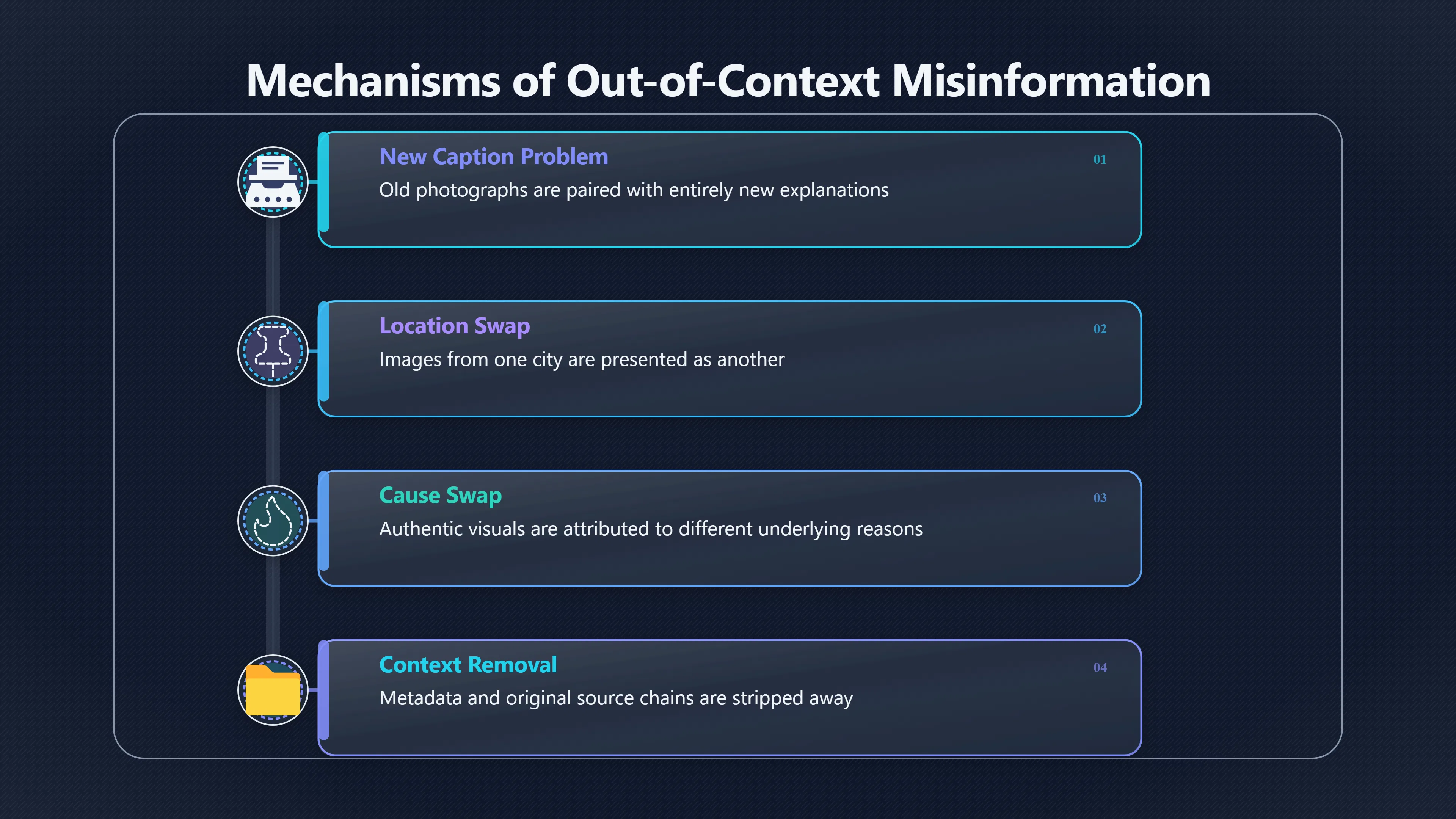
The New Caption Problem
A common pattern is simple recaptioning. A photograph from a previous event is reposted with a new explanation.
For example, Reuters and other fact-checking organisations frequently identify videos and photographs from earlier disturbances, demonstrations or incidents that later resurface as supposed evidence of a new crisis. In such cases the visual content may be genuine, but the date attached to it is wrong.[Reuters]reuters.comReuters Fact CheckReuters Fact Check addresses online misinformation with coverage that maintains accuracy, integrity and impartia…
The misleading caption often exploits a current emotional moment. During a flood, people are primed to believe dramatic flood images. During civil unrest, they are primed to believe dramatic protest images. The recycled photograph appears to fit the developing story and therefore receives less scrutiny.
The Location Swap
A second pattern keeps the image’s date but changes its location.
An image from one city, region or country may be presented as evidence from another. This is especially common during conflicts and disasters because audiences often lack detailed knowledge of local landmarks. A photograph of destruction from one event can be reframed as destruction from an entirely different event.[The Verge]theverge.comThe Verge How the experts figure out what's real in the age of deepfakesTrusted digital investigators like The New York Times, Bellingcat, and Indicator rely on rigorous verification protocols to discern real…
Once the original location is detached from the image, viewers may interpret it as proof of claims that the photograph never documented.
The Cause Swap
Sometimes the time and place remain broadly accurate while the explanation changes.
A photograph of a fire, crowd or damaged building may be real, but the post falsely attributes the scene to a different cause. A picture from an accident becomes evidence of sabotage. A routine gathering becomes evidence of political mobilisation. The visual record remains authentic while the narrative around it changes.[arXiv]arxiv.orgImage-Text Out-Of-Context Detection Using Synthetic…29 Jan 2024 — One common form of multimodal misinformation is Out-of-context…
Why Breaking-News Moments Are Especially Vulnerable
Old-image recycling thrives during uncertainty.
When major events first unfold, verified information is scarce and public demand for updates is high. People search for visual proof before journalists, authorities and witnesses have fully documented what happened. That information gap creates an opportunity for recycled material to spread.[arXiv]arxiv.orgFrom Verification to Amplification: Auditing Reverse Image Search as Algorithmic Gatekeeping in Visual Misinformation Fact-checkingM…
Several factors make these moments particularly risky:
- Speed beats verification. Viral posts can travel globally before fact-checkers identify the original image.
- Emotional content spreads faster. Dramatic visuals attract attention and sharing.
- People expect incomplete information. During breaking news, uncertainty feels normal, reducing suspicion.
- Visuals create urgency. Users often react to images before examining captions carefully.[The Verge]theverge.comThe Verge How the experts figure out what's real in the age of deepfakesTrusted digital investigators like The New York Times, Bellingcat, and Indicator rely on rigorous verification protocols to discern real…
The same photograph may therefore cycle through multiple news events over many years, accumulating new stories each time it is reposted.
Reverse-Image and Archive Checks That Help
The most effective defence against recycled images is to ask not only whether the image is real, but whether it is being used in the correct context.
Start With Reverse Image Search
Reverse image search allows users to upload an image or search using the image itself rather than keywords. Search engines and verification teams use this method to identify earlier appearances of the same photograph.
If the supposedly breaking-news image appears in articles or posts from months or years earlier, that is a strong indication that the current caption may be misleading. Reverse searches often reveal the original publication date, photographer and location.[The Verge]theverge.comThe Verge How the experts figure out what's real in the age of deepfakesTrusted digital investigators like The New York Times, Bellingcat, and Indicator rely on rigorous verification protocols to discern real…
Look for the Earliest Known Appearance
Finding an older version is often more valuable than finding many recent reposts.
Questions worth asking include:
- When did this image first appear online?
- Which publication used it earliest?
- Was it originally associated with a different event?
- Does the original caption match the current claim?
A genuine breaking-news image should generally have a traceable path back to the event being discussed.
Check News Archives and Fact-Checks
Many recycled images have already been investigated.
Professional fact-checkers maintain searchable archives documenting recurring false-context claims. During major news events, organisations such as Reuters, AP, AFP and others frequently publish analyses showing that supposedly new images actually originated elsewhere.[Reuters+2AP News]reuters.comReuters Fact CheckReuters Fact Check addresses online misinformation with coverage that maintains accuracy, integrity and impartia…
Searching for distinctive details from a photograph—landmarks, uniforms, signs, vehicles or visible text—can often uncover prior reporting.
Compare the Visual Details
Basic visual clues can expose a mismatch between the image and the claim.
Useful checks include:
- Weather conditions versus the reported date.
- Seasonal indicators such as vegetation or clothing.
- Vehicle registrations, road signs or language.
- Architectural features tied to a specific region.
- Known landmarks visible in the background.
Open-source investigators and verification teams routinely combine these clues with mapping tools and archive searches to establish where and when an image was actually taken.[The Verge]theverge.comThe Verge How the experts figure out what's real in the age of deepfakesTrusted digital investigators like The New York Times, Bellingcat, and Indicator rely on rigorous verification protocols to discern real…
A Useful Critical-Thinking Habit
When encountering a dramatic photograph presented as proof of a current event, the most important question is often not “Is this image fake?” but “When and where was this image originally taken?”
That shift in thinking reflects a central lesson of critical thinking in the age of social media and AI. Visual misinformation is not limited to fabricated images. Real photographs can become misleading evidence when they are detached from their original context and given a new story. The image may be authentic; the claim attached to it may not be.[arXiv+2PBS]arxiv.orgImage-Text Out-Of-Context Detection Using Synthetic…29 Jan 2024 — One common form of multimodal misinformation is Out-of-context…
Amazon book picks
Further Reading
Books and field guides related to When Real Images Get New Stories. Use these as the next step if you want deeper reading beyond the article.
The Skeptics' Guide to the Universe
Provides methods for verifying claims tied to images.
eBay marketplace picks
Marketplace Samples
Example marketplace items related to this page. Use the search link to explore similar finds on eBay.
Endnotes
1.
Source: arxiv.org
Link:https://arxiv.org/html/2403.08783v1
Source snippet
Image-Text Out-Of-Context Detection Using Synthetic...29 Jan 2024 — One common form of multimodal misinformation is Out-of-context...
2.
Source: pbs.org
Title: out of context photos are a powerful low tech form of misinformation
Link:https://www.pbs.org/newshour/science/out-of-context-photos-are-a-powerful-low-tech-form-of-misinformation
Source snippet
Out-of-context photos are a powerful low-tech form...18 Feb 2020 — Psychological research demonstrates that these out-of-context phot...
3.
Source: reuters.com
Link:https://www.reuters.com/fact-check/
Source snippet
Reuters Fact CheckReuters Fact Check addresses online misinformation with coverage that maintains accuracy, integrity and impartia...
4.
Source: arxiv.org
Link:https://arxiv.org/abs/2603.09130
Source snippet
From Verification to Amplification: Auditing Reverse Image Search as Algorithmic Gatekeeping in Visual Misinformation Fact-checkingM...
5.
Source: arxiv.org
Link:https://arxiv.org/html/2503.13500v1
Source snippet
for each step with the visual and textual context of previous steps, ensuring...
6.
Source: factcheck.afp.com
Link:https://factcheck.afp.com/
Source snippet
Fact CheckAFP Fact Check is a department within Agence France-Presse (AFP), a multi-lingual, multicultural news agency whose mission is t...
7.
Source: apnews.com
Link:https://apnews.com/article/1cd447e8963456af2be9a24d660ed1d6
Source snippet
Several false claims were debunked: photos falsely identified both the officer involved and the victim; the officer was misnamed Steve Gr...
8.
Source: theverge.com
Title: The Verge How the experts figure out what’s real in the age of [deepfakes]({{ ‘deepfakes/’ | relative_url }})
Link:https://www.theverge.com/tech/888303/photo-video-fake-news-verification-nyt-bellingway
Source snippet
Trusted digital investigators like The New York Times, Bellingcat, and Indicator rely on rigorous verification protocols to discern real...
9.
Source: reutersinstitute.politics.ox.ac.uk
Link:https://reutersinstitute.politics.ox.ac.uk/generative-ai-and-news-report-2025-how-people-think-about-ais-role-journalism-and-society
Source snippet
AI and news report 2025: How people think about...7 Oct 2025 — The report is based on a survey conducted by YouGov on behalf of the Reut...
Additional References
10.
Source: researchgate.net
Link:https://www.researchgate.net/publication/369976751_Disinformation_and_Misinformation_During_Kenya%27s_2022_Election_Implications_for_Voter_Confidence_in_the_Electoral_Process
Source snippet
Disinformation and Misinformation During Kenya's 2022...13 Apr 2023 — This policy brief explores the effects of disinformation and misin...
11.
Source: openreview.net
Link:https://openreview.net/pdf/ab9fa0996fbc0463c30f0a927de5af8b040fd154.pdf
Source snippet
LONG-HORIZON VISUAL INSTRUCTION GENERATIONOur intuition for addressing these issues is to first generate a draft image for each step with...
12.
Source: researchgate.net
Link:https://www.researchgate.net/publication/376991347_Detecting_Out-of-Context_Image-Caption_Pair_in_News_A_Counter-Intuitive_Method
Source snippet
Detecting Out-of-Context Image-Caption Pair in News15 Apr 2026 — CoVLM [19] is a semi-supervised framework for detecting fake news, where...
13.
Source: instagram.com
Title: Images can also be 100% accurate but used in the wrong context.Read more
Link:https://www.instagram.com/p/DWdVjFYgbCr/?hl=en
Source snippet
Fake news spreads in seconds, causing fear, confusion...There are often deliberate attempts to use old news as those that are current...
14.
Source: facebook.com
Link:https://www.facebook.com/unescophnompenh/videos/we-often-see-images-being-shared-and-reused-out-of-context-with-captions-that-do/807522592274259/
Source snippet
self from being misled by this tactic, you need to know how to...
15.
Source: marinaamaral.substack.com
Title: ai is creating fake historical photos
Link:https://marinaamaral.substack.com/p/ai-is-creating-fake-historical-photos
Source snippet
is creating fake historical photos, and that's a problemthese AI models can churn out "vintage" photos that are virtually indistinguishab...
16.
Source: theguardian.com
Title: 28 fake images that fooled the world
Link:https://www.theguardian.com/artanddesign/2025/apr/12/28-fake-images-that-fooled-the-world
Source snippet
'It never happened – but the picture says it did': 28 fake...12 Apr 2025 — From the pope in a puffer to the Princess of Wales and family...
17.
Source: iptc.org
Title: IPTC PhotoMetadataWhitePaper2007 11
Link:https://www.iptc.org/std/photometadata/0.0/documentation/IPTC-PhotoMetadataWhitePaper2007_11.pdf
Source snippet
Photo Metadata White Paper 2007Detailed information is required to make a 50-year-old press photo findable in the correct historical cont...
18.
Source: tribune.com.pk
Title: when war learns to photoshop
Link:https://tribune.com.pk/article/98124/when-war-learns-to-photoshop
Source snippet
12 Mar 2026 — The viral images were therefore classified as misinformation or manipulated visuals rather than evidence of a verified batt...
19.
Source: facebook.com
Link:https://www.facebook.com/freepressunltd/posts/-a-photo-without-context-an-old-video-presented-as-new-or-a-claim-designed-to-pr/1480089297484125/
Source snippet
💡 A photo without context, an old video presented as new...Use reverse image search: is an image authentic or is it a stock photo or be...
Topic Tree