Within Emotional Posts
The flattering posts that bypass doubt
Pride-based misinformation feels safer than outrage, but it can still make readers accept claims because they flatter a group identity.
On this page
- Why positive emotion can still mislead
- Common patterns in identity flattering claims
- How to check victory stories and heroic anecdotes
Page outline Jump by section
Introduction
Not all misleading social media posts rely on anger, fear or panic. Some spread because they feel good. A post that praises a nation, community, profession, political movement, fan base or social group can lower scepticism by offering readers something emotionally rewarding: a positive view of themselves and the people they identify with. When a claim arrives wrapped in pride, recognition or collective achievement, the emotional question—“Does this make us look good?”—can quietly replace the factual question—“Is this actually true?” Research on identity and misinformation consistently finds that people process information partly through the lens of group belonging, making identity-affirming narratives especially persuasive when they reinforce existing loyalties and values.[PubMed+2duepublico2.uni-due.de]pubmed.ncbi.nlm.nih.govUpdating the identity-based model of belief: From false…by JJ Van Bavel · 2024 · Cited by 94 — The Identity-based Model of Polit…
 This matters for critical thinking in the age of social media and AI because flattering misinformation often looks harmless. Unlike outrage-driven content, it may appear uplifting, patriotic, inspiring or celebratory. Yet the same psychological shortcut can operate: emotional satisfaction arrives before evidence.
Why positive emotion can still mislead
Pride is not a problem. Communities need stories of achievement, resilience and success. The difficulty arises when positive emotion becomes evidence by proxy.
Psychologists studying identity-protective reasoning have found that people often evaluate information in ways that protect valued group identities. Rather than asking only whether a claim is supported, individuals may unconsciously ask whether accepting or rejecting it would threaten their standing within a group or challenge a positive self-image.[duepublico2.uni-due.de+2JSTOR]duepublico2.uni-due.deKahan, D. M. (2017). Misconceptions, misinformation, and the logic of identity-protective cognition (No. 164…Read more…
On social media, this mechanism is particularly powerful because identity is publicly displayed. Users often belong simultaneously to political, national, cultural, professional and lifestyle communities. A post celebrating “our side” can therefore serve two functions at once:
- It presents a factual claim.
- It signals group membership.
When those functions become fused, sharing the claim can feel like an act of solidarity rather than a statement about evidence. Researchers examining misinformation and social identity note that information frequently gains traction because it aligns with group interests, narratives or worldviews rather than because it has been independently verified.[Sage Journals+2Default]journals.sagepub.comSage JournalsDisinformation and Echo Chambersby C Diaz Ruiz · 2023 · Cited by 344 — Therefore, although it remains essential to continue…
Positive emotion can therefore bypass doubt in a quieter way than outrage. The reader experiences affirmation instead of alarm, but the reduction in scrutiny may be similar.
Common patterns in identity-flattering claims
The “we are secretly winning” story
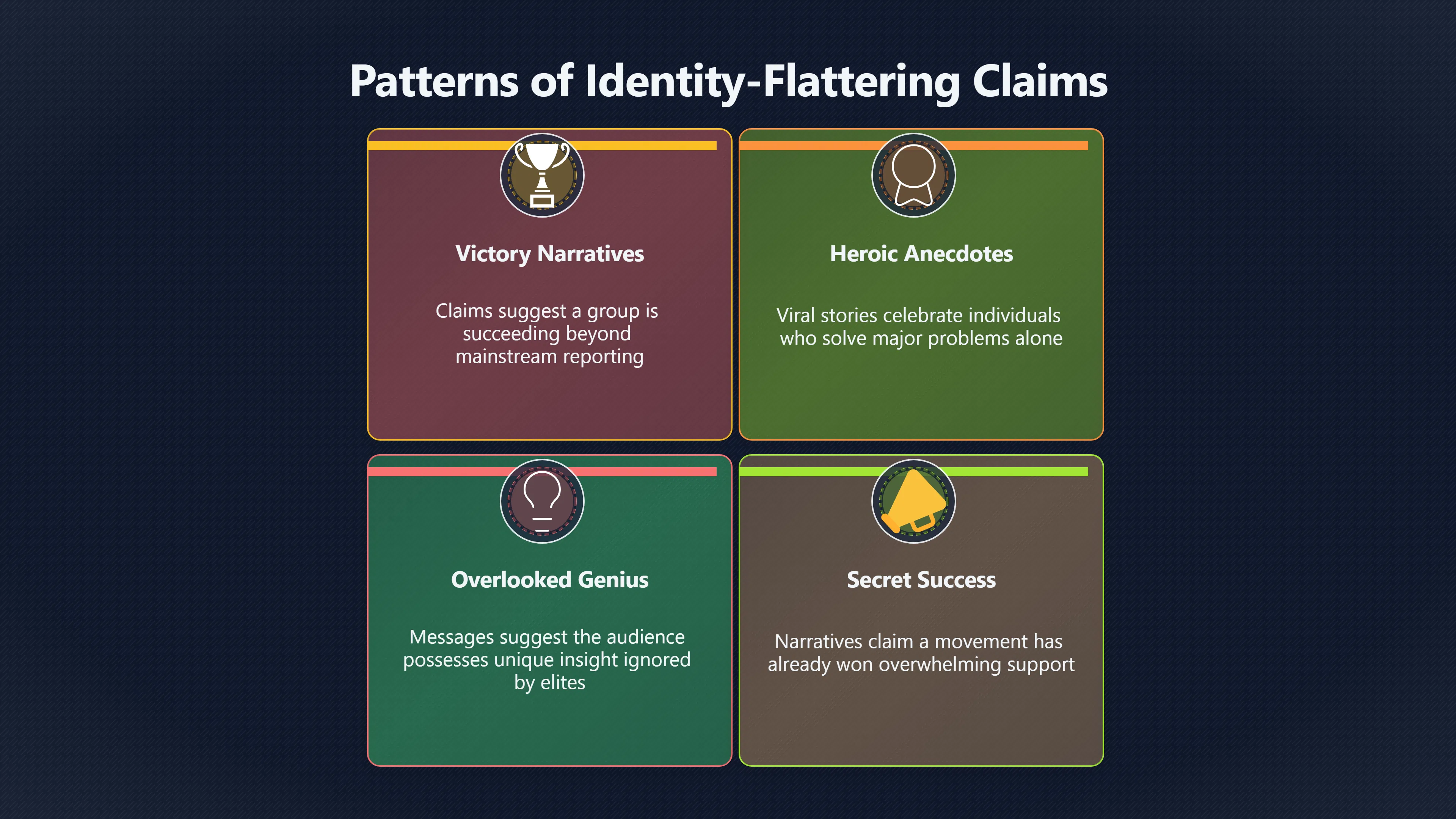
One recurring pattern is the victory narrative. These posts claim that a favoured group, country, movement or organisation is succeeding far beyond what mainstream reporting supposedly recognises.
Typical examples include claims that:
- A nation has achieved a world-leading milestone.
- A political movement has already won overwhelming public support.
- A social campaign has produced dramatic results.
- A community has defeated a powerful opponent.
Such posts often contain a kernel of truth but exaggerate scale, certainty or significance. The emotional appeal comes from collective pride: readers are invited to feel part of a successful group before they examine the evidence.
Researchers studying disinformation narratives have repeatedly noted the power of larger cultural stories involving triumph, rebirth, success and historical destiny. These narratives can make individual claims feel plausible because they fit a broader identity framework that audiences already find meaningful. Journal of International Affairs+2Taylor & Francis Online[jia.sipa.columbia.edu]jia.sipa.columbia.edumaster narratives disinformation campaignsJournal of International AffairsMaster Narratives of Disinformation Campaigns | Columbia24 Sept 2018 — This essay explores how political…
The heroic anecdote
Another common pattern centres on exceptional individuals.
A viral post may celebrate:
- A student who supposedly outperformed an entire institution.
- A local volunteer who allegedly solved a major problem alone.
- A member of a favoured group who achieved an extraordinary feat.
- An underdog who supposedly embarrassed powerful elites.
These stories are often difficult to verify because they depend on a single anecdote rather than systematic evidence. Yet they spread easily because they offer an emotionally satisfying character: the hero who proves that “people like us” are capable, moral or superior.
The anecdote may be true, partly true or fabricated. The important point is that the emotional reward often arrives before verification.
The overlooked genius claim
Some posts flatter audiences by suggesting they possess special insight ignored by outsiders.
The message is often implicit:
- “Our group saw the truth first.”
- “Experts dismissed us, but we were right.”
- “The media will not tell you this success story.”
- “Ordinary people understand what elites cannot.”
This framing turns belief itself into a source of pride. Accepting the claim becomes evidence of independence, intelligence or loyalty. Research on identity-based belief formation suggests that such narratives can become attractive because they reinforce a positive sense of who group members are.[PubMed+2ResearchGate]pubmed.ncbi.nlm.nih.govUpdating the identity-based model of belief: From false…by JJ Van Bavel · 2024 · Cited by 94 — The Identity-based Model of Polit…

Why flattering claims often feel more trustworthy
People commonly associate manipulation with fear and hostility, so affirming messages may attract less suspicion.
Several factors contribute:
Lower perceived risk. Sharing a positive story appears socially safer than sharing an attack. Readers may apply fewer credibility checks because the content seems constructive rather than divisive.
Identity rewards. Social identity research shows that belonging to groups often involves positive emotional attachment and affirmation. Information that enhances group esteem can therefore feel intuitively appealing.[PMC]pmc.ncbi.nlm.nih.govPMCTesting a Model of Minority Identity Achievementby CDEM Psychol · 2011 · Cited by 275 — The term identity affirmation refers to the affective process of developing positive feelings…
Processing fluency. Information that fits existing beliefs and narratives is often easier to process mentally. Studies of online misinformation environments have found that group identity cues can reinforce acceptance and engagement by making messages feel familiar and socially coherent.[arXiv]arxiv.orgInside the echo chamber: Linguistic underpinnings of misinformation on TwitterApril 24, 2024…
Social reinforcement. Likes, reposts and supportive comments create visible signals that others approve of the message. When a claim is framed as a celebration of collective success, disagreement may feel socially awkward or disloyal.
The result is not that people become incapable of reasoning. Rather, attention shifts away from verification and towards maintaining a positive relationship with a valued group.[arXiv]arxiv.orgAdherence to Misinformation on Social Media Through Socio-Cognitive and Group-Based ProcessesJune 30, 2022…
How to check victory stories and heroic anecdotes
Separate the achievement from the evidence
Begin by treating the emotional appeal and the factual claim as different questions.
For example:
- Is the achievement real?
- Is the scale accurately described?
- Is the comparison fair?
- Does independent evidence support the conclusion?
A community can genuinely achieve something important while a viral post exaggerates its significance.

Look for independent confirmation
Identity-flattering posts often rely on screenshots, graphics, memes or unsourced quotations.
Before accepting the claim:
- Search for reporting from multiple independent outlets.
- Look for original datasets or official documents.
- Check whether experts in the relevant field acknowledge the result.
- Verify dates and context.
Claims supported only by repeated sharing are not independently confirmed.
Beware of single examples
A heroic anecdote can illustrate a trend, but it cannot prove one.
If a post celebrates one remarkable person, ask:
- Is this an isolated case?
- Are there broader statistics?
- Does the story represent a larger pattern?
Anecdotes are emotionally memorable precisely because they simplify complex realities.
Check whether the claim flatters everyone on one side
A useful warning sign is perfect moral alignment.
If a story presents one group as entirely wise, brave, competent or virtuous while leaving no room for complexity, caution is warranted. Real-world successes usually involve trade-offs, uncertainty and mixed evidence.
Narratives become suspicious when they appear designed primarily to provide emotional validation.
The critical-thinking habit that pride posts test
The challenge posed by pride-based misinformation is subtle. Readers generally expect to question information that frightens or angers them. They are less likely to question information that makes them feel recognised, respected or successful.
Yet evidence does not become stronger because it is flattering.
One practical habit is to pause whenever a post seems to offer collective validation. If the immediate emotional response is, “This proves our side is right,” that is often the moment when evidence deserves the closest inspection. Social identity can be a source of belonging and meaning, but it should not become a substitute for verification. Research across misinformation studies increasingly suggests that identity-aligned narratives gain influence not merely because people seek facts, but because information is often evaluated through the social groups to which people feel attached.[Taylor & Francis Online+3PubMed+3Sage Journals]pubmed.ncbi.nlm.nih.govUpdating the identity-based model of belief: From false…by JJ Van Bavel · 2024 · Cited by 94 — The Identity-based Model of Polit…


eBay marketplace picks
Marketplace Samples
Example marketplace items related to this page. Use the search link to explore similar finds on eBay.


Endnotes
1.
Source: duepublico2.uni-due.de
Link:https://duepublico2.uni-due.de/servlets/MCRFileNodeServlet/duepublico_derivate_00075899/Wischnewski_et_al_2021_Role_of_Emotions.pdf
Source snippet
Kahan, D. M. (2017). Misconceptions, misinformation, and the logic of identity-protective cognition (No. 164...Read more...
2.
Source: researchgate.net
Link:https://www.researchgate.net/publication/335950236_Your_fake_news_our_facts_Identity-based_motivation_shapes_what_we_believe_share_and_accept
Source snippet
ResearchGate(PDF) Your fake news, our facts: Identity-based motivation...20 Sept 2019 — The psychology of fake news: Accepting, sharing...
3.
Source: jstor.org
Link:https://www.jstor.org/stable/48584355
Source snippet
Addressing identity-related barriers to collaboration for...by K Hurst · 2020 · Cited by 27 — Misconceptions, misinformation, and t...
4.
Source: researchgate.net
Title: 359647280 On The Role of Social Identity in the Market for Misinformation
Link:https://www.researchgate.net/publication/359647280_On_The_Role_of_Social_Identity_in_the_Market_for_Misinformation
Source snippet
effect of social. identity on misinformation can better inform our search for. counter mechanisms to this ubiquitous issue. In our work...
5.
Source: pmc.ncbi.nlm.nih.gov
Title: PMCTesting a Model of Minority Identity Achievement
Link:https://pmc.ncbi.nlm.nih.gov/articles/PMC3158128/
Source snippet
by CDEM Psychol · 2011 · Cited by 275 — The term identity affirmation refers to the affective process of developing positive feelings...
6.
Source: arxiv.org
Link:https://arxiv.org/abs/2404.15925
Source snippet
Inside the echo chamber: Linguistic underpinnings of misinformation on TwitterApril 24, 2024...
Published: April 24, 2024
7.
Source: arxiv.org
Link:https://arxiv.org/abs/2112.07968
Source snippet
Science Factionalism: How Group Identity Language Affects Public Engagement with Misinformation and Debunking Narratives on a Popula...
8.
Source: arxiv.org
Link:https://arxiv.org/abs/2206.15237
Source snippet
Adherence to Misinformation on Social Media Through Socio-Cognitive and Group-Based ProcessesJune 30, 2022...
Published: June 30, 2022
9.
Source: researchgate.net
Link:https://www.researchgate.net/publication/376516799_Disinformation_and_Fact-Checking_in_Contemporary_Society
Source snippet
(PDF) Disinformation and Fact-Checking in Contemporary...various forms of misinformation and disinformation (Potter, 2013; Tornero, 2008)...
10.
Source: pubmed.ncbi.nlm.nih.gov
Link:https://pubmed.ncbi.nlm.nih.gov/38295623/
Source snippet
Updating the identity-based model of belief: From false...by JJ Van Bavel · 2024 · Cited by 94 — The Identity-based Model of Polit...
11.
Source: journals.sagepub.com
Link:https://journals.sagepub.com/doi/10.1177/07439156221103852
Source snippet
Sage JournalsDisinformation and Echo Chambersby C Diaz Ruiz · 2023 · Cited by 344 — Therefore, although it remains essential to continue...
12.
Source: Lawfare
Title: social identity and misinformation
Link:https://www.lawfaremedia.org/article/social-identity-and-misinformation
Source snippet
Identity and Misinformation29 Aug 2025 — Young does so as follows: “Scholars define misinformation as information that is inconsistent wi...
13.
Source: jia.sipa.columbia.edu
Title: master narratives disinformation campaigns
Link:https://jia.sipa.columbia.edu/news/master-narratives-disinformation-campaigns
Source snippet
Journal of International AffairsMaster Narratives of Disinformation Campaigns | Columbia24 Sept 2018 — This essay explores how political...
14.
Source: tandfonline.com
Link:https://www.tandfonline.com/doi/full/10.1080/10584609.2026.2644198
Source snippet
Taylor & Francis OnlineFull article: Disinformation as Cultural Narrativeby AE Marwick · 2026 — Understanding that successful disinformat...
15.
Source: journals.sagepub.com
Title: Sage Journals A Social Identity Theory of Digital Identity
Link:https://journals.sagepub.com/doi/10.1177/17456916261419813
Source snippet
by WJ Bingley · Cited by 4 —... [shared identity]({{ 'shared-identity/' | relative_url }}) within an online group will make that group more cohesive and functional.... false beli...
16.
Source: pmc.ncbi.nlm.nih.gov
Link:https://pmc.ncbi.nlm.nih.gov/articles/PMC12173498/
Source snippet
trustworthy information: countering disinformation...by M Boumans · 2025 · Cited by 7 — Not only because it is impossible to debunk or f...
17.
Source: jmhorizons.com
Link:https://jmhorizons.com/index.php/journal/article/view/1127
Source snippet
NARRATIVES OF VICTORY AND VICTIMHOOD13 Dec 2025 — These narratives collectively reshape Ukrainian national identity, presenting Ukraine a...
Additional References
18.
Source: misinforeview.hks.harvard.edu
Title: critical disinformation studies history power and politics
Link:https://misinforeview.hks.harvard.edu/article/critical-disinformation-studies-history-power-and-politics/
Source snippet
disinformation studies: History, power, and politics12 Aug 2021 — This essay advocates a critical approach to disinformation research tha...
19.
Source: riojournal.com
Link:https://riojournal.com/article/64121/
Source snippet
Prejudice Against Citizens with Right-aligned Political...by V Weidlich · 2021 — The fake news game: actively inoculating against the ri...
20.
Source: henryjacksonsociety.org
Title: HJS The Psychology of Disinformation Report
Link:https://henryjacksonsociety.org/wp-content/uploads/2026/05/HJS-The-Psychology-of-Disinformation-Report.pdf
Source snippet
HJS 'The Psychology of Disinformation' Report.indd14 May 2026 — Unlike misinformation (which is shared in the misguided belief that it is...
Published: May 2026
21.
Source: lse.ac.uk
Title: winning the information war full report pdf
Link:https://www.lse.ac.uk/iga/assets/documents/arena/archives/winning-the-information-war-full-report-pdf.pdf
Source snippet
Winning the Information Warby E Lucas · 2016 · Cited by 72 — It brazenly seeds disinformation, but ensures that its lies are entertaining...
22.
Source: open-research-europe.ec.europa.eu
Link:https://open-research-europe.ec.europa.eu/articles/3-121
Source snippet
manipulation and historical revisionismby CM Arribas · 2023 · Cited by 44 — Background: Disinformation and historical revisionism have be...
23.
Source: youtube.com
Link:https://www.youtube.com/watch?v=mNm_rkWOJUw
Source snippet
Why People Believe Misinformation: The Psychology of Fear | Beyond the Books...
24.
Source: instagram.com
Title: New research from Dr
Link:https://www.instagram.com/p/DW4DR1ZEczA/?img_index=3
Source snippet
Aldo Barrita finds that affirming...Dave loves teaching students in the library, especially at a time in our country's history when misi...
25.
Source: youtube.com
Title: Why People Believe Misinformation: The Psychology of Fear | Beyond the Books
Link:https://www.youtube.com/watch?v=_7otmig_7Co
Source snippet
What goes viral and why? With Jonah Berger, PhD | Speaking of Psychology...
26.
Source: tandfonline.com
Link:https://www.tandfonline.com/doi/full/10.1080/02699931.2024.2362366
Source snippet
Full article: Putting the affect into affective polarisationby BN Bakker · 2024 · Cited by 74 — Partisan blocking: Biased responses to sh...
27.
Source: youtube.com
Title: What goes viral and why? With Jonah Berger, Ph D | Speaking of Psychology
Link:https://www.youtube.com/watch?v=cBVLQNYrVzQ
Source snippet
Why Misinformation Sticks in Your Brain Even After It's Debunked...
Topic Tree