Within Emotional Posts
When fear turns speed into a trap
Fear posts can seem protective in a crisis, but urgent instructions often push weak claims ahead of reliable information.
On this page
- The difference between warning and panic
- How crisis posts compress checking time
- A safer pause routine for urgent claims
Page outline Jump by section
Introduction
Fear can be useful in a genuine emergency. It pushes people to pay attention, seek safety and warn others. The problem arises when social media posts use the feeling of danger as a shortcut around verification. During a crisis, people often have limited information, little time and a strong desire to protect family, friends or their community. A post that says “Act now before it is deleted” or “Share this immediately to save lives” can therefore gain traction before anyone has checked whether the claim is accurate. This dynamic is one reason why misinformation often flourishes during emergencies and why health and crisis researchers have devoted increasing attention to the problem of the “infodemic” — an overabundance of information, including false or misleading claims, that accompanies a crisis.[World Health Organization+2NCBI]who.intWorld Health OrganizationInfodemicRefining an AI-based infodemic observatory to assess the current status of misinformation and disinform…
 Within the broader problem of emotional content bypassing scepticism, fear-based posts are distinctive because they attack the reader’s sense of time. Their central message is not merely “this is dangerous” but “you cannot afford to wait”. That urgency can turn speed itself into a trap.
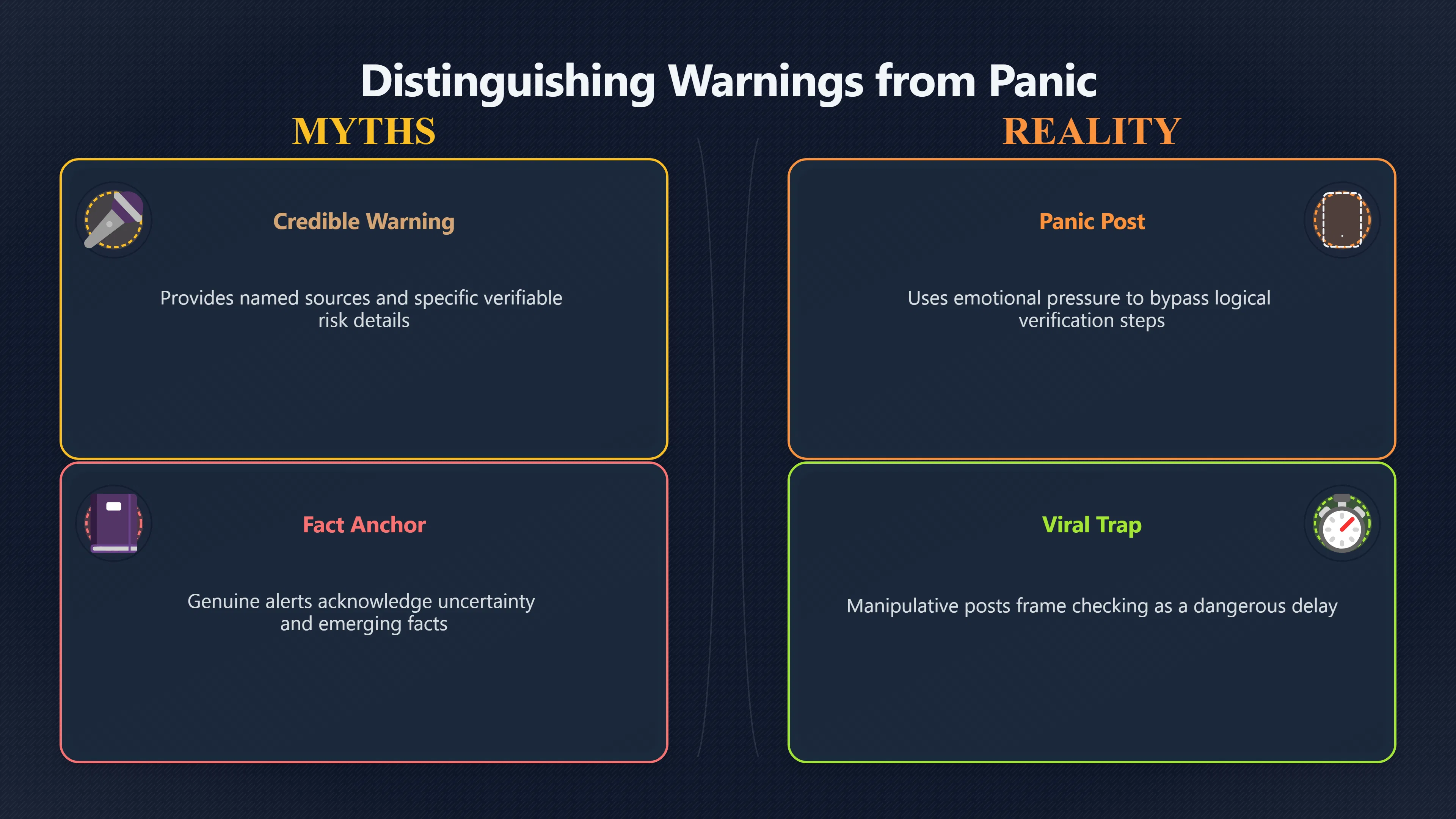
The difference between warning and panic
Not every alarming message is manipulative. Real emergencies require warnings, and responsible crisis communication often involves explaining risks clearly and promptly. The key difference is that credible warnings try to increase understanding, while panic-inducing posts try to accelerate action before understanding is possible.[ASSET]asset-scienceinsociety.euASSETCrisis and Emergency Risk CommunicationASSETAugust 11, 2015 — Crisis and Emergency Risk Communication is an introductory course that addresses a number of topics critical to su…
A genuine warning usually contains several features:
- A named source or authority.
- Specific information about the risk.
- Practical actions that can be verified elsewhere.
- Recognition of uncertainty where facts are still emerging.
Fear-based viral posts often reverse those priorities. They rely on emotional pressure rather than evidence. Common signals include:
- “Share before it gets removed.”
- “The media will not tell you this.”
- “Everyone must know immediately.”
- Claims that questioning the message is dangerous or irresponsible.
These posts frame delay as a threat. The reader is encouraged to see verification not as a safety measure but as a luxury that the situation supposedly cannot afford.
How crisis posts compress checking time
The most effective fear-driven misinformation does not necessarily convince people that a claim is true. Instead, it convinces them that there is no time to evaluate whether it is true.
This works because crises naturally create uncertainty. During disease outbreaks, natural disasters, security incidents or public emergencies, people often search for information faster than reliable institutions can collect and confirm it. Researchers studying infodemics note that large volumes of rapidly changing information can overwhelm people’s ability to judge quality, especially when events are unfolding in real time.[PMC+2Frontiers]pmc.ncbi.nlm.nih.govInfodemics and health misinformation: a systematic review of…by IJB do Nascimento · 2022 · Cited by 695 — This phenomenon, called a…
Fear-based posts exploit this gap through several mechanisms:
They shorten the decision window.
Instead of asking readers to assess evidence, they ask readers to decide immediately. The implied choice becomes “act now or risk harm”.
They increase perceived stakes.
A claim about an ordinary event may receive little attention. The same claim framed as an imminent threat to children, health, safety or survival attracts far more urgency.
They replace uncertainty with certainty.
Responsible crisis communication often includes phrases such as “based on current evidence” or “information may change”. Manipulative posts frequently present speculation as settled fact.
They encourage forwarding as a protective act.
People are more likely to share information when they believe sharing could help others avoid danger. The social reward becomes protecting friends rather than checking accuracy.
The result is a communication environment where speed becomes a signal of virtue. The first person to warn others appears responsible, while the person who pauses to verify can seem slow or indifferent.

Why fear can outrun reliable information
The challenge is not simply that false information exists. It is that fear changes what people prioritise.
Studies of misinformation during health emergencies have repeatedly found that misleading information can spread rapidly online and influence behaviour, trust and risk perception. Researchers examining COVID-19-related misinformation observed that false information often travels faster and more broadly than accurate information, particularly on social media platforms where engagement is rewarded.[PMC+2arXiv]pmc.ncbi.nlm.nih.govUnderstanding the spread of COVID‐19 misinformation on…by X Wang · 2021 · Cited by 103 — Researchers have revealed that misinformat…
The World Health Organization has argued that emergencies are frequently accompanied by infodemics in which rumours, misleading narratives and factual information compete for attention at the same time. This overload can make it difficult for people to identify trustworthy guidance when they need it most.[World Health Organization+2United Nations]who.intWorld Health OrganizationInfodemicRefining an AI-based infodemic observatory to assess the current status of misinformation and disinform…
Fear accelerates this process because it changes the reader’s question. Instead of asking, “Is this true?”, people may begin asking, “What if it is true and I ignored it?” The possibility of missing a threat can feel more important than the possibility of sharing an error.
That psychological shift helps explain why old warnings, recycled images and unsupported emergency claims often resurface during new crises. Even when evidence is weak, the perceived cost of ignoring the warning can appear high enough to justify immediate sharing.
A familiar pattern during public emergencies
Public health crises provide some of the clearest examples.[who.int]who.intdisinformation and public healthWorld Health OrganizationDisinformation and public healthFeb 6, 2024 — This WHO questions and answers page looks at how health-related di…
During the COVID-19 pandemic, researchers documented widespread circulation of unverified medical advice, conspiracy claims and exaggerated warnings. Many messages presented themselves as urgent life-saving information and encouraged rapid sharing before verification. Health organisations and researchers repeatedly warned that this information environment complicated public decision-making and sometimes undermined effective responses.[World Health Organization+2JMIR]who.intdisinformation and public healthWorld Health OrganizationDisinformation and public healthFeb 6, 2024 — This WHO questions and answers page looks at how health-related di…
Importantly, fear-based misinformation does not need to be entirely fabricated. A common pattern is to begin with a real concern and then attach unsupported conclusions, outdated information or dramatic predictions. Because part of the message is true, the entire message can appear credible.
This mixture of fact and exaggeration is often more persuasive than a completely invented story. It gives readers enough reality to anchor their fears while supplying speculation that intensifies the perceived urgency.
A safer pause routine for urgent claims
Critical thinking during a crisis is difficult precisely because some situations genuinely are urgent. The goal is not to ignore warnings but to prevent urgency from replacing verification.
A practical pause routine can help:
- Identify the claimed deadline.
What specifically requires action right now? Is the urgency explained, or merely asserted?
- Look for the original source.
Is the claim linked to a recognised emergency agency, health authority, news organisation or named expert?
- Check whether multiple independent sources agree.
Genuine emergencies usually generate confirmation from more than one credible source.
- Separate the danger from the instruction.
Even if a risk is real, the recommended action may be unsupported or incorrect.
- Wait briefly before sharing.
A delay of even a few minutes can be enough to locate verification, corrections or additional context.
This pause is not about complacency. It is a safeguard against one of the most common weaknesses in online crisis communication: treating emotional urgency as evidence.

Why slowing down can be the most responsible response
Fear-based posts succeed when they convince people that speed is more important than accuracy. In genuine emergencies, however, reliable information is often most valuable precisely because decisions matter.
The central lesson is simple: urgency should increase scrutiny, not eliminate it. A message that insists there is no time to verify may be asking readers to suspend the very judgement they need most. In the age of social media and AI-generated content, recognising that pressure is a critical part of resisting emotional posts that bypass scepticism.
Amazon book picks
Further Reading
Books and field guides related to When fear turns speed into a trap. Use these as the next step if you want deeper reading beyond the article.
Thinking, Fast and Slow
Shows how urgency triggers intuitive rather than analytical thinking.
Foolproof: Why We Fall for Misinformation and How to Build Im...
Closely aligned with evidence-based interventions and accuracy prompts.

Foolproof: Why Misinformation Infects Our Minds and How to Bu...
Covers emotional manipulation and crisis misinformation.
eBay marketplace picks
Marketplace Samples
Example marketplace items related to this page. Use the search link to explore similar finds on eBay.
Endnotes
1.
Source: who.int
Link:https://www.who.int/health-topics/infodemic
Source snippet
World Health OrganizationInfodemicRefining an AI-based infodemic observatory to assess the current status of misinformation and disinform...
2.
Source: ncbi.nlm.nih.gov
Title: NCBIWhat are the historical roots of the COVID-19 infodemic
Link:https://www.ncbi.nlm.nih.gov/books/NBK585504/
Source snippet
WHO defines an infodemic as “too much information, including false or misleading information, in digital and physical environments du...
3.
Source: asset-scienceinsociety.eu
Title: ASSETCrisis and Emergency Risk Communication
Link:https://www.asset-scienceinsociety.eu/sites/default/files/cdc_risk_communication_book.pdf
Source snippet
ASSETAugust 11, 2015 — Crisis and Emergency Risk Communication is an introductory course that addresses a number of topics critical to su...
Published: August 11, 2015
4.
Source: jmir.org
Link:https://www.jmir.org/2024/1/e56854/
Source snippet
Crisis and Emergency Risk Communication and Emotional...by SS Ho · 2024 · Cited by 18 — This study aimed to analyze public health commun...
5.
Source: pmc.ncbi.nlm.nih.gov
Link:https://pmc.ncbi.nlm.nih.gov/articles/PMC9421549/
Source snippet
Infodemics and health misinformation: a systematic review of...by IJB do Nascimento · 2022 · Cited by 695 — This phenomenon, called a...
6.
Source: who.int
Link:https://www.who.int/europe/news/item/25-01-2024-addressing-dangerous-health-narratives-in-emergencies–an-operational-toolkit
Source snippet
World Health OrganizationAddressing dangerous health narratives in emergencies25 Jan 2024 — Infodemics occur when too much information, i...
7.
Source: pmc.ncbi.nlm.nih.gov
Link:https://pmc.ncbi.nlm.nih.gov/articles/PMC8653058/
Source snippet
Understanding the spread of COVID‐19 misinformation on...by X Wang · 2021 · Cited by 103 — Researchers have revealed that misinformat...
8.
Source: arxiv.org
Link:https://arxiv.org/abs/2306.14378
9.
Source: who.int
Title: disinformation and public health
Link:https://www.who.int/news-room/questions-and-answers/item/disinformation-and-public-health
Source snippet
World Health OrganizationDisinformation and public healthFeb 6, 2024 — This WHO questions and answers page looks at how health-related di...
10.
Source: jmir.org
Link:https://www.jmir.org/2022/2/e35552
Source snippet
A Deadly Infodemic: Social Media and the Power of COVID...by MA Gisondi · 2022 · Cited by 332 — In this editorial, the authors examine t...
11.
Source: who.int
Link:https://www.who.int/europe/news/item/01-09-2022-infodemics-and-misinformation-negatively-affect-people-s-health-behaviours–new-who-review-finds
Source snippet
Infodemics and misinformation negatively affect people's...Sep 1, 2022 — The systematic review found that people feel mental, social, po...
13.
Source: frontiersin.org
Link:https://www.frontiersin.org/journals/public-health/articles/10.3389/fpubh.2024.1343902/full
Source snippet
Management of infodemics in outbreaks or health crisesby L Abuhaloob · 2024 · Cited by 20 — The World Health Organization (WHO) defined a...
14.
Source: un.org
Title: tackling ‘infodemic’ misinformation and cybercrime covid 19
Link:https://www.un.org/en/un-coronavirus-communications-team/un-tackling-%E2%80%98infodemic%E2%80%99-misinformation-and-cybercrime-covid-19
Source snippet
fake news that “spreads faster and more easily... They can spread misinformation, disinformation and rumours during a health emergency.R...
15.
Source: pmc.ncbi.nlm.nih.gov
Link:https://pmc.ncbi.nlm.nih.gov/articles/PMC11375383/
Source snippet
Comprehensive Analysis of COVID-19 Misinformation...by S Kisa · 2024 · Cited by 142 — We used (“COVID-19” OR “SARS-CoV-2” OR “Coronaviru...
16.
Source: pmc.ncbi.nlm.nih.gov
Link:https://pmc.ncbi.nlm.nih.gov/articles/PMC9114791/
Source snippet
Misinformation shared...
17.
Source: pmc.ncbi.nlm.nih.gov
Link:https://pmc.ncbi.nlm.nih.gov/articles/PMC9947390/
Source snippet
Cross-National Study of Fear Appeal Messages in YouTube...by YMM Ng · 2023 · Cited by 19 — In the domain of science communication, fear...
18.
Source: pmc.ncbi.nlm.nih.gov
Link:https://pmc.ncbi.nlm.nih.gov/articles/PMC8435678/
Source snippet
Pandemic Factors Associated to Public Anxiety...by J Xu · 2021 · Cited by 55 — This study aims to explore the infodemic vs. pandemic inf...
19.
Source: ncbi.nlm.nih.gov
Link:https://www.ncbi.nlm.nih.gov/books/NBK609021/
Source snippet
Management in the Twenty-First Century - NCBI - NIHby S Briand · 2023 · Cited by 41 — Although many health authorities are already respon...
20.
Source: pmc.ncbi.nlm.nih.gov
Link:https://pmc.ncbi.nlm.nih.gov/articles/PMC9030304/
Source snippet
Are We Losing Knowledge in Information? - PMCby GM Sogi · 2022 · Cited by 2 — An infodemic is an overabundance of information – including...
21.
Source: pmc.ncbi.nlm.nih.gov
Link:https://pmc.ncbi.nlm.nih.gov/articles/PMC11955583/
Source snippet
media and the spread of misinformation - PMC - NIHby E Denniss · 2025 · Cited by 134 — Third, internet robots or 'bots' are known to auto...
22.
Source: pmc.ncbi.nlm.nih.gov
Link:https://pmc.ncbi.nlm.nih.gov/articles/PMC8088318/
Source snippet
misinformation infodemic during public health...by N Chowdhury · 2021 · Cited by 132 — This rapid integrative review will draw on knowle...
23.
Source: pmc.ncbi.nlm.nih.gov
Link:https://pmc.ncbi.nlm.nih.gov/articles/PMC11369541/
Source snippet
by D Kbaier · 2024 · Cited by 105 — This scoping review underscores the significance of addressing online health misinformation, parti...
24.
Source: pmc.ncbi.nlm.nih.gov
Link:https://pmc.ncbi.nlm.nih.gov/articles/PMC10546230/
Source snippet
structured literature review of the health infodemic on social...by C Hove · 2023 · Cited by 11 — This strategic review described the ro...
25.
Source: frontiersin.org
Link:https://www.frontiersin.org/journals/communication/articles/10.3389/fcomm.2025.1560936/full
Source snippet
Unravelling the infodemic: a systematic review of...by S Bhattacharya · 2025 · Cited by 14 — The spread of misinformation during the pan...
Additional References
26.
Source: europarl.europa.eu
Link:https://www.europarl.europa.eu/RegData/etudes/STUD/2023/740063/IPOL_STU%282023%29740063_EN.pdf
Source snippet
This study analyses how governments, public health experts and other professionals communicated during the COVID-19 pandemic, and the imp...
27.
Source: pure.uva.nl
Link:https://pure.uva.nl/ws/files/144487415/10.4324_9781003043409-15_chapterpdf.pdf
Source snippet
uva.nlUvA-DARE (Digital Academic Repository)Against the backdrop of far-reaching consequences of misinforma- tion during a crisis, studie...
28.
Source: researchgate.net
Title: 402116390 Crisis Communication and Media Coverage During Emergencies
Link:https://www.researchgate.net/publication/402116390_Crisis_Communication_and_Media_Coverage_During_Emergencies
Source snippet
(PDF) Crisis Communication and Media Coverage During...17 Mar 2026 — Crisis communication plays a critical role in managing information...
29.
Source: publichealthontario.ca
Link:https://www.publichealthontario.ca/-/media/Documents/nCoV/main/2023/risk-communication-trust-public-health-covid-19-pandemic.pdf?rev=015f717e6a474c98a46022722879fb98%E2%89%BB_lang%3Den
Source snippet
The COVID-19 pandemic presented challenges for risk communication, such as the spread of misinformation and disinformation and growing di...
30.
Source: fph.org.uk
Link:https://www.fph.org.uk/media/hoejpp0s/social-media-consultation-fph-response.pdf
Source snippet
nformation and misinformation via social media platforms, leading to fear.Read more...
31.
Source: facebook.com
Link:https://www.facebook.com/WHOAFRO/posts/health-emergencies-can-create-uncertainty-and-cause-panicin-todays-digital-age-i/1087355143571538/
Source snippet
it can be hard to know who to trust or what advice to follow...
32.
Source: facebook.com
Link:https://www.facebook.com/dailymirror/posts/experts-raised-fears-that-vulnerable-people-are-receiving-misleading-health-cont/1393280152847065/
Source snippet
Experts raised fears that vulnerable people are receiving...Misinformation, fake news, and misleading information can spread quickly on...
33.
Source: youtube.com
Link:https://www.youtube.com/watch?v=QFxA57UZ0xs
Source snippet
Why did we stop caring about disinformation? | Skylar Hughes | TEDxDuke...
34.
Source: tandfonline.com
Link:https://www.tandfonline.com/doi/full/10.1080/10410236.2019.1573295
Source snippet
The Effects of Corrective Information Type and Sourceby TGLA van der Meer · 2020 · Cited by 542 — The findings contribute to misinformati...
35.
Source: youtube.com
Title: What goes viral and why? With Jonah Berger, Ph D | Speaking of Psychology
Link:https://www.youtube.com/watch?v=cBVLQNYrVzQ
Source snippet
Building Effective Public Warning and Incident Response Systems | Mini Webinar Series 5...
Topic Tree