Within Not Cynicism
Why viral numbers are not evidence
Likes, views and confident delivery can make weak claims look credible even when creators have not checked the facts.
On this page
- Why likes and views feel persuasive
- What creator fact checking gaps mean for readers
- Better signals to look for before sharing
Page outline Jump by section
Introduction
On social media, popularity is often displayed before evidence. A post may show millions of views, hundreds of thousands of likes and thousands of comments long before a reader sees any supporting facts. This creates a powerful shortcut: people can begin treating popularity as proof. For creators, that popularity can become a form of borrowed credibility, making claims appear more trustworthy than the underlying evidence justifies.
 This does not mean that popular content is automatically wrong. Many accurate creators attract large audiences because they consistently produce useful work. The problem arises when audience size, engagement metrics or confident presentation are used as substitutes for verification. In an online environment where many creators function as information sources, critical thinking requires separating evidence from attention. UNESCO’s global survey of digital content creators found that 62% did not carry out rigorous and systematic fact-checking before sharing information, highlighting why reach and reliability should not be treated as the same thing.[UNESCO]unesco.org2/3 of digital content creators do not check their facts before27 Nov 2024 — A UNESCO survey published today reveals that 62% do no…
Why likes and views feel persuasive
Humans are social learners. When many other people appear to approve of something, it feels safer to accept it ourselves. Psychologists often describe this tendency as social proof: people use the behaviour of others as a cue when judging what is likely to be true, useful or important. On social platforms, likes, shares, comments and follower counts turn that social proof into visible numbers.[The Decision Lab]thedecisionlab.comThe Decision LabSocial ProofToday, the vast reach of social media amplifies the effects of social proof. Likes, shares, comments, and vie…
Creators understand this dynamic. Even without explicitly saying “trust me”, a creator can signal authority through screenshots of analytics, follower milestones, trending labels or references to viral success. The implicit message is that large audiences would not engage unless the information were valuable.
Research suggests that popularity cues can influence how people evaluate messages. A meta-analysis covering dozens of studies found that so-called “bandwagon cues” have a measurable positive effect on perceived credibility, even if the effect is generally modest.[Sage Journals]journals.sagepub.comSage Journals Do Bandwagon Cues Affect Credibility Perceptions?A…19 Jan 2023 — Based on 161 effect sizes from 41 studies, the current meta-analysis revealed that bandwagon cues had a positive, albe…
The crucial distinction is that popularity measures attention, not accuracy. A claim can become viral because it is surprising, emotionally charged, entertaining or confirms existing beliefs. None of those qualities guarantee that it is correct.
How creators turn attention into authority
Popularity becomes false credibility when creators encourage audiences to treat engagement metrics as evidence.
This can happen in several ways:
- Follower count as expertise. A creator may imply that having a large audience proves knowledge in areas where they lack relevant qualifications or experience.
- Virality as validation. Statements such as “millions have watched this” or “everyone is talking about it” can create the impression that widespread attention confirms truth.
- Confidence amplified by metrics. Strong delivery combined with visible engagement can make weakly supported claims seem more convincing.
- Selective display of approval. Creators may highlight supportive comments, repost praise or showcase impressive statistics while avoiding discussion of evidence quality.
- Algorithmic reinforcement. When platforms repeatedly promote high-engagement content, users may mistake visibility for reliability.
The effect is often subtle. The creator may never directly claim that popularity equals truth. Instead, audience members make that connection themselves because the platform constantly displays popularity signals alongside the content.
What creator fact-checking gaps mean for readers
The risk becomes clearer when popularity and verification are compared directly.
UNESCO’s survey found that many creators rely on informal credibility indicators when assessing information, while rigorous fact-checking is far from universal. The organisation reported that nearly two-thirds of surveyed creators did not systematically verify information before sharing it.[UNESCO]unesco.org2/3 of digital content creators do not check their facts before27 Nov 2024 — A UNESCO survey published today reveals that 62% do no…
This matters because creators increasingly occupy roles once associated with journalists, commentators and subject-matter experts. Audiences often encounter news, health advice, financial opinions and political claims through creator accounts rather than traditional publications.
A creator can therefore accumulate trust through consistency, personality and audience growth even when their checking process is weak. The resulting credibility is partly social rather than evidential. Readers may assume that someone with a large following must have done the research, when in reality the audience size and the fact-checking quality are separate questions.
The danger is not limited to deliberate misinformation. Honest creators can also spread inaccurate claims if they prioritise speed, engagement or trend participation over verification. Popularity can magnify mistakes just as effectively as it magnifies expertise.

Why viral numbers and evidence often get confused
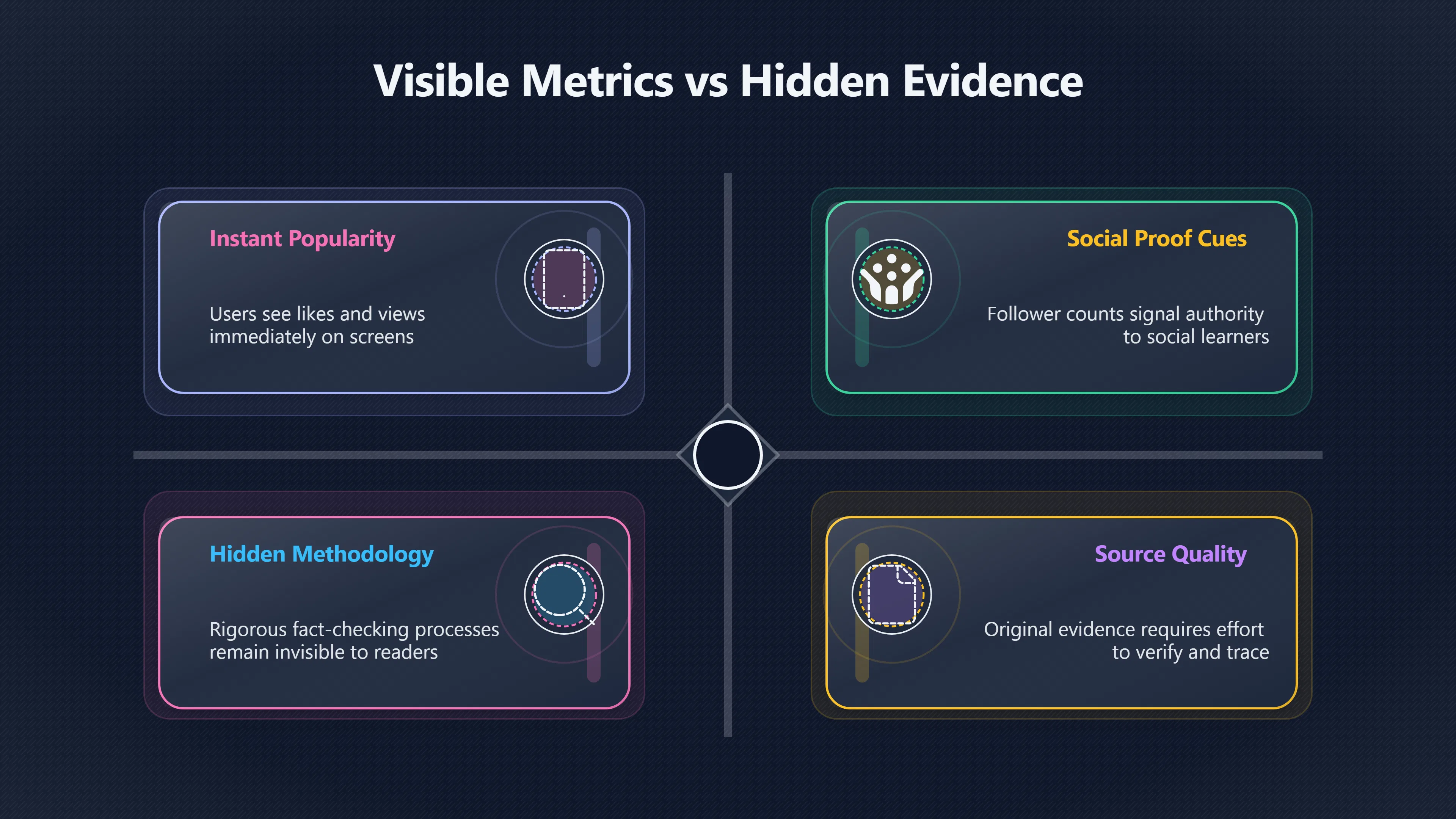
One reason popularity works so well as a credibility signal is that platforms make it highly visible. Evidence usually requires effort to examine. A reader may need to open sources, compare reports or check dates. Likes and views, by contrast, can be assessed instantly.
This creates an information imbalance:
Easy to seeHarder to seeViewsSource qualityLikesMethodologySharesOriginal evidenceFollower countsFact-checking processTrending statusUncertainty and limitations
As a result, users can unconsciously replace the question “Is this supported?” with “How many people seem to believe it?”
Studies examining social cues on digital platforms show that engagement indicators influence perception and behaviour, even though the relationship between popularity and credibility is complex and varies by context.[PMC+2Nature]pmc.ncbi.nlm.nih.govPMCThe persuasive effects of social cues and sourceNIHby CS Traberg · 2024 · Cited by 65 — We find that social cues only impact individual judgements when they influence perceptions…
The key point for critical thinking is that popularity metrics describe audience behaviour. They do not directly measure truth.
Better signals to look for before sharing
A critical reader does not need to ignore popularity completely. Engagement can indicate that a topic is attracting attention or discussion. The mistake is treating that attention as proof.
Before accepting or sharing a creator’s claim, look for stronger signals:
Does the creator show their sources?
Reliable creators typically make it possible to trace important claims back to original documents, studies, data or firsthand reporting. Popularity becomes less important when evidence is visible.
Can the claim be checked elsewhere?
Independent confirmation matters. If a claim appears only within one creator’s content ecosystem, caution is warranted. If multiple credible sources reach similar conclusions through separate reporting or analysis, confidence increases.
Does the creator acknowledge uncertainty?
People genuinely interested in accuracy often discuss limitations, competing explanations and unresolved questions. Overconfidence can be a warning sign, especially when combined with appeals to popularity.
How do they handle corrections?
Credibility is strengthened when creators update mistakes transparently. Refusing correction while pointing to audience size is often a sign that popularity is being used defensively rather than evidence being examined.
Is expertise relevant to the claim?
A creator may be highly knowledgeable in one area and poorly informed in another. A large audience does not automatically transfer expertise across subjects.
Critical thinking means separating influence from evidence
Within debates about cynicism and critical thinking online, popularity cues create a particular challenge. Cynicism may respond by assuming that every successful creator is untrustworthy. Critical thinking takes a different approach. It recognises that audience size can provide information about influence, but not necessarily about accuracy.
The central question is not how many people watched a claim. It is how well the claim is supported. Likes, views and followers can explain why a message spreads. They cannot, by themselves, establish whether the message is true.
In the age of social media and AI, that distinction is increasingly important. Platforms are designed to surface engagement quickly. Critical thinking requires slowing down long enough to ask for evidence before granting credibility.

eBay marketplace picks
Marketplace Samples
Example marketplace items related to this page. Use the search link to explore similar finds on eBay.



Endnotes
1.
Source: unesco.org
Link:https://www.unesco.org/en/articles/2/3-digital-content-creators-do-not-check-their-facts-sharing-want-learn-how-do-so-unesco-survey
Source snippet
2/3 of digital content creators do not check their facts before27 Nov 2024 — A UNESCO survey published today reveals that 62% do no...
2.
Source: unesco.org
Title: trains digital content creators become trusted voices online
Link:https://www.unesco.org/en/articles/unesco-trains-digital-content-creators-become-trusted-voices-online
Source snippet
UNESCO trains digital content creators to become trusted...18 Mar 2025 — However, according to a UNESCO survey, 62% of digital content c...
3.
Source: pmc.ncbi.nlm.nih.gov
Title: PMCThe persuasive effects of social cues and source
Link:https://pmc.ncbi.nlm.nih.gov/articles/PMC10879158/
Source snippet
NIHby CS Traberg · 2024 · Cited by 65 — We find that social cues only impact individual judgements when they influence perceptions...
4.
Source: nature.com
Link:https://www.nature.com/articles/s41599-021-00889-5
Source snippet
The processing and evaluation of news content on social...by AB Boot · 2021 · Cited by 49 — This study investigated whether the processi...
5.
Source: unesco.org
Link:https://www.unesco.org/es
Source snippet
Construyendo la Paz a través de la Educación, la...La UNESCO es la organización de las Naciones Unidas que promueve la cooperaci...
6.
Source: unesdoc.unesco.org
Title: ; Person as author.Read more
Link:https://unesdoc.unesco.org/ark%3A/48223/pf0000392006
Source snippet
the screens: insights from digital content creatorsBehind the screens: insights from digital content creators; understanding their intent...
7.
Source: unesco.org
Title: digital content creators
Link:https://www.unesco.org/en/digital-content-creators
Source snippet
Empowering Digital Content Creators as Trusted...8 Apr 2026 — Discover UNESCO's initiative to empower digital content creators with Medi...
8.
Source: thedecisionlab.com
Link:https://thedecisionlab.com/reference-guide/psychology/social-proof
Source snippet
The Decision LabSocial ProofToday, the vast reach of social media amplifies the effects of social proof. Likes, shares, comments, and vie...
9.
Source: journals.sagepub.com
Title: Sage Journals Do Bandwagon Cues Affect Credibility Perceptions?
Link:https://journals.sagepub.com/doi/10.1177/00936502221124395
Source snippet
A...19 Jan 2023 — Based on 161 effect sizes from 41 studies, the current meta-analysis revealed that bandwagon cues had a positive, albe...
10.
Source: pmc.ncbi.nlm.nih.gov
Link:https://pmc.ncbi.nlm.nih.gov/articles/PMC12543200/
Source snippet
by P Ranjith · 2025 · Cited by 5 — Trust in online communities also reduces perceived risk and mediates the relationship between infor...
11.
Source: pmc.ncbi.nlm.nih.gov
Link:https://pmc.ncbi.nlm.nih.gov/articles/PMC8869166/
Source snippet
nih.govTrust, Media Credibility, Social Ties, and the Intention to Share...by P Majerczak · 2022 · Cited by 183 — The study explores whi...
12.
Source: facebook.com
Link:https://www.facebook.com/unescobangkok/posts/-fact-checking-gap-alert-two-thirds-of-digital-content-creators-admit-they-dont-/990596479776317/
Source snippet
UNESCO BangkokTwo-thirds of digital content creators admit they don't verify information before sharing, according to UNESCO's new 'Behin...
13.
Source: europeanjournalists.org
Link:https://europeanjournalists.org/blog/2024/12/06/unesco-report-highlights-urgent-need-for-media-literacy-training-for-digital-content-creators-who-report-the-news/
Source snippet
News; 06-12-2024.Read more...
14.
Source: journals.sagepub.com
Link:https://journals.sagepub.com/doi/10.1177/10776990241284597
Source snippet
21 Oct 2024 — The fake news phenomenon: Impact of heuristic cues on perceived credibility and sharing on social media [Unpublished doctor...
15.
Source: journals.sagepub.com
Link:https://journals.sagepub.com/doi/10.1177/1532673X251343035
Source snippet
Cue Taking on Social Media...26 May 2025 — Social media posts with high popularity cues will cause teenagers to give even higher credibi...
Published: May 2025
16.
Source: business-humanrights.org
Title: unesco warns that online influencers urgently need fact checking training
Link:https://www.business-humanrights.org/ko/%EC%B5%9C%EC%8B%A0-%EB%89%B4%EC%8A%A4/unesco-warns-that-online-influencers-urgently-need-fact-checking-training/
Source snippet
UNESCO warns that online influencers urgently need fact...Nov 26, 2024 — Unesco said its findings, which come from a survey of influence...
17.
Source: business-humanrights.org
Link:https://www.business-humanrights.org/pt/%C3%BAltimas-not%C3%ADcias/unesco-warns-that-online-influencers-urgently-need-fact-checking-training/
Source snippet
UNESCO warns that online influencers urgently need fact..."Online influencers need 'urgent' fact-checking training, warns Unesco", 26 No...
18.
Source: business-humanrights.org
Title: unesco warns that online influencers urgently need fact checking training
Link:https://www.business-humanrights.org/zh-hant/%E6%9C%80%E6%96%B0%E6%B6%88%E6%81%AF/unesco-warns-that-online-influencers-urgently-need-fact-checking-training/
Source snippet
misinformation online, Unesco has warned. According to a report by...Read more...
19.
Source: youtube.com
Link:https://www.youtube.com/watch?v=KnutyInddYM
Source snippet
UNESCO: Influencers Don't Verify InformationA United Nations study has found that a majority of these influencers don't verify informatio...
Additional References
20.
Source: bgsu.edu
Link:https://www.bgsu.edu/news/online-media-newsroom/2024/12/bgsu-leads-first-of-its-kind-global-unesco-study-on-the-motivations-ethical-standards-of-digital-content-creators.html
Source snippet
BGSU leads first-of-its-kind global UNESCO study on...3 Dec 2024 — UNESCO-affiliated study that found nearly two-thirds of content creat...
21.
Source: workplaceinsight.net
Link:https://workplaceinsight.net/majority-of-digital-content-creators-dont-check-facts-but-use-likes-on-social-media-to-gauge-reliability-of-information/
Source snippet
Majority of 'digital content creators' don't check facts but use...27 Nov 2024 — A UNESCO survey suggests that 62 percent of digital con...
22.
Source: essay.utwente.nl
Link:https://essay.utwente.nl/fileshare/file/106172/Rikmanspoel_MA_BMS.pdf
Source snippet
Impact of Social Proof and Authority on Ad Credibility...This study contributes to the growing body of research on persuasion in B2B mar...
23.
Source: journals.uol.edu.pk
Link:https://journals.uol.edu.pk/JCAC/article/download/3127/1669/17528
Source snippet
of Followers Count on Perceived Credibility in...In the context of social media, a high follower count may act as a form of social proof...
24.
Source: researchgate.net
Link:https://www.researchgate.net/publication/383610067_The_Role_of_Online_Reviews_and_Perceived_Risk_on_Customer_Trust_of_China%27s_Rural_E-Commerce_Business
Source snippet
(PDF) The Role of Online Reviews and Perceived Risk on...2 Sept 2024 — This study examined the impact of brand identification and brand...
25.
Source: researchgate.net
Link:https://www.researchgate.net/publication/332056674_In_likes_we_trust_likes_disclosures_and_firm-serving_motives_on_social_media
Source snippet
(2019) found that a social media ad displayed with a higher number of "likes" is perceived to be more credible, which can then yield...R...
26.
Source: researchgate.net
Title: 313737416 Social proof in social media shopping An experimental design research
Link:https://www.researchgate.net/publication/313737416_Social_proof_in_social_media_shopping_An_experimental_design_research
Source snippet
Social proof in social media shopping: An experimental...29 Apr 2026 — This study empirically compares the effect of number of followers...
27.
Source: tmla.co.uk
Link:https://tmla.co.uk/article/social-proof-in-action/
Source snippet
Social proof in action: How reviews, influencers and UGC...19 Jun 2025 — Social proof builds trust and reduces uncertainty...
28.
Source: c3.unu.edu
Title: behind the screens the credibility challenge of digital content creators
Link:https://c3.unu.edu/blog/behind-the-screens-the-credibility-challenge-of-digital-content-creators
Source snippet
Credibility Challenge of Digital Content Creators10 Dec 2024 — Discover the motivations, challenges, and practices of digital content cre...
29.
Source: theguardian.com
Title: online influencers need urgent fact checking training warns unesco
Link:https://www.theguardian.com/media/2024/nov/26/online-influencers-need-urgent-fact-checking-training-warns-unesco
Source snippet
Online influencers need 'urgent' fact-checking training...26 Nov 2024 — Unesco said its findings, which come from a survey of influencer...
Topic Tree