Within Not Cynicism
When distrust becomes its own trap
Cynicism can feel protective online, but it often replaces evidence with emotional shortcuts and familiar voices.
On this page
- Why cynicism feels safer than checking
- How distrust relocates trust to weaker sources
- Questions that turn suspicion back into evaluation
Page outline Jump by section
Introduction
Blanket distrust feels protective. In an online environment full of manipulated images, misleading headlines, AI-generated content and genuine mistakes, it can seem safer to assume that official accounts, journalists, experts and institutions are all hiding something. Yet this reaction creates a paradox: when people stop evaluating evidence and begin distrusting everything by default, rumours can start to feel more believable than verified information.
 The key mechanism is not that distrust eliminates trust. It relocates it. People who reject established sources rarely stop believing things altogether. Instead, they often place confidence in alternative sources that feel more authentic, emotionally satisfying or socially familiar. As a result, misinformation can exploit distrust just as effectively as gullibility. Research consistently finds links between broad institutional distrust, conspiracy beliefs and greater susceptibility to misinformation.[PMC+2MDPI]pmc.ncbi.nlm.nih.govConspiracy beliefs and distrust of science predicts reluctance…by T Winter · 2022 · Cited by 59 — Our findings indicated that publi…
Why cynicism feels safer than checking
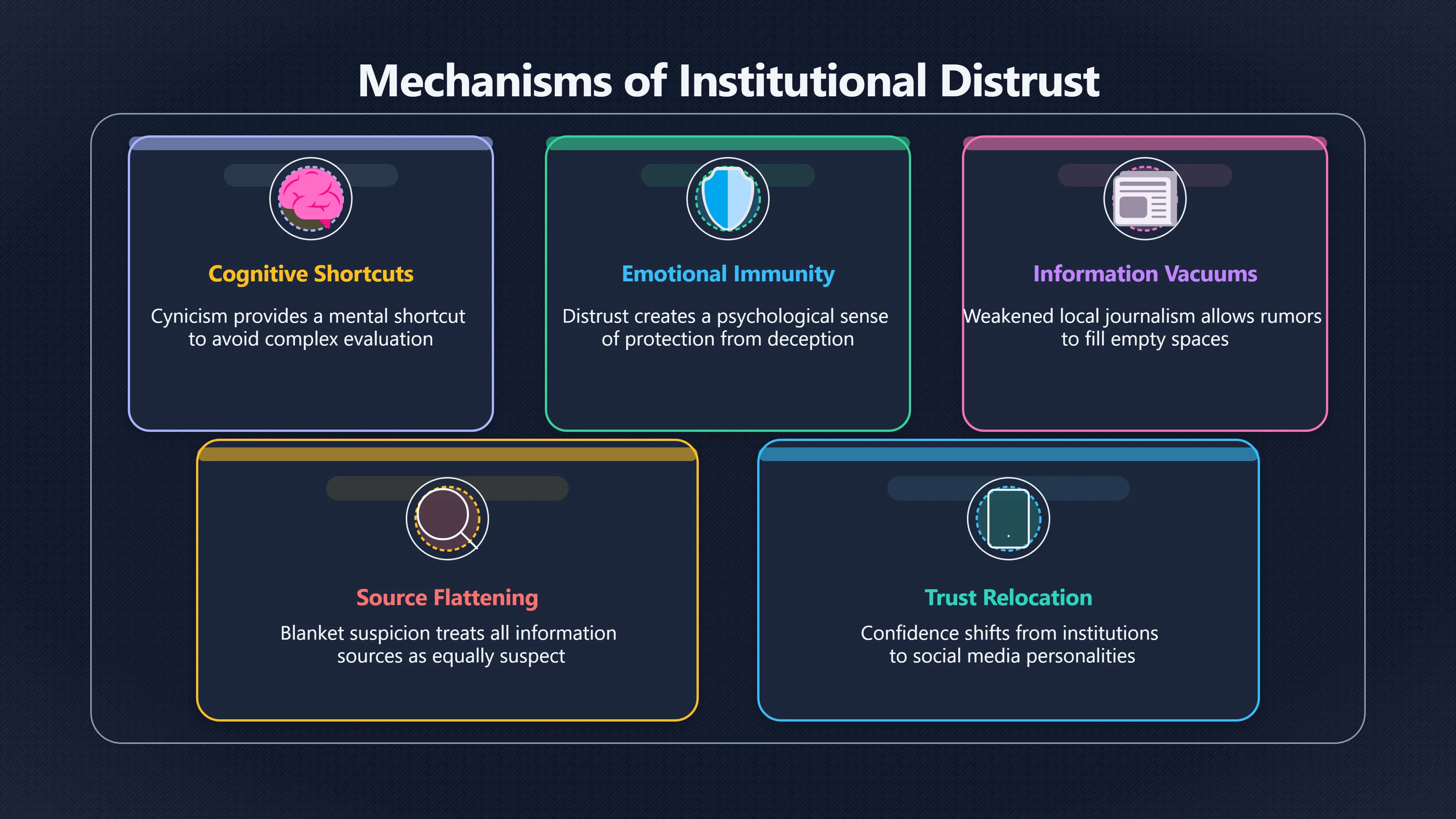
Critical thinking requires effort. It means comparing sources, examining evidence, accepting uncertainty and sometimes changing one’s mind. Blanket distrust offers a shortcut.
If every institution is presumed deceptive, then difficult evaluation questions disappear. A person no longer has to decide whether a specific report is reliable, whether a correction is legitimate or whether a source has supporting evidence. The answer is already assumed: nobody can be trusted.
Psychologists have long noted that people are motivated not only by accuracy but also by the desire to avoid being fooled. Cynicism satisfies that desire because it creates a sense of immunity. If you trust nobody, it feels impossible to be deceived. The emotional reward comes before any evidence is examined. Research on misinformation belief highlights how cognitive and emotional factors can shape acceptance of claims independently of their factual basis.[Nature]nature.comThe psychological drivers of misinformation belief and its…by UKH Ecker · 2022 · Cited by 1941 — In this Review, we describe the…
This is one reason rumours can feel safer than verified information. Verified information often arrives with caveats, uncertainty and revisions. Rumours frequently offer certainty. A rumour that claims to reveal “what they don’t want you to know” can feel psychologically cleaner than a careful explanation that acknowledges gaps in knowledge.
The result is a subtle shift. Instead of asking, “What evidence supports this claim?”, the question becomes, “Which story fits my distrust?”
How distrust relocates trust to weaker sources
A common misunderstanding is that distrust and belief are opposites. In practice, people need information to navigate the world, so distrust usually shifts trust elsewhere rather than eliminating it.
Someone who dismisses mainstream reporting may still trust:
- A social media personality they follow regularly.
- A friend in a group chat.
- Anonymous accounts presenting “inside information”.
- Alternative media outlets that share their worldview.
- Viral screenshots or videos that appear authentic.
These sources often feel trustworthy because they seem independent of institutions. Yet independence alone says nothing about accuracy.
Research increasingly shows that misinformation is frequently associated with distrust of institutions and established information channels. Studies examining conspiracy beliefs, misinformation susceptibility and trust find that lower trust in scientific and institutional authorities is linked to greater acceptance of unsupported claims.[PMC+2MDPI]pmc.ncbi.nlm.nih.govConspiracy beliefs and distrust of science predicts reluctance…by T Winter · 2022 · Cited by 59 — Our findings indicated that publi…
This helps explain why rumours often spread through communities that see themselves as highly sceptical. Members may believe they are resisting manipulation, while actually relying on weaker verification systems. The trust has not disappeared; it has simply moved.
A useful comparison is replacing a regulated bridge with an uninspected footpath because the bridge authority is distrusted. The alternative may feel more independent, but independence does not make it safer.
Why rumours fit a distrust-driven worldview
Rumours often succeed because they provide narratives that explain why trusted institutions should not be trusted.
Many rumours share common themes:
- Hidden agendas.
- Secret coordination.
- Suppressed evidence.
- Corrupt elites.
- Cover-ups by authorities.
These themes are powerful because they are self-reinforcing. Evidence against the rumour can be interpreted as proof that the cover-up is working. Lack of evidence can be reinterpreted as evidence of concealment.
Researchers studying conspiracy beliefs describe similar dynamics. Disrupted forms of what psychologists call “epistemic trust”—the ability to judge when information from others deserves consideration—are associated with greater endorsement of conspiracy narratives.[PMC]pmc.ncbi.nlm.nih.govPMC“Trust me, do not trust anyone”: how epistemic mistrust and…by F Brauner · 2023 · Cited by 45 — Previous research shows that the pr…
This creates an asymmetry. Official information must continually prove itself. Rumours merely need to remain plausible within a framework of distrust.
The emotional logic becomes:
- Institutions cannot be trusted.
- Institutions deny the rumour.
- Therefore the denial increases suspicion.
At that point, distrust itself becomes evidence.
What happens when every source looks equally suspect
One of the most damaging effects of blanket distrust is the collapse of distinctions between sources.
Critical thinking depends on recognising differences. A peer-reviewed study, a government report, a local eyewitness account, an anonymous meme and an AI-generated post should not receive identical credibility scores.
Cynicism flattens these differences. Everything becomes equally questionable.
Research separating media scepticism from media cynicism finds that the two are not the same. Scepticism involves evaluation and evidence-seeking. Cynicism is a broad negative orientation towards information sources. Recent studies have found that higher news cynicism is associated with greater belief in misinformation, whereas knowledge-based scepticism is associated with better judgement.[Erasmus University Rotterdam]pure.eur.nlErasmus University Rotterdamtsfati-barnoy-2025-media-cynicism-media-skepticism-and-…Today — 25 Mar 2025 — Conflating cynicism and skep…
When distinctions disappear, rumours gain an advantage because they often have lower standards to satisfy. A carefully sourced explanation may appear no more credible than a dramatic unsupported claim if both are viewed through the same lens of blanket suspicion.
A real-world consequence: information vacuums
Rumours become especially powerful when trusted information sources weaken or disappear.
Recent research on local information ecosystems in the UK found substantially higher levels of misinformation in areas with limited local journalism. In these environments, unofficial social media groups increasingly fill the information gap, often without editorial oversight or verification standards.[The Guardian]theguardian.comThe Guardian'Killer of trust': social media groups fuel misinformation in UK, report findsTopics such as immigration and Islamophobia are the most frequent subjects of false claims. The spread intensifies around elections, with…
The pattern is important. People do not stop seeking information when trusted institutions lose credibility. They turn to whatever remains available.
A similar dynamic has appeared in health misinformation crises. In the Democratic Republic of Congo, false health rumours spread through social media and community networks contributed to panic, violence and resistance to health interventions. Public health officials linked the spread of the rumours partly to existing mistrust of authorities and institutions.[Reuters]reuters.comFake rumors, real killings: Inside Congo's deadly health misinformation crisisThe panic led to violence, including the killing of four health workers conducting vaccination surveys. The WHO and Africa Infodemic Resp…
These examples illustrate the same mechanism: when distrust creates an information vacuum, rumours often rush in to fill it.
Questions that turn suspicion back into evaluation
Distrust is not always irrational. Institutions make mistakes. Journalists get things wrong. Governments sometimes mislead. Critical thinking does not require blind trust.
The difference is that critical thinking treats suspicion as a starting point rather than a destination.
When encountering a claim, especially one that feels satisfying because it confirms distrust, useful questions include:
- What specific evidence supports this claim?
- Would I accept the same quality of evidence if it supported the opposite conclusion?
- Who originally produced this information?
- Is the source accountable for errors?
- Has the claim been independently verified?
- What evidence would change my mind?
- Am I trusting this because it is well-supported, or because it matches my expectations?
These questions redirect attention away from emotional certainty and back towards evidence.
The goal is not to trust everything. It is to avoid replacing one shortcut with another. In the age of social media and AI, misinformation often succeeds not because people trust too much, but because distrust becomes so broad that rumours begin to feel like the safest option available. Evidence, rather than cynicism, is what breaks that trap.

Amazon book picks
Further Reading
Books and field guides related to When distrust becomes its own trap. Use these as the next step if you want deeper reading beyond the article.
The Skeptics' Guide to the Universe
Distinguishes evidence-based skepticism from cynicism.
eBay marketplace picks
Marketplace Samples
Example marketplace items related to this page. Use the search link to explore similar finds on eBay.




Endnotes
1.
Source: pmc.ncbi.nlm.nih.gov
Link:https://pmc.ncbi.nlm.nih.gov/articles/PMC8856386/
Source snippet
Conspiracy beliefs and distrust of science predicts reluctance...by T Winter · 2022 · Cited by 59 — Our findings indicated that publi...
2.
Source: mdpi.com
Link:https://www.mdpi.com/2673-5172/7/1/61
Source snippet
Trust in Scientists and Conspiracy Beliefs Predict Online...by A Katsiroumpa · 2026 · Cited by 1 — Our findings showed associations...
3.
Source: nature.com
Link:https://www.nature.com/articles/s44159-021-00006-y
Source snippet
The psychological drivers of misinformation belief and its...by UKH Ecker · 2022 · Cited by 1941 — In this Review, we describe the...
4.
Source: reuters.com
Title: Fake rumors, real killings: Inside Congo’s deadly health misinformation crisis
Link:https://www.reuters.com/business/media-telecom/fake-rumors-real-killings-inside-congos-deadly-health-misinformation-crisis-2026-05-07/
Source snippet
The panic led to violence, including the killing of four health workers conducting vaccination surveys. The WHO and Africa Infodemic Resp...
5.
Source: pmc.ncbi.nlm.nih.gov
Link:https://pmc.ncbi.nlm.nih.gov/articles/PMC10782893/
Source snippet
PMC“Trust me, do not trust anyone”: how epistemic mistrust and...by F Brauner · 2023 · Cited by 45 — Previous research shows that the pr...
6.
Source: pure.eur.nl
Link:https://pure.eur.nl/ws/portalfiles/portal/187962991/tsfati-barnoy-2025-media-cynicism-media-skepticism-and-automatic-media-trust-explicating-their-connection-with-news.pdf
Source snippet
Erasmus University Rotterdamtsfati-barnoy-2025-media-cynicism-media-skepticism-and-...Today — 25 Mar 2025 — Conflating cynicism and skep...
7.
Source: theguardian.com
Link:https://www.theguardian.com/media/2026/jun/08/social-media-groups-fuel-misinfomation-uk-[news-deserts
Source snippet
Topics such as immigration and Islamophobia are the most frequent subjects of false claims. The spread intensifies around elections, with...
8.
Source: pmc.ncbi.nlm.nih.gov
Link:https://pmc.ncbi.nlm.nih.gov/articles/PMC10623619/
Source snippet
by Z Adams · 2023 · Cited by 147 — The actual effects that are measured vary from self-reported behaviors in response to inaccurate he...
9.
Source: dr.ntu.edu.sg
Link:https://dr.ntu.edu.sg/server/api/core/bitstreams/73555724-4ba7-4fd7-a65a-d86053f33708/content
Source snippet
high-effort pragmatic scepticism to low effort cynicby C Fisher · 2024 · Cited by 9 — The current study examines how people manage the ov...
10.
Source: reutersinstitute.politics.ox.ac.uk
Link:https://reutersinstitute.politics.ox.ac.uk/snap-judgements-how-audiences-who-lack-trust-news-navigate-information-digital-platforms
Source snippet
judgements: how audiences who lack trust in news...4 Apr 2022 — In this report, we qualitatively examine how audiences who lack trust in...
Additional References
11.
Source: researchgate.net
Link:https://www.researchgate.net/publication/397783879_Trust_in_scientists_and_conspiracy_beliefs_predict_online_misinformation_susceptibility_and_fake_news_detection_a_cross-sectional_study_in_Greece
Source snippet
(PDF) Trust in scientists and conspiracy beliefs predict...19 Nov 2025 — Objective: To examine the effect of trust in scientists and con...
12.
Source: researchgate.net
Link:https://www.researchgate.net/publication/391772475_Conceptualisations_and_analyses_of_distrust_and_mistrust_in_news_media_Reviewing_research_from_a_decade_of_distrust
Source snippet
Conceptualisations and analyses of distrust and mistrust in...PDF | This article provides a comprehensive review of research on distrust...
13.
Source: misinforeview.hks.harvard.edu
Link:https://misinforeview.hks.harvard.edu/article/misinformation-in-action-fake-news-exposure-is-linked-to-lower-trust-in-media-higher-trust-in-government-when-your-side-is-in-power/
Source snippet
news exposure is linked to lower trust in media...by K Ognyanova · 2020 · Cited by 515 — Research suggests that negative or biased repor...
14.
Source: misinforeview.hks.harvard.edu
Link:https://misinforeview.hks.harvard.edu/article/not-so-different-after-all-antecedents-of-believing-in-misinformation-and-conspiracy-theories-on-covid-19/
Source snippet
Antecedents of believing in...by F Wintterlin · 2025 — Research on media use and misperceptions suggests that belief in conspiracy theor...
15.
Source: research.rug.nl
Title: lack of trust conspiracy beliefs and social media use predict cov
Link:https://research.rug.nl/en/publications/lack-of-trust-conspiracy-beliefs-and-social-media-use-predict-cov/
Source snippet
of Trust, Conspiracy Beliefs, and Social Media Use...by W Jennings · 2021 · Cited by 728 — As COVID-19 vaccines are rolled out across th...
16.
Source: jstor.org
Link:https://www.jstor.org/stable/45419856
Source snippet
Social and Cognitive Aspects of the Vulnerability to...by M Pantazi · 2021 · Cited by 90 — of misinformation, and many other social prob...
17.
Source: ucl.ac.uk
Title: both mistrust and credulity linked believing conspiracies
Link:https://www.ucl.ac.uk/news/2024/dec/both-mistrust-and-credulity-linked-believing-conspiracies
Source snippet
Both mistrust and credulity linked to believing conspiracies5 Dec 2024 — People who are either too trusting or too mistrustful are more l...
18.
Source: news.ku.edu
Link:https://news.ku.edu/news/article/study-finds-people-more-cynical-toward-news-more-likely-to-believe-misinformation-ARTICLE-F26T9T-ARTICLE-F26T9T-ARTICLE-F26T9T
Source snippet
Those with higher levels of...Read more...
19.
Source: youtube.com
Title: Why people fall for misinformation
Link:http://www.youtube.com/watch?v=hz6GULbowAk
Source snippet
Psychology of conspiracy theories and institutional distrust The Psychology of Conspiracy Theorists Psychology with Dr. Ana...
20.
Source: arxiv.org
Link:https://arxiv.org/html/2503.11116v1
Source snippet
Trust in Disinformation Narratives: a Trust in the News...14 Mar 2025 — Understanding why people trust or distrust one another, institut...
Topic Tree