Within Synthetic Images
Why spotting weird hands is not enough
Hands, shadows and text can still reveal problems, but their absence no longer makes an image trustworthy.
On this page
- Old AI tells that still sometimes help
- Why real photos can also look strange
- How to treat visual clues as triage
Page outline Jump by section
Introduction
For several years, the standard advice for spotting AI-generated images was simple: count the fingers, inspect the shadows, and look for garbled text. That advice was useful when image generators routinely produced obvious mistakes. It is much less reliable today.
 Modern image models have become dramatically better at rendering hands, faces, lighting and typography, while real photographs can contain compression artefacts, motion blur, unusual perspectives and camera glitches that look suspicious. As a result, visual inspection still has value, but mainly as a first-pass screening tool rather than a method of verification. The critical-thinking challenge is no longer finding obvious flaws. It is recognising that the absence of visible flaws does not make an image trustworthy.[GIJN+2The Guardian]gijn.orgguide detecting ai generated contentReporter's Guide to Detecting AI-Generated Content1 Sept 2025 — As a result, hands are no longer a reliable way to detect AI-created…
Why spotting weird hands is not enough
The famous “AI hand problem” became a popular detection shortcut because early image generators often produced extra fingers, fused hands or anatomically impossible poses. Researchers and journalists repeatedly highlighted these errors during the first wave of public image-generation tools.[The New Yorker]newyorker.comBut they have no understanding of what a hand really is.”The New YorkerThe Uncanny Failure of A.I.-Generated HandsMarch 9, 2023 — 10 Mar 2023 — AI tools “have learned that hands have elements su…
However, image-generation systems have improved rapidly. Investigative journalism guides that once recommended checking hands now explicitly warn that this clue has become far less dependable because major image models render hands much more accurately than earlier systems.[GIJN]gijn.orgguide detecting ai generated contentReporter's Guide to Detecting AI-Generated Content1 Sept 2025 — As a result, hands are no longer a reliable way to detect AI-created…
This creates a common reasoning error: people remember yesterday’s failure modes and assume they remain reliable indicators. In practice:
- Some AI images still contain hand, jewellery, text or background mistakes.
- Many AI images contain none of those mistakes.
- Some genuine photographs contain odd-looking details that resemble AI artefacts.
The result is a shrinking overlap between “looks strange” and “is fake”.
Studies examining human ability to distinguish AI-generated images from real photographs increasingly find that people perform only modestly above chance when faced with modern synthetic images. Large-scale experiments have reported success rates around 62%, while other controlled tests found average performance barely above random guessing.[arXiv+2PC Gamer]arxiv.orgHow good are humans at detecting AI-generated images? Learnings from an experimentMay 12, 2025…
The implication is not that visual clues have disappeared. It is that they are no longer decisive.
Old AI tells that still sometimes help
Certain visual inconsistencies remain useful because image generators still struggle with some forms of physical and contextual coherence.
Common examples include:
Text and numbers. Signs, labels, licence plates and packaging often reveal subtle inconsistencies. Letters may be malformed, spacing irregular, or numbers inconsistent with their surroundings. Reuters fact-checkers have repeatedly identified synthetic images through incoherent labelling and textual details.[Reuters]reuters.comImage of human hand 'meat' on store shelves is AI-generatedShared widely on Facebook with captions suggesting it depicted real human meat, the image confused and alarmed many viewers. Comments on…
Object relationships. A hand gripping an object incorrectly, clothing intersecting with a body, or a shadow that does not match a light source can still indicate synthetic generation. Such problems arise because models learn visual patterns rather than understanding physical reality.[The New Yorker]newyorker.comBut they have no understanding of what a hand really is.”The New YorkerThe Uncanny Failure of A.I.-Generated HandsMarch 9, 2023 — 10 Mar 2023 — AI tools “have learned that hands have elements su…
Background consistency. Faces often receive the most attention during image generation. Backgrounds, architecture and secondary objects may receive less modelling precision, creating subtle distortions that become noticeable during careful inspection.[The Guardian]theguardian.comIdentificarlas implica observar ciertos detalles: 1) áreas extrañas alrededor de la boca o la barbilla, con pocas arrugas o mala sincroni…
Complex scenes. Crowds, intricate machinery, detailed signage and repeated structures remain harder for many models to render consistently. Research on diffusion-generated imagery continues to find that scene complexity affects both image quality and human detection accuracy.[arXiv]arxiv.orgCharacterizing Photorealism and Artifacts in Diffusion Model-Generated ImagesFebruary 17, 2025…
The important limitation is that these clues work asymmetrically. Their presence can raise suspicion. Their absence cannot establish authenticity.
Why real photos can also look strange
A major weakness of the visual-inspection approach is that genuine photographs often violate people’s expectations of what reality should look like.
Camera technology creates effects that can appear artificial:
- Motion blur can deform limbs and faces.
- Wide-angle lenses can stretch bodies and buildings.
- Reflections can create apparently impossible geometry.
- Compression and social-media processing can distort edges and textures.
- Low light can produce strange shadows and noise patterns.
Researchers examining image authentication note that low resolution and compression can obscure or distort the very features people are told to inspect.[ResearchGate]researchgate.netResearchGate(PDF) How to Distinguish AI-Generated Images from…June 12, 2024 — 17 Jun 2024 — Low quality and low resolution images redu…
This means that unusual appearance alone is weak evidence. A blurry hand in a genuine smartphone photo may look more suspicious than a perfectly rendered hand in a synthetic image.
The problem becomes even harder during breaking news. Images captured under chaotic conditions often contain visual imperfections. Ironically, these imperfections can make authentic photographs appear less trustworthy than polished AI-generated imagery.
The trap of visual confidence
One of the most important findings from recent research is not simply that people struggle to identify AI images. It is that many people remain confident in their ability to do so.[arXiv]arxiv.orgarXiv We are not able to identify AI-generated imagesarXiv We are not able to identify AI-generated images
This confidence creates a dangerous shortcut:
“I checked the image carefully and saw nothing wrong, therefore it is probably real.”
That conclusion does not follow from the evidence.
Visual inspection is vulnerable because it focuses on the image itself while ignoring questions about origin, context and corroboration. An image generator only needs to avoid obvious mistakes. It does not need to provide evidence that an event occurred.
The viral image of Pope Francis in a white puffer jacket demonstrated this dynamic. Many viewers searched for visual flaws. The more important question was whether any independent evidence connected the image to a real event. The answer was no.[Time]time.comhow to spot deepfake popeDespite some telltale signs of fakery, the image was convincing enough to become a significant viral misinformation event. AI-generated i…
In critical-thinking terms, authenticity is not a property that can always be read directly from pixels.
How to treat visual clues as triage
The most useful way to think about visual inspection is as triage rather than proof.
When examining a suspicious image:
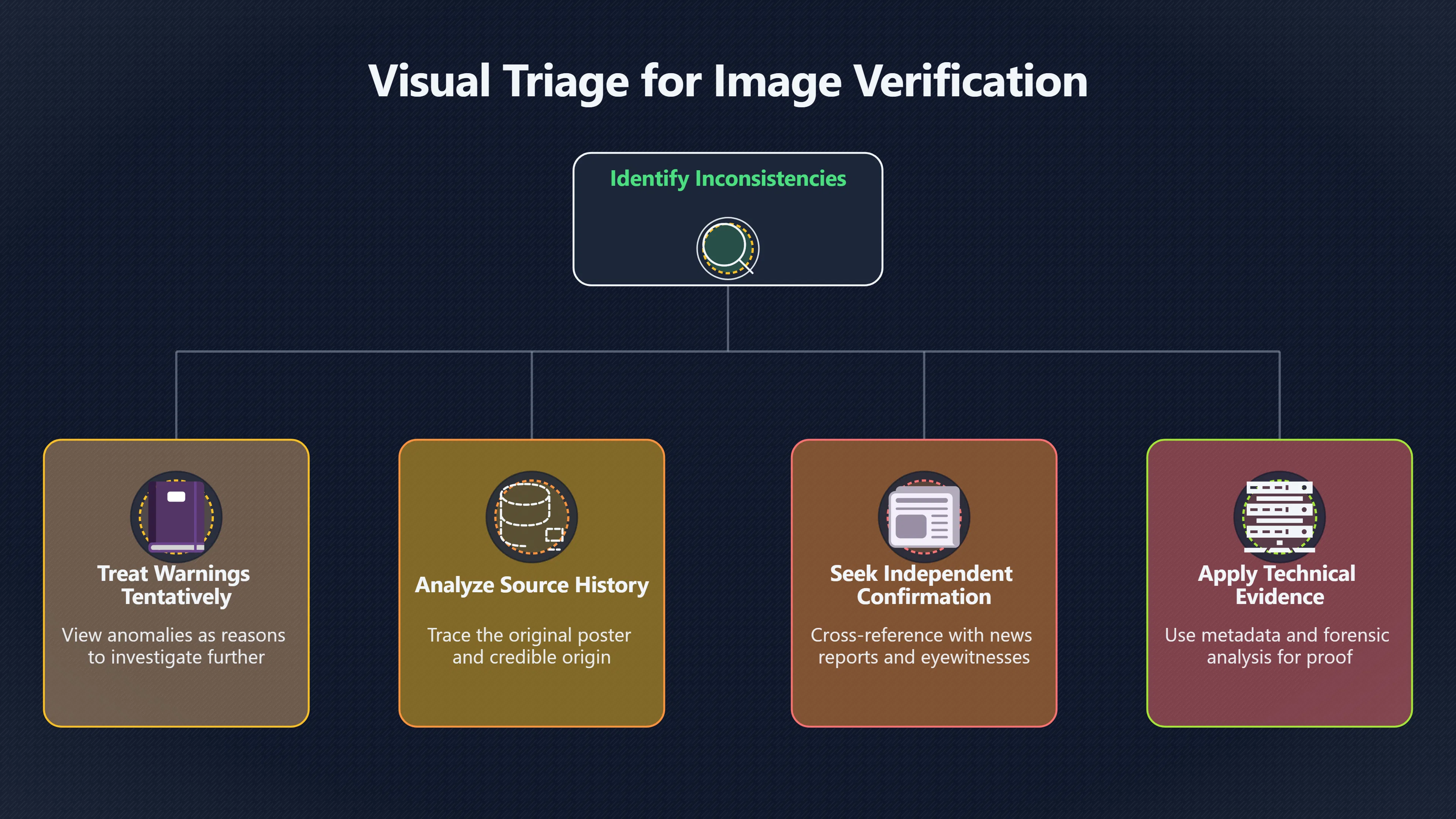
- Look for visual inconsistencies. Hands, shadows, reflections, text and object interactions can still provide useful warnings.
- Treat warnings as reasons to investigate, not as final verdicts.
- Treat the absence of warnings the same way. A clean-looking image should move you to verification, not belief.
- Check source history. Who first posted the image? Is there a credible origin?
- Seek independent confirmation. News reports, eyewitness accounts, additional photographs or official statements matter more than image quality.
- Use technical evidence when available. Metadata, content credentials, reverse-image searches and forensic analysis often provide stronger evidence than visual judgement alone. JISI
This approach aligns with a broader shift in the age of social media and AI. The question is no longer “Can I spot the fake?” The more reliable question is “What evidence exists beyond the image itself?”
The new limit of the looks-real test
The fading usefulness of weird hands, distorted shadows and broken text does not mean visual inspection is worthless. These clues still catch many synthetic images. Fact-checkers continue to use them as part of their investigations. Reuters
What has changed is their role.
Visual inspection once functioned as a rough authenticity test. Increasingly, it functions as a rough anomaly detector. It can identify reasons for doubt, but it cannot reliably establish truth. As image generators become more realistic, the critical-thinking skill that matters most is not finding flaws in a picture. It is resisting the assumption that a flawless picture deserves belief. GIJN+2arXiv
Amazon book picks
Further Reading
Books and field guides related to Why spotting weird hands is not enough. Use these as the next step if you want deeper reading beyond the article.


eBay marketplace picks
Marketplace Samples
Example marketplace items related to this page. Use the search link to explore similar finds on eBay.




Endnotes
1.
Source: gijn.org
Title: guide detecting ai generated content
Link:https://gijn.org/resource/guide-detecting-ai-generated-content/
Source snippet
Reporter's Guide to Detecting AI-Generated Content1 Sept 2025 — As a result, hands are no longer a reliable way to detect AI-created...
2.
Source: time.com
Title: how to spot deepfake pope
Link:https://time.com/6266606/how-to-spot-deepfake-pope/
Source snippet
Despite some telltale signs of fakery, the image was convincing enough to become a significant viral misinformation event. AI-generated i...
3.
Source: arxiv.org
Link:https://arxiv.org/abs/2507.18640
Source snippet
How good are humans at detecting AI-generated images? Learnings from an experimentMay 12, 2025...
Published: May 12, 2025
4.
Source: arxiv.org
Title: arXiv We are not able to identify AI-generated images
Link:https://arxiv.org/abs/2512.22236
5.
Source: reuters.com
Title: Image of human hand ‘meat’ on store shelves is AI-generated
Link:https://www.reuters.com/fact-check/image-human-hand-meat-store-shelves-is-ai-generated-2024-04-08/
Source snippet
Shared widely on Facebook with captions suggesting it depicted real human meat, the image confused and alarmed many viewers. Comments on...
6.
Source: arxiv.org
Link:https://arxiv.org/abs/2502.11989
Source snippet
Characterizing Photorealism and Artifacts in Diffusion Model-Generated ImagesFebruary 17, 2025...
Published: February 17, 2025
7.
Source: researchgate.net
Link:https://www.researchgate.net/publication/381404243_How_to_Distinguish_AI-Generated_Images_from_Authentic_Photographs
Source snippet
ResearchGate(PDF) How to Distinguish AI-Generated Images from...June 12, 2024 — 17 Jun 2024 — Low quality and low resolution images redu...
Published: June 12, 2024
9.
Source: arxiv.org
Link:https://arxiv.org/html/2510.23775v1
Source snippet
We present an explainable image...Read more...
10.
Source: arxiv.org
Link:https://arxiv.org/pdf/2509.21135
Source snippet
The Unwinnable Arms Race of AI Image Detectionby T Aczel · 2025 — Despite growing awareness, unaided human observers perform only slightl...
11.
Source: arxiv.org
Link:https://arxiv.org/html/2512.22236v1
Source snippet
We are not able to identify AI-generated images23 Dec 2025 — Taken together, these findings show that human judgment alone is insufficien...
12.
Source: researchgate.net
Title: 369380286 Can AI Generated Text be Reliably Detected
Link:https://www.researchgate.net/publication/369380286_Can_AI-Generated_Text_be_Reliably_Detected
Source snippet
(PDF) Can AI-Generated Text be Reliably Detected?17 Mar 2023 — In this paper, both empirically and theoretically, we show that these dete...
13.
Source: researchgate.net
Link:https://www.researchgate.net/publication/389876822_Comparing_AI_and_humans%27_ability_to_recognize_AI-generated_images
Source snippet
f AI models designed to detect these images...
14.
Source: theguardian.com
Link:https://www.theguardian.com/technology/article/2024/jul/01/seven-signs-deepfake-artificial-intelligence-videos-photographs
Source snippet
Identificarlas implica observar ciertos detalles: 1) áreas extrañas alrededor de la boca o la barbilla, con pocas arrugas o mala sincroni...
15.
Source: newyorker.com
Title: But they have no understanding of what a hand really is.”
Link:https://www.newyorker.com/culture/rabbit-holes/the-uncanny-failures-of-ai-generated-hands
Source snippet
The New YorkerThe Uncanny Failure of A.I.-Generated HandsMarch 9, 2023 — 10 Mar 2023 — AI tools “have learned that hands have elements su...
Published: March 9, 2023
16.
Source: pcgamer.com
Link:https://www.pcgamer.com/software/ai/microsoft-study-suggests-folks-cant-tell-the-difference-between-real-and-ai-generated-images-about-62-percent-of-the-time-can-you-do-any-better/
Source snippet
The research involved 12,500 participants evaluating 287,000 images, including 350 real copyright-free photos and 700 AI-generated ones c...
Additional References
17.
Source: nist.gov
Link:https://www.nist.gov/publications/guardians-forensic-evidence-evaluating-analytic-systems-against-ai-generated-[deepfakes
Source snippet
Guardians of Forensic Evidence: Evaluating Analytic...by H Guan · 2025 — Guardians of Forensic Evidence: Evaluating Analytic Systems Aga...
18.
Source: britannica.com
Link:https://www.britannica.com/topic/Why-does-AI-art-screw-up-hands-and-fingers-2230501
Source snippet
Encyclopedia BritannicaWhy does AI art screw up hands and fingers?An AI-generated hand might have nine fingers or fingers sticking out of...
19.
Source: reddit.com
Link:https://www.reddit.com/r/photography/comments/1t1079s/how_to_distinguish_real_photos_from_aigenerated/
Source snippet
How to distinguish real photos from AI-generated onesLens compression doesn't actually exist, it's actually perspective distortion.... S...
20.
Source: medium.com
Link:https://medium.com/%40xsankalp13/nist-ai-rmf-map-function-the-complete-guide-ctos-wish-theyd-read-first-1c0023072ffb
Source snippet
NIST AI RMF Map Function: The Complete Guide CTOs...The system will handle routing autonomously for tickets it scores above 90% confiden...
21.
Source: infoq.com
Link:https://www.infoq.com/news/2024/05/nist-gen-ai-discriminator/
Source snippet
NIST Launches Program to Discriminate How Far from "...The pilot aims to measure and understand system behaviours for discriminating bet...
22.
Source: medium.com
Link:https://medium.com/%40ml-point/why-ai-images-look-real-but-they-arent-e89be491afa1
Source snippet
Why AI Images Look Real But They Aren't | by ML PointThe AI-generated look strange because reality is harder than appearance. Most discus...
23.
Source: nist.gov
Title: 2025 nist genai pilot evaluation plan image generators
Link:https://www.nist.gov/publications/2025-nist-genai-pilot-evaluation-plan-image-generators
Source snippet
2025 NIST GenAI (Pilot) Evaluation Plan for Image...by G Awad · 2025 — GenAI is an evaluation series that provides a platform for testin...
24.
Source: netarx.com
Title: navigating the new nist deepfake standards protecting against social
Link:https://www.netarx.com/blog/navigating-the-new-nist-deepfake-standards-protecting-against-social
Source snippet
Navigating the New NIST Deepfake Standards18 Feb 2026 — Guardians of Forensic Evidence: Evaluating Analytic Systems Against AI-Generated...
25.
Source: openreview.net
Title: However, the evaluation is limited to only two tampered datasets
Link:https://openreview.net/forum?id=GcVvWAdQx7
Source snippet
Advanced Image Forensics: Detecting Tampered and AI-...by S LEARNING — The paper aims to address the joint detection of both tampered an...
26.
Source: nist.gov
Title: 2024 nist genai pilot study text text evaluation overview and results
Link:https://www.nist.gov/publications/2024-nist-genai-pilot-study-text-text-evaluation-overview-and-results
Source snippet
2024 NIST GenAI (Pilot Study): Text-to-Text Evaluation...by H Iyer · 2025 — The 2024 NIST Generative AI (GenAI) Pilot Study focuses on e...
Topic Tree