Within Synthetic Images
Why fake images feel true at first glance
Photorealistic AI images can make false claims feel verified before viewers ask where the image came from.
On this page
- How concreteness shortcuts doubt
- Why plausibility beats inspection in feeds
- What realism can and cannot prove
Page outline Jump by section
Introduction
Photorealistic AI images feel like evidence because human beings do not evaluate pictures the same way they evaluate written claims. A realistic image provides concrete visual details—faces, objects, lighting, weather, emotions and settings—in a single glance. Those details create the impression that someone witnessed a real event and recorded it with a camera. The result is that people often experience a sense of verification before they have asked where the image came from, who created it, or whether the depicted event ever occurred. Research in psychology and misinformation studies suggests that images can increase perceived truth even when they provide little or no actual evidence for the claim they accompany.[DigitalCommons at Fairfield]digitalcommons.fairfield.eduDigitalCommons at FairfieldNonprobative photos rapidly lead people to believe claims…by BA Cardwell · 2016 · Cited by 36 — Research sh…
 In the age of AI-generated imagery, this matters because realism has become easier to manufacture than ever. A convincing image can now be generated without any camera, location, subject or event existing in the real world. Yet many of the mental shortcuts that once made photographs useful still activate when people encounter synthetic images online.[arXiv]arxiv.orgCrafting Synthetic Realities: Examining Visual Realism and Misinformation Potential of Photorealistic AI-Generated ImagesSeptember 2…
How concreteness shortcuts doubt
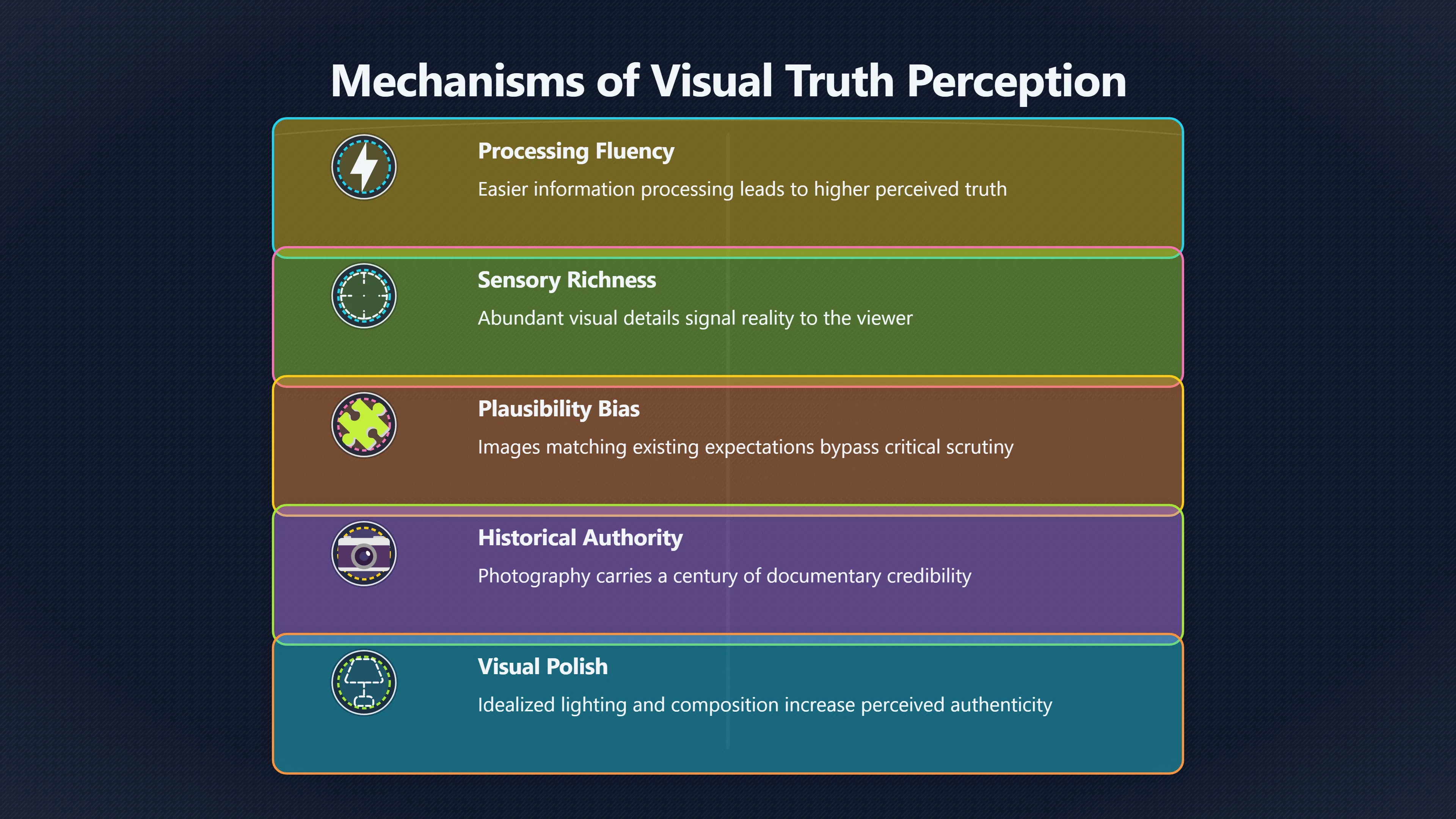
The key mechanism is not gullibility but efficiency. Human perception relies on shortcuts that help people make rapid judgments in environments full of information. Images are particularly powerful because they supply sensory detail that text leaves abstract.
Consider two versions of the same claim:
- “A major protest took place outside a government building.”
- The same sentence accompanied by a realistic image of a crowd outside that building.
The image does not necessarily provide proof that the event occurred, yet it makes the claim feel more complete and easier to imagine. Psychologists have repeatedly found that photographs can increase acceptance of claims even when the photographs are non-probative—that is, when they do not actually provide evidence for the claim itself.[DigitalCommons at Fairfield]digitalcommons.fairfield.eduDigitalCommons at FairfieldNonprobative photos rapidly lead people to believe claims…by BA Cardwell · 2016 · Cited by 36 — Research sh…
One reason is known as processing fluency. Information that is easier to process often feels more familiar, and familiar information is more likely to be judged as true. Research on visual fluency and truth judgments has shown that the ease with which people process images can influence perceived accuracy.[LuissThesis]tesi.luiss.itThesisThe Illusory Truth Effect in the Visual ContextSeptember 30, 2019 — Our findings show that images' perceptual fluency does ind…
A realistic AI image exploits this shortcut. The viewer’s brain receives abundant sensory information and unconsciously treats that richness as a signal that there must be something real behind it. The image feels less like a claim and more like a record.
Why plausibility beats inspection in social feeds
Most people do not carefully inspect every image they encounter. Social platforms are designed around speed, scrolling and rapid reactions. Under those conditions, plausibility often matters more than forensic examination.
When a synthetic image matches existing expectations, scrutiny tends to decrease. A viewer who already believes that a politician is controversial, that a disaster could happen in a particular region, or that a celebrity might wear unusual clothing is more likely to accept a fitting image at first glance. The image succeeds not because it survives detailed inspection but because it arrives before inspection begins.[The Guardian]theguardian.comThe Guardian'It never happenedFrom early examples such as Abraham Lincoln’s doctored portraits and spirit photography, to politically motivated fakes like doctored ima…
This dynamic helps explain why famous AI-generated images have spread so widely. The viral image of Pope Francis in a white designer-style puffer jacket worked because it combined a familiar public figure with a visually coherent and culturally plausible scene. Many viewers accepted it momentarily because nothing about the image immediately violated their expectations of reality.[Time]time.comHow to Spot an AI-Generated Image Like the 'Balenciaga PopeDespite some telltale signs of fakery, the image was convincing enough to become a significant viral misinformation event. AI-generated i…
Recent research on photorealistic AI-generated images suggests that successful synthetic images often feature recognisable people, celebrities and politicians, while minimising obvious signs of AI generation. They are designed to fit naturally into the visual language people already associate with photography, journalism and social media.[arXiv]arxiv.orgCrafting Synthetic Realities: Examining Visual Realism and Misinformation Potential of Photorealistic AI-Generated ImagesSeptember 2…

The hidden authority of photographic style
Part of the realism trap comes from the cultural status of photography itself. For more than a century, photographs have functioned as a form of documentary evidence. Courts, newspapers, historians and ordinary people have treated photographs as records of what a camera observed.
Even though photographs have always been capable of manipulation, the photographic look still carries a residue of authority. A grainy phone image, a news-style composition or a seemingly candid portrait activates assumptions built from decades of experience with cameras and journalism.[WIRED]wired.comPhotography Is No Longer Evidence of AnythingThe controversy around an edited image of the Princess of Wales has highlighted the ease with which photos can be altered and the various…
AI-generated images can imitate these visual conventions extremely well. They do not merely depict a scene; they imitate the appearance of photographic witnessing. This distinction is important. People often respond not only to what an image shows but also to how it appears to have been produced.
A photorealistic image therefore borrows credibility from photography’s historical reputation, even when no photograph was ever taken.[Taylor & Francis Online]tandfonline.comTaylor & Francis Online Photorealism versus photographyAI-generated depiction…by L Hausken · 2024 · Cited by 76 — The use of AI to generate images was discussed with sometimes shrill words…
When fake images become more convincing than real ones
An uncomfortable possibility is that some synthetic images may appear more convincing than genuine photographs.
Studies of AI-generated faces have found that people often struggle to distinguish synthetic faces from real ones. Some research has even identified forms of “AI hyper-realism” in which generated faces can appear unusually trustworthy or familiar because they are statistically optimised representations rather than ordinary human photographs.[PMC]pmc.ncbi.nlm.nih.govAI-generated images of familiar faces are indistinguishable…by RSS Kramer · 2025 · Cited by 2 — Abstract. Human users are now able…
This matters because people frequently judge authenticity using visual polish. A perfectly lit portrait, an emotionally compelling expression or a dramatic composition may appear more credible than a messy, imperfect real photograph. Yet those same qualities can be produced deliberately by image-generation systems.
The danger is not simply that fake images look real. It is that they can look like idealised versions of what people expect reality to look like.[ResearchGate]researchgate.netdisinformation, may influence authenticity judgements of AI-generated disinformation images…. AI-generated misinformation, the study…
What realism can and cannot prove
Realism can establish only one thing: that an image looks realistic.
It cannot, by itself, prove:
- That a depicted event occurred.
- That the people shown were present.
- That a scene was captured by a camera.
- That the image is contemporary rather than recycled.
- That the surrounding caption is accurate.
- That the implied conclusion is true.
An image may be realistic and entirely fabricated. It may be real but attached to the wrong story. It may be edited, cropped or stripped of context. Research on misinformation consistently shows that images can influence attention, memory and judgments of truth even when their evidential connection to a claim is weak or nonexistent.[ResearchGate]researchgate.netHow images influence perceptions of truth and what can be…30 Nov 2023 — We organize image types by their substantive relat…
The critical thinking shift required by photorealistic AI is therefore subtle but important. The question is no longer “Does this look real?” but “What independent evidence connects this image to reality?” A realistic image may justify curiosity. It does not automatically justify belief.[Misinformation Review+2WIRED]misinforeview.hks.harvard.eduCarefully examining…Read more…

eBay marketplace picks
Marketplace Samples
Example marketplace items related to this page. Use the search link to explore similar finds on eBay.


Endnotes
1.
Source: digitalcommons.fairfield.edu
Link:https://digitalcommons.fairfield.edu/cgi/viewcontent.cgi?article=1013&context=psychology-facultypubs&httpsredir=1&referer=
Source snippet
DigitalCommons at FairfieldNonprobative photos rapidly lead people to believe claims...by BA Cardwell · 2016 · Cited by 36 — Research sh...
2.
Source: researchgate.net
Link:https://www.researchgate.net/publication/376077541_Misinformed_by_images_How_images_influence_perceptions_of_truth_and_what_can_be_done_about_it
Source snippet
How images influence perceptions of truth and what can be...30 Nov 2023 — We organize image types by their substantive relat...
3.
Source: arxiv.org
Link:https://arxiv.org/abs/2409.17484
Source snippet
Crafting Synthetic Realities: Examining Visual Realism and Misinformation Potential of Photorealistic AI-Generated ImagesSeptember 2...
4.
Source: researchgate.net
Link:https://www.researchgate.net/publication/299396072_Nonprobative_photos_rapidly_lead_people_to_believe_claims_about_their_own_and_other_people%27s_pasts
Source snippet
Nonprobative photos rapidly lead people to believe claims...Photos lead people to believe that both true and false events have happened...
5.
Source: time.com
Title: How to Spot an AI-Generated Image Like the ‘Balenciaga Pope’
Link:https://time.com/6266606/how-to-spot-deepfake-pope/
Source snippet
Despite some telltale signs of fakery, the image was convincing enough to become a significant viral misinformation event. AI-generated i...
6.
Source: wired.com
Title: Photography Is No Longer Evidence of Anything
Link:https://www.wired.com/story/the-end-of-photography-as-evidence-of-anything
Source snippet
The controversy around an edited image of the Princess of Wales has highlighted the ease with which photos can be altered and the various...
7.
Source: researchgate.net
Link:https://www.researchgate.net/publication/393144803_Deciphering_authenticity_in_the_age_of_AI_how_AI-generated_disinformation_images_and_AI_detection_tools_influence_judgements_of_authenticity
Source snippet
disinformation, may influence authenticity judgements of AI-generated disinformation images.... AI-generated misinformation, the study...
8.
Source: arxiv.org
Link:https://arxiv.org/html/2409.17484v1
Source snippet
Crafting Synthetic Realities: Examining Visual Realism and...26 Sept 2024 — Our findings provide important implications and insights for...
9.
Source: misinforeview.hks.harvard.edu
Link:https://misinforeview.hks.harvard.edu/article/people-are-more-susceptible-to-misinformation-with-realistic-ai-synthesized-images-that-provide-strong-evidence-to-headlines/
Source snippet
Carefully examining...Read more...
10.
Source: tesi.luiss.it
Link:https://tesi.luiss.it/25790/1/698381_DI%20MARCO_GIANCARLO.pdf
Source snippet
ThesisThe Illusory Truth Effect in the Visual ContextSeptember 30, 2019 — Our findings show that images' perceptual fluency does ind...
Published: September 30, 2019
11.
Source: theguardian.com
Title: The Guardian’It never happened
Link:https://www.theguardian.com/artanddesign/2025/apr/12/28-fake-images-that-fooled-the-world
Source snippet
From early examples such as Abraham Lincoln’s doctored portraits and spirit photography, to politically motivated fakes like doctored ima...
12.
Source: tandfonline.com
Title: Taylor & Francis Online Photorealism versus photography
Link:https://www.tandfonline.com/doi/full/10.1080/20004214.2024.2340787
Source snippet
AI-generated depiction...by L Hausken · 2024 · Cited by 76 — The use of AI to generate images was discussed with sometimes shrill words...
13.
Source: pmc.ncbi.nlm.nih.gov
Link:https://pmc.ncbi.nlm.nih.gov/articles/PMC12521686/
Source snippet
AI-generated images of familiar faces are indistinguishable...by RSS Kramer · 2025 · Cited by 2 — Abstract. Human users are now able...
14.
Source: pmc.ncbi.nlm.nih.gov
Link:https://pmc.ncbi.nlm.nih.gov/articles/PMC12295870/
Source snippet
Human-Made Images - PMCby D Velásquez-Salamanca · 2025 · Cited by 20 — Impact of an Artificial Intelligence Research Frame on the Perceiv...
15.
Source: pmc.ncbi.nlm.nih.gov
Link:https://pmc.ncbi.nlm.nih.gov/articles/PMC10149139/
Source snippet
Treachery of Images: How Realism Influences Brain and...by JC Snow · 2021 · Cited by 160 — Images predominate over real objects in resea...
16.
Source: misinforeview.hks.harvard.edu
Title: guo misinformation susceptability ai images 20251110
Link:https://misinforeview.hks.harvard.edu/wp-content/uploads/2025/11/guo_misinformation_susceptability_ai_images_20251110.pdf
Source snippet
are more susceptible to misinformation with realistic AI...by S Guo · 2025 · Cited by 2 — In a pre- registered experiment, we examine ho...
Additional References
17.
Source: onlineacademiccommunity.uvic.ca
Link:https://onlineacademiccommunity.uvic.ca/lindsaylab/wp-content/uploads/sites/4861/2020/07/NewmanGarryBernsteinKantnerLindsay2013_0.pdf
Source snippet
uvic.caNon-Probative Photographs (or Words) Inflate Truthinessby EJ Newman · Cited by 298 — This body of research suggests that photos mi...
18.
Source: csiro.au
Link:https://www.csiro.au/en/research/technology-space/ai
19.
Source: dl.acm.org
Link:https://dl.acm.org/doi/10.1145/3706599.3719834
Source snippet
ACM Digital LibraryExamining Visual Realism and Misinformation Potential of...To develop a codebook for analyzing AIGI features related...
20.
Source: jsk.stanford.edu
Title: seeing no longer believing artificial intelligences impact photojournalism
Link:https://jsk.stanford.edu/news/seeing-no-longer-believing-artificial-intelligences-impact-photojournalism
Source snippet
is no longer believing: Artificial Intelligence's impact on...Dec 18, 2024 — I'm going to be studying the impacts of AI-generated images...
21.
Source: artdoc.photo
Title: Photography was originally considered a way to objectively represent reality,
Link:https://www.artdoc.photo/articles/truth-in-photography-perception-myth-and-reality-in-the-postmodern-world
Source snippet
Truth in photography: Perception, myth and reality in the...Photography uses the archetype of beauty as a connection to truth...
22.
Source: centerprode.com
Link:https://centerprode.com/conferences/4IeCSHSS/coas.e-conf.04.23255n.pdf
Source snippet
On the one hand, how true is the photographic image in particular, and how much we can trust...Read more...
23.
Source: libraries.rutgers.edu
Title: how ai generated images are fueling misinformation
Link:https://www.libraries.rutgers.edu/news/how-ai-generated-images-are-fueling-misinformation
Source snippet
AI-Generated Images Are Fueling Misinformation24 Mar 2026 — A recent study published in Computers in Human Behavior found that people who...
24.
Source: youtube.com
Title: Visual Evidence: How [Deepfakes]({{ ‘deepfakes/’ | relative_url }}) & Bias Sway Courtroom Justice
Link:https://www.youtube.com/watch?v=7seO9tc4qPI
Source snippet
Why images make claims feel true truthiness psychology Experts Explain: Norbert Schwarz and Eryn Newman on 'Truthiness' and Political Fac...
25.
Source: OpenAI
Link:https://openai.com/
Source snippet
comOpenAI | OpenAIWe believe our research will eventually lead to artificial general intelligence, a system that can solve human-level pr...
26.
Source: nngroup.com
Link:https://www.nngroup.com/articles/picture-superiority-effect/
Source snippet
The Picture-Superiority Effect: Harness the Power of Visuals26 Apr 2024 — The picture-superiority effect refers to the fact that people t...
Topic Tree