Within Source Tracing
Can more AI citations make answers worse?
Long link lists can create a false sense of certainty when the right sources are not matched to the right claims.
On this page
- Why more links can reduce traceability
- Precision versus citation theatre
- How to choose the few sources that matter
Page outline Jump by section
Introduction
A common assumption about AI-assisted answers is that more citations make an answer more trustworthy. In practice, the opposite can happen. An answer supported by twenty links may be harder to verify than one supported by three carefully matched sources. The problem is not simply bad citations. It is citation overload: a situation in which the volume of references exceeds a reader’s ability to check them, creating the appearance of rigour without necessarily improving traceability.
 This matters because source tracing depends on a clear connection between a claim and the evidence that supports it. When AI systems attach large numbers of citations, readers can mistake quantity for quality. Research on user trust in AI-generated responses has found that citations increase perceived trustworthiness even when the cited sources are random rather than relevant, suggesting that citations can function as credibility signals independent of their evidential value.[arXiv]arxiv.orgarXiv Citations and Trust in LLM Generated ResponsesCitations and Trust in LLM Generated ResponsesJanuary 2, 2025…
Why More Links Can Reduce Traceability
The goal of a citation is not to decorate an answer but to help a reader verify a specific claim. Citation overload interferes with that purpose in several ways.
First, readers have limited time and attention. If an AI-generated report contains dozens of references, most users will not inspect them individually. Instead, they often treat the presence of citations as evidence that verification has already been done. Studies of trust in AI-generated answers show that trust rises when citations are present, while trust falls when people actually check those citations.[arXiv]arxiv.orgarXiv Citations and Trust in LLM Generated ResponsesCitations and Trust in LLM Generated ResponsesJanuary 2, 2025…
Second, a large citation list can obscure which source supports which statement. Consider two answers:
- Answer A cites two sources directly next to the claims they support.
- Answer B provides twenty links at the end of the response without indicating which evidence belongs to which assertion.
Although Answer B appears more heavily sourced, it requires far more effort to audit. The reader must reconstruct the evidential chain manually.
Third, citation overload creates what might be called a verification bottleneck. Each additional citation increases the work required to determine whether the source exists, whether it is relevant, and whether it actually supports the claim. When that workload becomes unrealistic, verification often stops altogether.
Precision Versus Citation Theatre
A useful distinction is between traceable sourcing and citation theatre.
Traceable sourcing answers a simple question: “What evidence supports this specific statement?” Citation theatre answers a different question: “Can this answer be made to look well supported?”
The distinction matters because AI systems can produce impressive-looking references that are only loosely connected to the claims they accompany. Research evaluating source attribution in AI “deep research” systems found a striking gap between surface-level citation quality and factual accuracy. Some systems maintained high rates of working links and topical relevance while achieving substantially lower factual accuracy when researchers checked whether the cited source actually supported the claim.[arXiv]arxiv.orgCited but Not Verified: Parsing and Evaluating Source Attribution in LLM Deep Research AgentsMay 7, 2026…
In other words, a citation can be:
- Real but irrelevant.
- Relevant but insufficient.
- Related to the topic but not the specific claim.
- Correctly linked yet interpreted incorrectly.
The appearance of extensive sourcing can therefore conceal a weak evidential foundation.
A recent example emerged when investigators examined a major AI-related report and found that most of its citations were inaccurate, distorted, or fabricated despite the document containing dozens of references. The large citation count created an impression of extensive research while making verification more difficult for readers who assumed the references had already been checked.[TechRadar]techradar.comTech Radar A major KPMG report on AI was found to be chock-full of…AI hallucinations Yesterday — A recent investigation by GPTZero hasThe report contained 45 citations, with only five found to be accurate; the rest were either fabricated, distorted, or misleading. GPTZer…
When More Retrieval Produces Worse Attribution
One of the more surprising findings from recent research is that increasing the amount of retrieved information does not necessarily improve source attribution.
A 2026 study of deep-research systems found that factual accuracy declined as some models performed more retrieval and generated more cited material. In experiments that increased search depth dramatically, factual accuracy dropped by roughly 42% on average even though measures such as link validity and topical relevance remained high. The result suggests that accumulating more sources can create synthesis problems rather than solving them.[arXiv]arxiv.orgCited but Not Verified: Parsing and Evaluating Source Attribution in LLM Deep Research AgentsMay 7, 2026…
This is a critical mechanism behind citation overload.
As the number of sources grows:

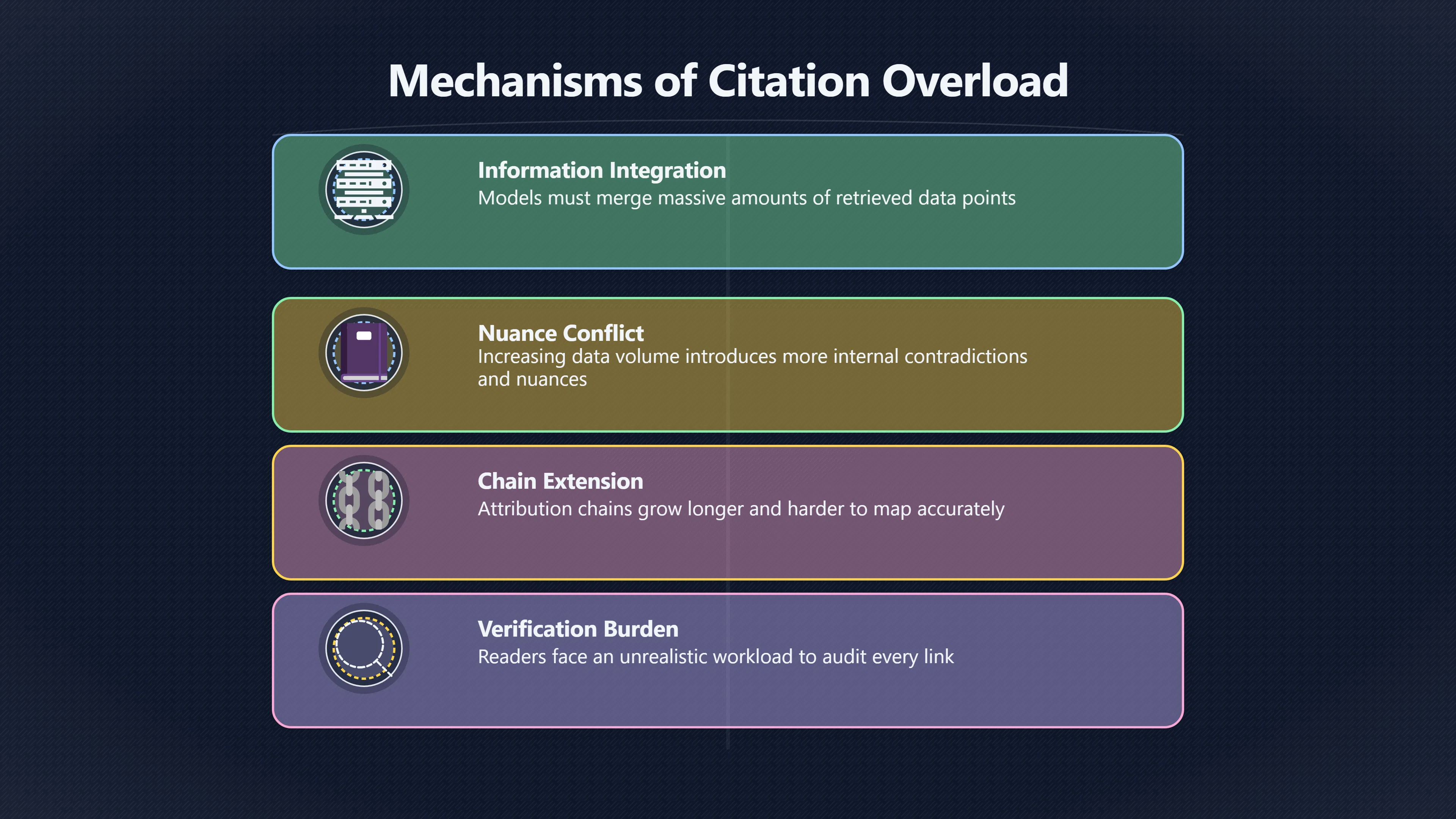
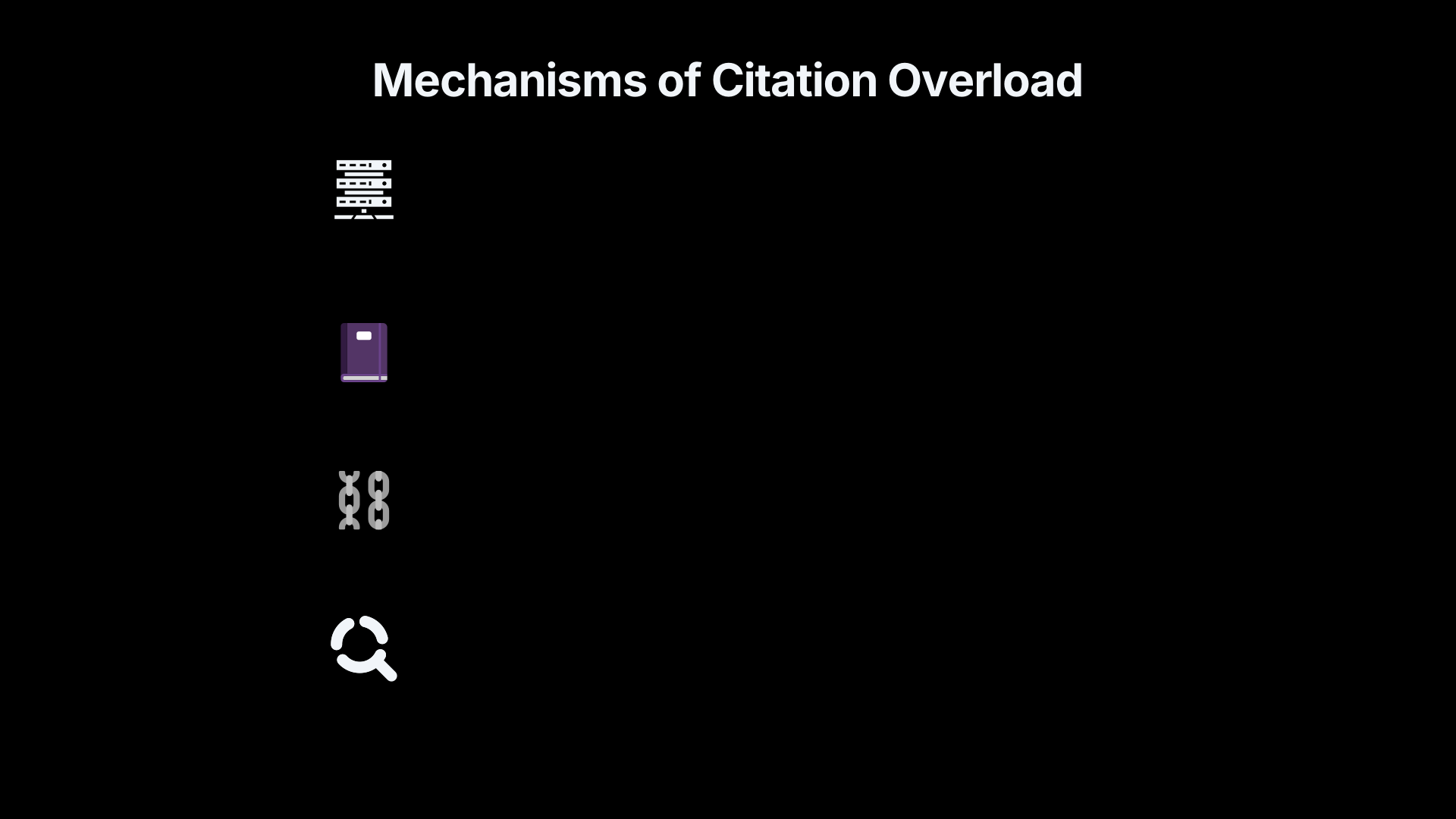
- The model must integrate more information.
- Contradictions and nuances increase.
- Attribution chains become longer.
- Readers face a larger verification burden.
The output may therefore contain more citations while becoming harder to audit accurately.
For source tracing, this means that the number of references is not a reliable proxy for evidential quality. An answer supported by a small set of carefully selected sources can be more transparent than one assembled from a hundred retrieved pages.
The False Sense of Certainty Problem
Citation overload also changes how readers interpret confidence.
Humans often use shortcuts when evaluating information. A long bibliography, multiple footnotes, or a dense list of links can act as signals of expertise. Research on AI-generated answers suggests that citations function partly through this mechanism of social proof: readers infer reliability from the presence of references even before examining them.[arXiv]arxiv.orgarXiv:2501.01303v1 [cs.CL] 2 Jan 2025January 3, 2025 — by Y Ding · 2025 · Cited by 53 — The present study investigated how variation…
This creates a dangerous situation when citations are mismatched.
A reader may see:
- Numerous references.
- Professional formatting.
- Detailed explanations.
- Confident prose.
Together, these elements can create a strong impression of evidential support even when the underlying sourcing is weak. The answer becomes harder to challenge because the burden of checking every citation is so high.
In the context of social media and AI, where information is consumed quickly and often shared without inspection, citation overload can therefore amplify misplaced confidence rather than genuine understanding.
How to Choose the Few Sources That Matter
The most useful AI-assisted answers are not necessarily the most heavily cited. They are the most inspectable.
When evaluating an answer, focus on source quality and claim matching rather than citation count.
A practical approach is to identify:
- The key factual claim. Which statement would most affect the conclusion if it were wrong?
- The supporting source. Is there a citation directly attached to that claim?
- The evidential match. Does the source actually support the statement being made?
- The source type. Is it a primary document, a reputable study, an official dataset, or merely a secondary summary?
Often, checking the two or three most important citations provides more insight than scanning twenty peripheral links.
Good source tracing therefore rewards selectivity. The strongest AI-assisted answers typically feature a small number of sources that are accessible, relevant, and clearly connected to specific claims. The objective is not citation abundance. It is a transparent path from assertion to evidence.
In that sense, the best citation is not the extra link that makes an answer look more authoritative. It is the one that allows a reader to verify the claim quickly, confidently, and without guesswork.

Amazon book picks
Further Reading
Books and field guides related to Can more AI citations make answers worse?. Use these as the next step if you want deeper reading beyond the article.
Calling Bullshit
Directly addresses how apparent evidence and data can create false confidence, matching citation overload and verification themes.
Thinking, Fast and Slow
Explains cognitive shortcuts that lead people to equate many citations with stronger evidence.

The art of thinking clearly
Covers common thinking errors that affect source evaluation and trust judgments.
Bad Science
Demonstrates how scientific-looking support can mislead when evidence is poorly interpreted.
eBay marketplace picks
Marketplace Samples
Example marketplace items related to this page. Use the search link to explore similar finds on eBay.
Endnotes
1.
Source: arxiv.org
Title: arXiv Citations and Trust in LLM Generated Responses
Link:https://arxiv.org/abs/2501.01303
Source snippet
Citations and Trust in LLM Generated ResponsesJanuary 2, 2025...
Published: January 2, 2025
2.
Source: arxiv.org
Link:https://arxiv.org/abs/2605.06635
Source snippet
Cited but Not Verified: Parsing and Evaluating Source Attribution in LLM Deep Research AgentsMay 7, 2026...
Published: May 7, 2026
3.
Source: techradar.com
Link:https://www.techradar.com/pro/a-major-kpmg-report-on-ai-was-found-to-be-chock-full-of-[ai-hallucinations
Source snippet
The report contained 45 citations, with only five found to be accurate; the rest were either fabricated, distorted, or misleading. GPTZer...
4.
Source: arxiv.org
Link:https://arxiv.org/html/2605.06635v1
Source snippet
Providers that generate more...
5.
Source: arxiv.org
Link:https://arxiv.org/pdf/2501.01303
Source snippet
arXiv:2501.01303v1 [cs.CL] 2 Jan 2025January 3, 2025 — by Y Ding · 2025 · Cited by 53 — The present study investigated how variation...
Published: January 3, 2025
Additional References
6.
Source: researchgate.net
Link:https://www.researchgate.net/publication/404626821_Cited_but_Not_Verified_Parsing_and_Evaluating_Source_Attribution_in_LLM_Deep_Research_Agents
Source snippet
(PDF) Cited but Not Verified: Parsing and Evaluating...by H Onweller · 2026 · Cited by 2 — Fact Check accuracy drops by approximately 42...
7.
Source: linkedin.com
Link:https://www.linkedin.com/posts/nishantha-ruwan-15b301b2_ghostcite-a-large-scale-analysis-of-citation-activity-7426777509108805632-Gg6v
Source snippet
LLMs and Citation Integrity: A Systematic Reliability IssueThe paper investigates how the rise of large language models (LLMs) affects th...
8.
Source: youtube.com
Link:https://www.youtube.com/watch?v=q-Io3IuDcz0
Source snippet
Deep Research: 3 Mistakes That Sabotage Your ResultWatch out for three common mistakes if you apply "Deep Research" AI Engines for your j...
9.
Source: researchsolutions.com
Title: securing trust in chatgpt quality control and the role of citations
Link:https://www.researchsolutions.com/blog/securing-trust-in-chatgpt-quality-control-and-the-role-of-citations
Source snippet
Securing Trust In ChatGPT: Quality Control & The Role of...24 May 2024 — Citations enhance trustworthiness by allowing users to verify i...
Published: May 2024
10.
Source: ottomedia.com.au
Title: pare Chat GPT vs Claude for research and learn when to trust AI
Link:https://www.ottomedia.com.au/ai-for-research/
Source snippet
The Truth About AI for Research (Speed vs Accuracy...31 Jan 2026 — AI for research cuts hours to minutes, but accuracy requires verifica...
11.
Source: themoonlight.io
Link:https://www.themoonlight.io/en/review/citations-and-trust-in-llm-generated-responses
Source snippet
the impact of citations on the perceived trustworthiness of responses generated...Read more...
12.
Source: researchgate.net
Title: 387670773 Citations and Trust in LLM Generated Responses
Link:https://www.researchgate.net/publication/387670773_Citations_and_Trust_in_LLM_Generated_Responses
Source snippet
(PDF) Citations and Trust in LLM Generated ResponsesJan 2, 2025 — We found a significant increase in trust when citations were present, a...
13.
Source: researchgate.net
Title: 390720939 Citations and Trust in LLM Generated Responses
Link:https://www.researchgate.net/publication/390720939_Citations_and_Trust_in_LLM_Generated_Responses
Source snippet
(PDF) Citations and Trust in LLM Generated Responses30 Apr 2025 — We found a significant increase in trust when citations were present, a...
14.
Source: medium.com
Title: exploring llm citation generation in 2025 4ac7c8980794
Link:https://medium.com/%40prestonblckbrn/exploring-llm-citation-generation-in-2025-4ac7c8980794
Source snippet
Exploring LLM Citation Generation In 2025However, the propensity for LLMs to hallucinate means that users should not trust responses, and...
15.
Source: thenewstack.io
Title: stop ai lies smarter answers with trusted sources
Link:https://thenewstack.io/stop-ai-lies-smarter-answers-with-trusted-sources/
Source snippet
Stop AI Lies: Smarter Answers With Trusted Sources10 Dec 2024 — Retrieval-augmented generation with citations transforms the way AI syste...
Topic Tree