Within Platform Incentives
When popularity starts to look like proof
Visible popularity signals can make a claim feel socially validated before anyone has checked the evidence behind it.
On this page
- Why social proof changes first impressions
- How likes and reposts reward confident claims
- Checks that separate reach from reliability
Page outline Jump by section
Introduction
On social platforms, like counts often appear before any evidence, source details or context. That ordering matters. A post with 50,000 likes can feel trustworthy within seconds, even if the claim itself is poorly supported. The effect is not that people consciously decide popularity equals truth. Rather, visible popularity acts as a shortcut. It signals that many other people have already noticed, endorsed or accepted the content, making a weak claim seem more credible than it would if viewed in isolation. Research on social influence, credibility judgements and misinformation consistently shows that popularity cues can shape first impressions, especially when people have limited time or information.[PMC]pmc.ncbi.nlm.nih.govPMCThe persuasive effects of social cues and sourceNIHby CS Traberg · 2024 · Cited by 65 — We find that social cues only impact individual judgements when they influence perceptions…
 Within the broader system of shareability incentives, like counts are important because they reward content that attracts attention. As those numbers grow, they can become evidence substitutes in the minds of readers who have not yet evaluated the underlying claim.
Why social proof changes first impressions
The mechanism begins with social proof: the tendency to use other people’s behaviour as a clue when judging what is true, valuable or worth attention. In everyday life, this can be useful. If a restaurant is full, that may indicate quality. On social media, however, the same instinct is applied to information claims, where popularity and accuracy are not necessarily related.[The Decision Lab]thedecisionlab.comThe Decision LabSocial ProofToday, the vast reach of social media amplifies the effects of social proof. Likes, shares, comments, and vie…
When users encounter a post with a large number of likes, they receive a rapid signal that many others have reacted positively. Because checking evidence takes effort, the brain may treat that visible approval as a rough indicator of credibility. Researchers describe this as a bandwagon effect: support from others increases the perceived validity of a message. A large meta-analysis covering dozens of studies found that bandwagon cues have a measurable positive effect on credibility perceptions, even if the effect is generally modest.[Sage Journals]journals.sagepub.comSage Journals Do Bandwagon Cues Affect Credibility Perceptions?A…19 Jan 2023 — Based on 161 effect sizes from 41 studies, the current meta-analysis revealed that bandwagon cues had a positive, albe…
The key point is that the likes are often processed before the evidence. A user scrolling quickly may notice the popularity count immediately while never opening a linked article, checking a source or examining supporting data.
The difference between attention and verification
A like count records engagement, not fact-checking. People may like content because it is funny, emotionally satisfying, politically aligned with their views or easy to understand. Yet the visible metric compresses all of those motives into a single number that looks like approval.
This creates a subtle illusion. Thousands of likes can resemble thousands of independent confirmations when, in reality, they may simply represent thousands of reactions. The metric measures response, not reliability.
How likes and reposts reward confident claims
Popularity signals are especially powerful when a claim is difficult to evaluate directly. Most users cannot immediately verify complex claims about health, politics, economics, science or current events. In those situations, social cues become more influential because they fill an information gap.[PMC]pmc.ncbi.nlm.nih.govPMCThe persuasive effects of social cues and sourceNIHby CS Traberg · 2024 · Cited by 65 — We find that social cues only impact individual judgements when they influence perceptions…
Confident claims benefit disproportionately from this environment.
A post that says “Scientists may be investigating several possible explanations” is harder to share than one that declares “Scientists have finally proved the answer.” The second statement projects certainty, attracts stronger reactions and often gains engagement more quickly. As likes accumulate, later viewers may interpret that engagement as evidence that the claim has already been validated.
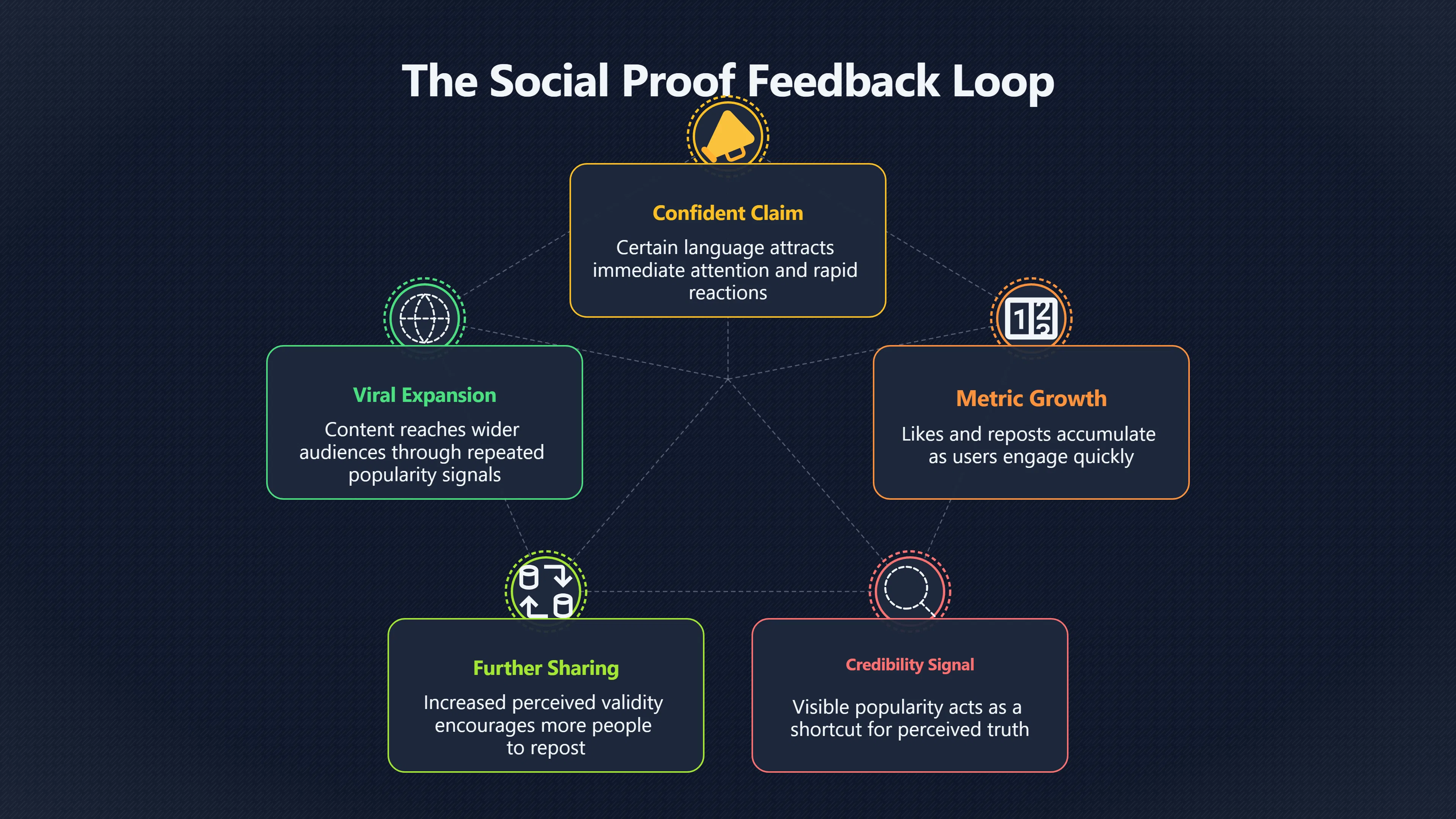
This creates a feedback loop:
- A confident claim attracts attention.
- Attention generates likes and reposts.
- Visible popularity increases perceived credibility.
- Increased credibility encourages further sharing.
- More sharing produces even greater visibility.
The result is that weak claims can acquire an appearance of legitimacy through repeated exposure to popularity signals rather than through evidence. Theoretical and empirical work on engagement-driven systems suggests that metrics such as likes and shares can contribute to the spread of misinformation by rewarding content that captures attention, regardless of accuracy.[arXiv]arxiv.orgCrowding out the truth? A simple model of misinformation, polarization and meaningful social interactionsOctober 5, 2022…
Why the effect feels rational
The influence of likes is not necessarily a sign of irrationality. In most situations, people rely on shortcuts because they cannot investigate every claim from first principles.
The problem is that social platforms make popularity unusually visible. In offline life, a person rarely sees a precise numerical display of how many people approve of an idea. Online, that number is often placed directly beside the claim itself. The design encourages users to treat social consensus as a source of information, even when the apparent consensus may be incomplete, manipulated or based on superficial reactions.
Research suggests that social cues influence judgement most strongly when they alter perceptions of broader social agreement. In other words, the likes matter because they imply that many other people have already reached a conclusion.[PMC]pmc.ncbi.nlm.nih.govPMCThe persuasive effects of social cues and sourceNIHby CS Traberg · 2024 · Cited by 65 — We find that social cues only impact individual judgements when they influence perceptions…
When popularity and truth diverge
One of the most important critical-thinking lessons is that popularity can correlate with many things besides accuracy.
Highly shared content may be:
- Emotionally charged rather than well supported.
- Easy to understand rather than precise.
- Aligned with group identity rather than evidence.
- Surprising or alarming rather than reliable.
- Entertaining rather than factual.
Studies of misinformation show that false or misleading content can attract substantial engagement online. Some misleading claims become viral precisely because they are believable enough to spread while remaining insufficiently supported by evidence.[PMC]pmc.ncbi.nlm.nih.govPMC(Why) Is Misinformation a Problem?by Z Adams · 2023 · Cited by 147 — (2022) showed that news classified as misinformation can garner increased attention, gauged by the…
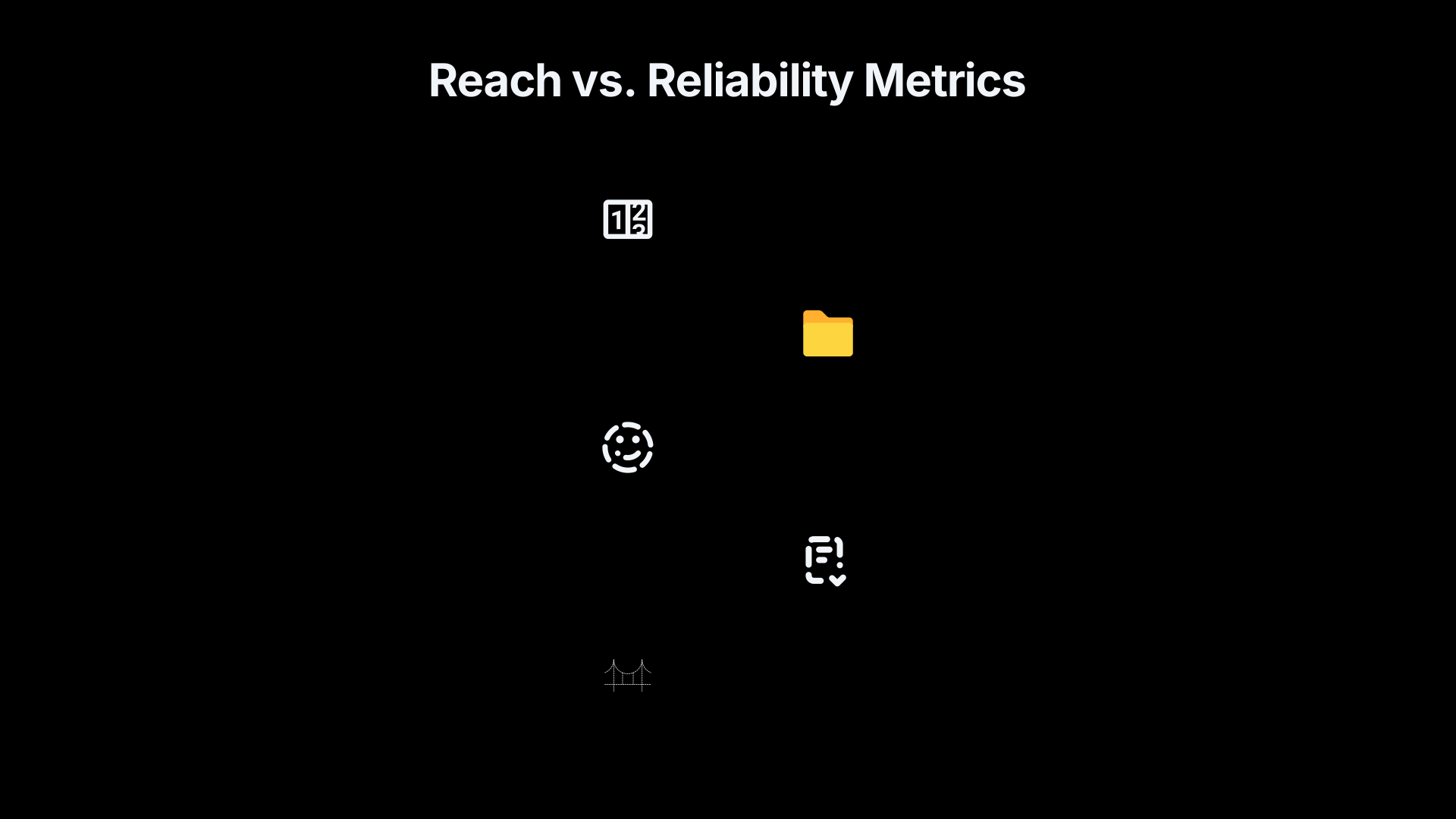
This helps explain why a post’s popularity should be treated as information about its reach, not as proof of its correctness. Reach tells us that people encountered and reacted to a claim. It does not tell us whether experts, evidence or independent verification support it.
Checks that separate reach from reliability
The most effective defence is not to ignore popularity signals entirely but to place them in the correct category.
Before treating a highly liked claim as credible, ask:
- What is the original source? Is the claim linked to evidence, data or identifiable expertise?
- Would the claim still seem convincing if the like count were hidden?
- Are independent sources reporting the same information?
- Does the post provide evidence, or only confidence?
- Is the popularity recent and organic, or could it reflect coordinated promotion, influencer amplification or algorithmic exposure?
A useful mental shift is to interpret likes as a measure of visibility rather than validity. A post with 100,000 likes may deserve attention because it is influential, but influence and truth are separate questions.
In the age of social media and AI-generated content, this distinction becomes increasingly important. Artificially generated text, images and videos can look persuasive from the moment they are published. When large engagement numbers are added on top, social proof can make unsupported claims feel established before anyone has checked whether they are actually true. The critical-thinking task is to resist treating popularity as proof and to evaluate the evidence that exists beyond the metric itself.[apa.org+2PMC]apa.orghow why misinformation spreadsHow and why does misinformation spread?29 Nov 2023 — Overall, most online misinformation originates from a small minority of “superspread…

Amazon book picks
Further Reading
Books and field guides related to When popularity starts to look like proof. Use these as the next step if you want deeper reading beyond the article.
Thinking, Fast and Slow
Explains why popularity cues and mental shortcuts can feel like evidence.
The Constitution of Knowledge
Distinguishes reliable knowledge creation from crowd approval.
eBay marketplace picks
Marketplace Samples
Example marketplace items related to this page. Use the search link to explore similar finds on eBay.




Endnotes
1.
Source: pmc.ncbi.nlm.nih.gov
Title: PMCThe persuasive effects of social cues and source
Link:https://pmc.ncbi.nlm.nih.gov/articles/PMC10879158/
Source snippet
NIHby CS Traberg · 2024 · Cited by 65 — We find that social cues only impact individual judgements when they influence perceptions...
2.
Source: arxiv.org
Link:https://arxiv.org/abs/2210.02248
Source snippet
Crowding out the truth? A simple model of misinformation, polarization and meaningful social interactionsOctober 5, 2022...
Published: October 5, 2022
3.
Source: arxiv.org
Link:https://arxiv.org/abs/2302.05443
4.
Source: apa.org
Title: how why misinformation spreads
Link:https://www.apa.org/topics/journalism-facts/how-why-misinformation-spreads
Source snippet
How and why does misinformation spread?29 Nov 2023 — Overall, most online misinformation originates from a small minority of “superspread...
5.
Source: journals.sagepub.com
Title: Sage Journals Do Bandwagon Cues Affect Credibility Perceptions?
Link:https://journals.sagepub.com/doi/10.1177/00936502221124395
Source snippet
A...19 Jan 2023 — Based on 161 effect sizes from 41 studies, the current meta-analysis revealed that bandwagon cues had a positive, albe...
6.
Source: thedecisionlab.com
Link:https://thedecisionlab.com/reference-guide/psychology/social-proof
Source snippet
The Decision LabSocial ProofToday, the vast reach of social media amplifies the effects of social proof. Likes, shares, comments, and vie...
7.
Source: journals.sagepub.com
Title: Sage Journals Do Bandwagon Cues Affect Credibility Perceptions?
Link:https://journals.sagepub.com/doi/abs/10.1177/00936502221124395
Source snippet
S Wang · 2023 · Cited by 56 — Based on 161 effect sizes from 41 studies, the current meta-analysis revealed that bandwagon cues h...
8.
Source: pmc.ncbi.nlm.nih.gov
Title: PMC(Why) Is Misinformation a Problem?
Link:https://pmc.ncbi.nlm.nih.gov/articles/PMC10623619/
Source snippet
by Z Adams · 2023 · Cited by 147 — (2022) showed that news classified as misinformation can garner increased attention, gauged by the...
9.
Source: pmc.ncbi.nlm.nih.gov
Link:https://pmc.ncbi.nlm.nih.gov/articles/PMC12543200/
Source snippet
by P Ranjith · 2025 · Cited by 7 — Firstly, the study aims to evaluate the impact of source credibility on perceived risk. Secondly, i...
10.
Source: pmc.ncbi.nlm.nih.gov
Link:https://pmc.ncbi.nlm.nih.gov/articles/PMC12451025/
Source snippet
Role of Real‐Time Engagement in Shaping Social Media...by X Lu · 2025 · Cited by 8 — Drawing upon Trust Theory, Social Influence Theory...
11.
Source: dictionary.cambridge.org
Link:https://dictionary.cambridge.org/dictionary/english/bandwagon
Source snippet
English meaning - Cambridge Dictionary5 days ago — an activity, group, etc., that has become successful or fashionable and so attracts...
12.
Source: Wikipedia
Link:https://en.wikipedia.org/wiki/Bandwagon
Source snippet
BandwagonThe term bandwagon, band wagon, bandwaggon, or band waggon, originally described large wagon that carried musicians, although...
13.
Source: thedecisionlab.com
Title: Bandwagon Effect
Link:https://thedecisionlab.com/biases/bandwagon-effect
Source snippet
The Decision...Bandwagon effect is when an idea or belief is being followed because everyone seems to be doing so. It is common in polit...
14.
Source: coursera.org
Title: social proof
Link:https://www.coursera.org/articles/social-proof
Source snippet
What Is Social Proof and How to Use It?23 Oct 2025 — Social proof refers to a psychological phenomenon occurring when you look to others'...
Additional References
15.
Source: merriam-webster.com
Link:https://www.merriam-webster.com/dictionary/bandwagon
Source snippet
BANDWAGON Definition & Meaning5 days ago — The meaning of BANDWAGON is a usually ornate and high wagon for a band of musicians especially...
16.
Source: bandwagongroup.co.uk
Link:https://bandwagongroup.co.uk/
Source snippet
BandwagonDiscover Bandwagon, a music charity in Cornwall dedicated to empowering disabled and vulnerable individuals through innovative m...
17.
Source: conversion-uplift.co.uk
Link:https://conversion-uplift.co.uk/post/bandwagon-effect-and-conversion-optimisation/
Source snippet
The Bandwagon Effect and Why People Follow the CrowdThe bandwagon effect is a psychological tendency where the adoption of ideas, product...
18.
Source: linkedin.com
Link:https://www.linkedin.com/pulse/power-social-proof-why-we-trust-what-others-like-harutyun-musheghyan-x4yjf
Source snippet
The Power of Social Proof: Why We Trust What Others LikeA study by Nielsen found that 83% of consumers trust recommendations from friends...
19.
Source: researchgate.net
Title: 313737416 Social proof in social media shopping An experimental design research
Link:https://www.researchgate.net/publication/313737416_Social_proof_in_social_media_shopping_An_experimental_design_research
Source snippet
Social proof in social media shopping: An experimental...Apr 29, 2026 — This study empirically compares the effect of number of follower...
20.
Source: acalytica.com
Link:https://acalytica.com/brand-popularity-bandwagon-effect/
Source snippet
The Bandwagon Effect in Branding: How Popularity Fuels...How does brand popularity create a self-reinforcing cycle of leadership?...
21.
Source: tmla.co.uk
Link:https://tmla.co.uk/article/social-proof-in-action/
Source snippet
Social proof in action: How reviews, influencers and UGC...19 Jun 2025 — Social proof builds trust and reduces uncertainty...
22.
Source: experts.illinois.edu
Title: the role of corporate credibility and bandwagon cues in sponsored
Link:https://experts.illinois.edu/en/publications/the-role-of-corporate-credibility-and-bandwagon-cues-in-sponsored/
Source snippet
role of corporate credibility and bandwagon cues in...by R Li · 2020 · Cited by 66 — Purpose: Sponsored social media content is one of t...
23.
Source: wadedigital.co.uk
Title: using social proof to build trust and credibility on your website
Link:https://wadedigital.co.uk/advice/using-social-proof-to-build-trust-and-credibility-on-your-website/
Source snippet
Showcase Customer Testimonials and Reviews · 2. Use Case Studies to Tell Stories That Sell · 3. Display Client Logos and Media Mentions ·...
24.
Source: thebandwagon.uk
Link:https://thebandwagon.uk/student-portal/
Source snippet
Student Portal | The BandwagonWelcome to your Student Portal. Home · About · Free Trial · Enrol now · Contact · Student Portal. SITE BY L...
Topic Tree